TL;DR
Listen free for 30 days with Audible
Thousands of audiobooks and originals — cancel anytime.
Start your free trialAs an affiliate, we earn on qualifying purchases.
Tripods are the default stability tool, but they’re slow to deploy and banned in many venues. Beanbags win for wildlife from vehicles, clamps win where floor space is zero, and flexible-leg tripods are the most versatile stand-in — as long as you respect their load limits. For long exposures and heavy telephotos, nothing fully replaces a real tripod.
The security guard at the museum was polite but firm: no tripods allowed. My full-size carbon fiber legs — the ones I’d carried through three airports — went back into the bag, and I shot the whole exhibit with a beanbag borrowed from a colleague resting on a display railing. Some of those frames are still in my portfolio.
That day taught me something twenty years of shooting has only confirmed: a tripod you can’t use is worth less than the support you actually have with you. Tripods are the default stability tool for good reason, but they’re bulky, slow to deploy, and banned in many venues — museums, concerts, some national monuments, even busy city sidewalks where extended legs become a tripping hazard.
In this guide, I’ll walk you through the three tripod alternatives I reach for constantly — beanbags, clamps, and flexible-leg tripods — with honest notes on where each one shines and where each one falls apart. No lab tests. Just what works in the field.
Match the tool to the environment: beanbags need a surface, clamps need a rigid anchor, flexible legs need a light kit — scout what your location offers before…
For safari or any vehicle-based wildlife shooting, a U-shaped window beanbag beats every other alternative for stabilizing long telephoto lenses.
Flexible-leg tripods range from roughly 325 g to 5 kg load capacity — buy rated well above your actual kit weight or joint creep will eventually dump your came…
Pack a travel beanbag empty and fill it with local rice or dried beans at your destination; discard the fill before flying home.
With 5–8 stops of modern IBIS, you can skip support entirely for static subjects at moderate shutter speeds — but long exposures and heavy telephotos still dem…
Tripod Alternatives: Beanbags, Clamps & Flexible Legs
Tripods are the default stability tool — but they’re bulky, slow to deploy, and banned in museums, concerts, monuments, and busy sidewalks. A tripod you can’t use is worth less than the support you actually carry. Here is what works in the field: no lab tests, just twenty years of borrowed railings and filled fabric.
“A tripod in the hotel room is like an umbrella left at home: the finest one ever made is useless when the rain starts.”
The Lisbon lesson · 4 days, 1 clamp, 0 tripodsThree Stand-Ins, Three Different Jobs
Alternatives trade some of a tripod’s versatility for portability, speed, and access — and access is the one that matters most. Match the tool to what your location offers: a surface, an anchor, or nothing at all.
The Beanbag
A fabric bag of poly pellets, rice, or buckwheat hulls that molds into a custom cradle and absorbs vibration through mass and friction. The professional standard on safari — a U-shaped window pod steadies a 600mm for hours, even over engine idle.
Shooting wildlife from vehicles or hides, or any time a ledge, boulder, or fence post can become your tripod. Slides sideways in complete silence.
Height is fixed by the surface you find; no panning or tilting; useless for video moves. Holds still beautifully — does not move gracefully.
The Clamp
A heavy-duty grip — usually with an articulating arm or ball head — that bites onto railings, table edges, branches, and poles. A palm-sized unit can suspend a 2 kg kit from a railing thinner than your thumb; the Super Clamp class grips anything from ~13 to 55 mm.
Bridges, balconies, stadiums, boats — railing-mounted long exposures with zero floor footprint, where tripod legs could never fit.
Needs a rigid anchor object; clamping pressure can mark delicate surfaces; a wobbly anchor transmits every vibration straight to the sensor.
Flexible Legs
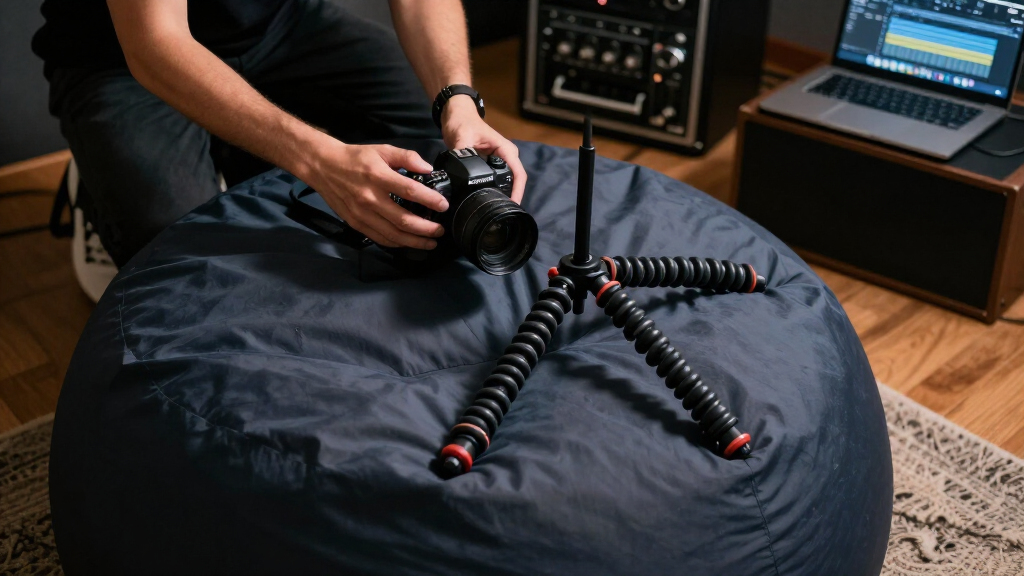
Segmented, bendable legs that wrap around poles, branches, and railings, or splay across uneven ground. Part mini tripod, part wrap-around mount, part vlogging grip — and it packs tiny enough to walk straight through a bag check.
Your kit is light and the venue is strict. Small models hold phones (~325 g); premium versions claim up to 5 kg for mirrorless kits.
Joints loosen over time and creep under heavy cameras; slow to position precisely; not for long telephotos or windy long exposures.
How Much Can They Really Hold?
Load capacity relative to size is where the alternatives surprise — and where the flexible-leg category quietly over-promises. Rated numbers are claims; joint creep is physics.
Practical Load Capacity · Typical Rig
“Buying below your actual gear weight is the single biggest cause of toppled cameras.”
Flexible-leg joints loosen with use. Buy rated well above your real kit weight — or one slow, silent sag will dump your camera while you watch.The Flexible-Leg Load Scale · 0 → 5 kg
The Field-Test Scorecard
No single alternative wins everywhere. The clamp column is tinted because it takes the access category — the one that decides whether you shoot at all.
| Field Test | Beanbag | Clamp | Flexible Legs |
|---|---|---|---|
| Deploys in seconds | ✓ | ✓ | ~ |
| Venue-friendly (museums, concerts) | ✓ | ✓ | ✓ |
| Long telephoto (600mm class) | ✓ | ~ | ✗ |
| Long exposure / night work | ~ | ✓ | ~ |
| Needs nothing but your kit | ✗ | ✗ | ✓ |
| Video panning moves | ✗ | ~ | ~ |
| Packs smallest / doubles as padding | ~ | ✓ | ✓ |
Pack the beanbag flat and empty, buy a kilo of rice or dried beans at a local market for two or three dollars, shoot all week — then donate or discard the fill before flying home. Padding on the way out, support system on location.
With 5–8 stops of modern in-body stabilization, static subjects at moderate shutter speeds need no support at all. Long exposures and heavy telephotos still do — stabilization corrects you, not the wind.
Lighter mirrorless bodies make flexible legs viable for real cameras, and new clamps ship phone-first — MagSafe quick-mounts, cold shoes, and grip-style pods that unfold into mini tripods.
Scout First, Then Reach Into the Bag
Every location offers something: a surface, an anchor, or nothing. Read the room before you unpack — the right choice takes ninety seconds, the wrong one takes the whole sunset.
Scout
What does the location offer? A ledge, a rigid edge, or nothing at all.
Match
Flat surface → beanbag. Rigid anchor → clamp. Neither, light kit → flex legs.
Rate
Check the load rating sits well above your actual kit weight. Always.
Shoot
The support in your hand beats the tripod in the hotel. Every time.
For long exposures and heavy telephotos, nothing fully replaces a real tripod — but a support you’re not allowed to use is worth less than the one you actually carry.
Why Your Tripod Stays Home More Often Than You Admit
Tripod alternatives exist because full-size tripods fail on logistics, not on stability. They’re heavy in a carry-on, slow to deploy when light changes in seconds, and prohibited in a surprising number of places — and a support tool left in the hotel room stabilizes nothing. A tripod in the hotel room is like an umbrella left at home: the finest one ever made is useless when the rain starts.
Think about the last time you traveled. A standard aluminum tripod weighs around 1.5 to 2.5 kg and takes up half your bag. Then you arrive at a cathedral, a rooftop bar, or a national monument viewpoint and spot the sign: no tripods. Staff worry about tripping hazards, crowd flow, and commercial-looking shoots. On a packed observation deck, even a compact tripod draws attention you don’t want. Last October in Lisbon, my tripod spent four straight days in the Airbnb while a 200-gram clamp handled every single sunset.
I’ve watched photographers argue with venue staff while the sunset burned away behind them. Meanwhile, the shooter next to them clipped a clamp onto the railing and got the shot in ninety seconds.
Here’s another scene I’ve lived more than once. At a rooftop concert in Chicago last summer, security turned away two full-size tripods at the door — then waved my friend’s shoulder bag straight through with a flexible-leg tripod tucked inside. Same venue, same night, same rule. The difference was purely what the gear looked like to a guard doing a thirty-second bag check.
There’s also the speed problem. Street photography and travel candids reward immediacy. By the time you’ve extended three leg sections and leveled a head, the moment has walked out of frame. Picture a fisherman mending nets on a dock at dawn: he glances up once, the light catches his face, and it’s gone. A clamp that was already on the railing gets that frame; a tripod still in its bag does not. Alternatives trade some of a tripod’s versatility for portability, speed, and access — and access, honestly, is the one that matters most.
camera beanbag support for wildlife photography
As an affiliate, we earn on qualifying purchases.
As an affiliate, we earn on qualifying purchases.
The Beanbag: Zero Setup, Rock-Solid on Almost Anything
A camera beanbag is a fabric bag filled with poly pellets, rice, dried beans, or buckwheat hulls that conforms to whatever surface you set it on and cradles your camera or lens. Through mass and friction, it absorbs vibration — and it asks for zero setup time. Think of the fill as memory foam for your lens: it shifts, settles, and then simply holds.
Drop it on a fence post, a boulder, a car window, or bare ground, and the fill molds itself into a custom cradle. Press your lens barrel into it, and you have support that rivals a tripod for static subjects. On safari, this is the professional standard: U-shaped window pods draped over a half-open vehicle window can steady a 600mm telephoto for hours. On my last trip through the Masai Mara, I ran a 600mm at 1/250 s from the Land Cruiser’s window all morning, and the beanbag soaked up even the engine’s idle vibration. Ask any wildlife guide — the beanbag, decisively, beats every flexible gadget for shooting from a vehicle.
You don’t need Africa to see the point. In a Hungarian photo hide last spring, I set a beanbag on the rough wooden window ledge and photographed herons at first light for three hours straight. The ledge became my tripod, and because the lens just sat in the fill, I could slide it sideways in complete silence as the birds moved — no knobs to loosen, no legs to shift, nothing to spook them.
Here’s my favorite travel trick. Pack the bag empty and flat, then buy a kilo or two of rice or dried beans at a local market when you land. A couple of dollars, maybe three. Fill it, shoot all week, then donate or discard the fill before flying home. You’ve carried padding on the way out and a full support system on location.
Between shoots, the bag doubles as protective padding around a lens in your pack. Two jobs, one piece of gear.
The limits are real, though. Your height is fixed by whatever surface you find — if there’s nothing to rest on, you have nothing. There’s no panning or tilting mechanism, so composition means nudging the camera into the fill. And for video moves, forget it. Beanbags hold still beautifully; they do not move gracefully.
clamp mount for camera or smartphone
As an affiliate, we earn on qualifying purchases.
As an affiliate, we earn on qualifying purchases.
A Clamp Turns Railings, Tables, and Branches Into Your Tripod
A camera clamp is a heavy-duty grip — usually paired with an articulating arm or small ball head — that bites onto railings, table edges, branches, poles, and handlebars to hold your camera where no tripod leg could fit. Load capacity relative to size is remarkably high; a palm-sized clamp can hold gear that would buckle a mini tripod. My own palm-sized unit suspends a 2 kg camera-and-lens kit from a railing thinner than my thumb.
The Manfrotto Super Clamp has been the industry standard in studios for decades, and for good reason: it grips almost anything between roughly 13 and 55 mm thick and accepts arms, heads, and accessories. Flat-plate designs like Platypod-style plates take the opposite approach — a low-profile metal slab with adjustable feet that sits on any flat surface and holds a full-size ball head. I’ve balanced a full-frame mirrorless with a 70-200mm on one, on a church pew, during a ceremony where tripods were forbidden.
Where clamps shine:
- Bridges and balconies — railing-mounted long exposures with zero floor footprint
- Stadiums and arenas — grip a handrail where legs would block walkways
- Boats and bikes — suction and handlebar mounts for action cameras
- The studio — the same clamp holds reflectors, monitors, and lights on quiet days
One concrete case: last winter I clamped to a footbridge railing anchored in stone and ran two-second exposures of the river all through blue hour. Every frame was sharp at 100% — not because the clamp was special, but because the anchor never moved a millimeter.
Another example from a different world entirely: a food photographer friend clamps her camera to a café table’s edge and aims it straight down for overhead flat-lays — a framing no tripod could reach without its legs photobombing the shot. She rigs it, shoots the dish, and breaks everything down before her coffee cools. The whole support system lives in her jacket pocket.
Two cautions from scars earned. First, clamping pressure can mark soft wood or painted surfaces — quality clamps have rubber jaws, so use them and don’t over-tighten. Second, your stability is only as good as your anchor. A clamp on a wobbly aluminum railing transfers every shiver of that railing straight into your frame. Grip something that doesn’t move.
A clamp’s load rating means nothing if the thing you’re clamped to flexes. Test the anchor with your hand before you trust it with your camera.
flexible tripod for camera and smartphone
As an affiliate, we earn on qualifying purchases.
As an affiliate, we earn on qualifying purchases.
Flexible-Leg Tripods: The Most Versatile Stand-In — With One Big Caveat
Flexible-leg tripods use segmented, bendable legs that wrap around poles, branches, and railings or splay across uneven ground, working as a mini tripod, a wrap-around mount, and a vlogging handgrip in one package. Of the three alternatives, this is the one I recommend most often to beginners — with a serious warning attached.
The versatility is genuine. Wrapped around a park railing, it’s an elevated support. Splayed on a rocky riverbank, it’s a low tripod. Folded together, small models become a handgrip for vlogging, which is why the creator market has embraced them — most new versions ship with phone mounts, cold shoes, and spots for an LED light or mic. Mirrorless cameras getting lighter has made these viable for “real” cameras too, not just phones.
Now the caveat, and it’s a big one: joint creep. Those bendy segments loosen with use, and a camera that was perfectly level at golden hour can slowly nose-dive by blue hour. It behaves exactly like a cheap desk lamp — perfectly still the moment you position it, then drooping by degrees under a load it can’t quite hold. I’ve watched a friend’s mirrorless slide sideways off a wrapped pole in slow motion. He caught it. You might not.
Here’s a side-by-side illustration from a coastal hike in Portugal. I wrapped my flexible tripod around a windswept pine branch for a self-portrait on a 10-second timer, and my 700 g mirrorless held rock steady. My hiking partner mounted his 2 kg DSLR on the identical branch with a bargain-bin flexible pod, and we watched the framing sink a degree at a time — within a minute his horizon had slid out of the shot entirely. Same branch, same technique, opposite results. Load was the only variable.
Load rating is the spec that matters. Small versions hold phones and action cams around 325 g to 1 kg; premium models claim up to 5 kg for mirrorless and DSLR kits. In real terms: 325 g is a smartphone in a case, while 5 kg is a pro body with a 70-200mm f/2.8 and a battery grip. Budget knockoffs often exaggerate those numbers badly.
Five rules I follow to beat the sag:
- Buy for your actual gear weight plus headroom — if your kit weighs 2 kg, don’t buy a 2 kg-rated model.
- Keep the center of gravity directly over the legs, never cantilevered out to one side.
- Avoid repeated tight wraps on the same joints — gentle curves last longer.
- Tighten joints if your model allows it; some premium designs have adjustable tension.
- Skip flexible legs for long telephotos or windy long exposures — the wobble never fully settles.
Which Alternative Fits Your Shoot? A Side-by-Side Look
Choose a beanbag for vehicle-based wildlife, a clamp for railings and zero floor space, and a flexible-leg tripod when you need one tool that adapts to everything. The right pick depends on your subject, your location’s rules, and how much weight you’ll carry — this table lays it out.
Picture three real shoots. A hotel balcony with a wrought-iron railing and a city view? Clamp. A dawn game drive with a 500mm resting on the door? Window beanbag. A week of city-hopping vlogs with a 900 g mirrorless? Flexible legs. Nine times out of ten, the location makes the decision for you before you touch your bag.
| Alternative | Best For | Setup Speed | Load Capacity | Weakest Point |
|---|---|---|---|---|
| Beanbag | Safari vehicles, hides, rocks, fence posts, ground-level work | Instant — drop and shoot | Excellent for long telephotos | Needs a surface; no pan or tilt |
| Clamp | Bridges, balconies, stadiums, boats, studios | Under a minute | Very high for its size | Needs a rigid anchor; can mark delicate surfaces |
| Flexible legs | Travel, vlogging, poles and branches, uneven ground | A minute or two of fiddling | 325 g to about 5 kg depending on model | Joint creep; wobble with heavy or long gear |
Notice the pattern: every weakness is about what’s available in the environment. Beanbags need a surface. Clamps need an anchor. Flexible legs need patience and a light kit. So the decision framework is simple — look at where you’ll shoot, not at product photos.
My own travel kit carries two of the three: a flat-plate support and a compact flexible tripod, together weighing under 600 g. On safari, I swap in a window pod and leave everything else at camp. Match the tool to the trip, and you’ll stop missing shots to logistics.
When No Alternative Will Do — and When You Need Nothing at All
For serious long exposures, night photography, and heavy telephoto work in wind, no beanbag, clamp, or flexible leg fully replaces a real tripod — but modern in-body stabilization means you need support far less often than you did a decade ago. Honesty about both ends of that spectrum is what keeps you from over- or under-buying.
Let’s take the “need nothing” end first. Modern IBIS and in-lens stabilization deliver roughly 5 to 8 stops of correction. In practice, that means I can handhold a static subject at shutter speeds around 1/15 second or slower with a wide lens and come home sharp. At 24mm I’ve handheld blue-hour street scenes at 1/8 s that printed cleanly at 40 cm on my hallway wall. For static subjects at moderate speeds, support is often optional now. That’s a genuine shift — and it’s why support marketing has moved toward video and long-lens niches, where stabilization can’t substitute.
Now the other end. A 30-second exposure of city lights doesn’t care about your IBIS — that’s more than two hundred times longer than the 1/8 s your stabilization just saved, and no algorithm bridges that gap. Neither does a 600mm lens in a coastal gale. Stabilization is power steering, not autopilot: it smooths your hand’s tremor, but it cannot hold the camera still for half a minute. For night work, a clamp or beanbag on a truly solid anchor beats a flexible tripod every time — but a proper tripod on open ground beats them both. If long exposure is your main genre, buy the tripod and accept the bulk.
One more option sits between all of these: the monopod. It gives you some support with far more mobility, which is why sports and wildlife shooters swear by them. You trade absolute stillness for the ability to track action all afternoon without your shoulders giving out.
A concrete illustration: at my nephew’s football final last month, I spent two hours on the touchline with a 100-400mm on a monopod, swinging from goal line to midfield as play moved. Handheld, my arms would have quit by halftime; on a tripod, I’d have been pinned to one spot and missed every counterattack. The monopod was the only tool that matched the day.
The craft question isn’t “tripod or not?” It’s “how much stability does this specific shot actually require?” Answer that honestly, and your bag gets lighter while your keeper rate climbs.
Frequently Asked Questions
Can a flexible-leg tripod hold a full-frame mirrorless camera with a zoom lens?
Only the highest-rated models — those claiming around 5 kg capacity — and even then, creep is a real risk. Keep the center of gravity directly over the legs rather than extended outward, and check the level every few minutes. For a heavy zoom on full frame, a clamp or flat-plate support is the safer call.
Are tripods really banned in some places, and will a clamp or beanbag get around that?
Yes — tripods are banned in many museums, concerts, some national monuments, and on busy city sidewalks, usually over tripping hazards and crowd flow. Small supports like beanbags often fly under the radar, but rules vary by venue. Clamping to property can still draw staff attention, so ask politely before you rig anything.
What should I fill a travel beanbag with?
Buy local when you land: rice, dried beans, or birdseed all work beautifully and cost a couple of dollars. Poly pellets and buckwheat hulls are great permanent fills at home. If you’re flying, empty the bag before your return flight to keep luggage light and avoid agricultural inspection hassles.
Beanbag vs. flexible tripod — which is better for safari photography?
The beanbag, decisively. A U-shaped window pod draped over a vehicle window steadies a 500mm or 600mm telephoto through mass and friction, with instant repositioning when an animal moves. Flexible legs can’t manage that weight, and their joints would creep under a long lens within minutes.
Do I still need a support if my camera has 8-stop IBIS?
For static subjects at moderate shutter speeds, often no — 5 to 8 stops of stabilization lets you handhold surprisingly slow speeds with wider lenses. But for video, long exposures measured in seconds, and heavy telephoto work, stabilization runs out of answers and real support earns its place again.
Are cheap knockoff flexible tripods worth buying?
Generally no. Budget models frequently exaggerate their load ratings, and joint failure is the common result — which puts your camera on the ground. A quality flexible tripod from an established maker costs more but uses joint materials that resist the loosening and sag that plague knockoffs. Your camera body is the expensive part of this equation; protect it.
Conclusion
Here’s the one thing to remember: the best support is the one that’s with you and allowed in the room. A beanbag on a railing will always beat the tripod sitting in your hotel, and a clamp on a bridge beats no shot at all.
So look at your next shoot — the venue rules, the surfaces, the weight you’ll carry — and pick the alternative that fits before you leave home. Then go make the frame the tripod-only crowd had to walk past.
Fall Picks
fall essentials
As an affiliate, we earn on qualifying purchases.