TL;DR
Open a free Amazon Business account
Business pricing, bulk buying and tax-exempt orders.
Create a free accountAs an affiliate, we earn on qualifying purchases.
Fireworks photography is mainly about controlling exposure: set ISO 100, f/8–f/11, and a 2–6 second shutter speed on a tripod, focus manually before the show, and open the shutter as each shell launches so each burst creates clean light trails without overexposing the sky. Time your exposures to the rhythm of the display — shorter for bright finales, longer for sparse bursts — and shoot early before smoke builds up.
The first time I photographed fireworks, I came home with forty frames of white blobs floating in a gray sky. Sound familiar? Here’s what nobody told me: fireworks photography is mainly about controlling exposure, not about having fast reflexes or expensive gear. Each burst is a self-lit subject that paints its own picture across your sensor — you just have to give it the right canvas.
Done right, a 3-second exposure lets each burst create clean light trails — ribbons of gold and red streaming down a black sky. Done wrong, you get mush. The difference comes down to a handful of settings and one skill: reading the rhythm of the show.
In this guide, I’ll walk you through the exact settings I use, how to focus when the sky is pitch black, when to open the shutter, and how to handle smoke, bright city skylines, and chaotic finales. Bring a tripod and a little patience — that’s most of the battle.
Start with Manual mode, ISO 100, f/8, 4 seconds, manual focus, and RAW — then adjust aperture (not shutter speed) to control brightness, since fireworks are se…
Open the shutter as the shell launches, not when it explodes — watch the launch point and listen for the mortar thumps to time each frame.
Focus manually before the show using a distant light or the first burst, magnified in live view; don’t trust the infinity marking on the lens barrel.
Shoot early and upwind — smoke accumulates fast, and your best frames often come in the first five minutes, not the finale.
For finales, shorten exposures to 1–2 seconds or stop down a stop; for bright skylines, blend a blue-hour foreground exposure with your fireworks frames.
Photographing Fireworks: Settings & Timing
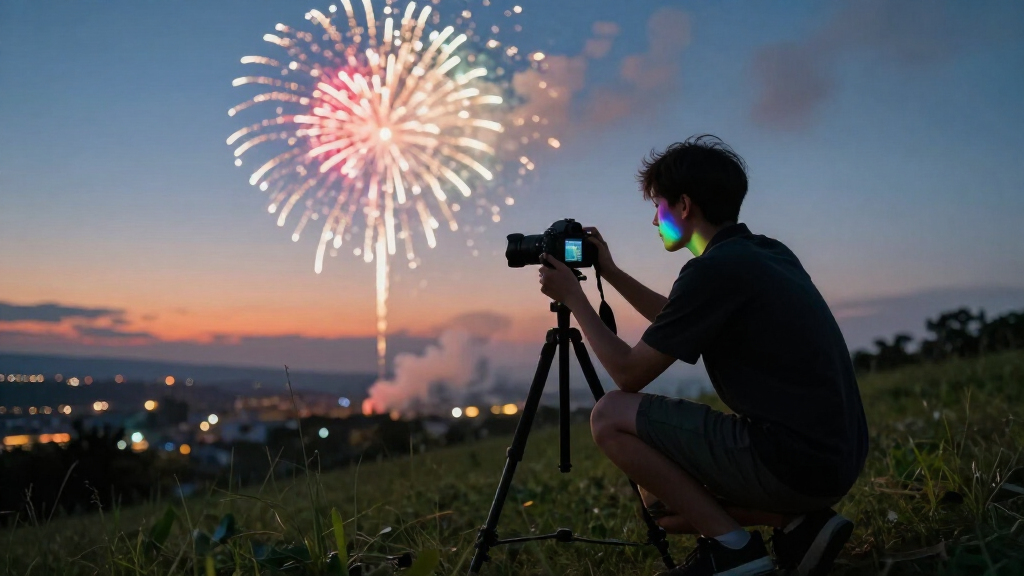
Fireworks are a self-lit subject that paints its own picture across your sensor. You just have to give it the right canvas: ISO 100, f/8–f/11, a 2–6 second shutter on a tripod — and the discipline to open the shutter as each shell launches, not when it explodes.
“Fireworks make their own light, so exposure is controlled by aperture and ISO — not shutter speed. Shutter duration only decides how much of the burst you record.”
Key Insight · The exposure modelSettings That Nail Fireworks on the First Burst
Start here: Manual mode, ISO 100, f/8, 4 seconds, manual focus, RAW. This combination will produce a good fireworks photograph at almost any display. Set white balance to Daylight (~4,000–5,500K) so colors render consistently frame to frame.
Auto modes will chase the changing light and ruin your consistency.
Higher ISO reduces highlight headroom and makes smoke glow like fog.
Too bright? Stop down. Too dim? Open up — this is your brightness dial.
Shapes the trails — how long the brush moves across the canvas.
Set once before the show, tape the ring, never touch it again.
RAW recovers highlights; fixed WB keeps colors stable.
Housekeeping before the first shell flies: turn off flash, switch off long-exposure noise reduction (it doubles your wait between shots during a finale), and disable image stabilization when tripod-mounted. Hang your camera bag from the tripod hook for stability, and keep a lens cloth handy for mist, drizzle, and ash flecks.
Read the Frame, Adjust the Aperture
Every common fireworks failure has a one-move fix. Resist raising ISO when things look dim — it clips the white-gold cores to featureless white.
| Problem | What’s Happening | Fix |
|---|---|---|
| Trails washed out, white | Overexposed burst cores | ✓ Close down to f/11–f/16 or drop ISO |
| Trails faint, colors dull | Underexposed bursts | ✓ Open to f/5.6–f/8 |
| Sky turning gray/orange | Ambient light accumulating | ✓ Shorten exposure or stop down |
| Smokey, hazy frames | Smoke building in frame | ✓ Shorten exposure, shoot earlier, move upwind |
| Every frame slightly soft | Trusted the infinity mark | ✓ Verify focus visually, magnified in live view |
How to Focus When the Sky Refuses to Give Your Camera Anything
Autofocus fails at fireworks shows because a dark sky is a focus-hunting ground. The fix is a thirty-second job — done once, before the show starts.
Find a target
Focus on a distant building, a light on the horizon, or the launch area itself.
Magnify live view
Fine-tune on that point until it’s critically sharp. Use focus peaking if mirrorless.
Lock to MF
Flip the lens switch to manual focus — and tape the ring if you’re paranoid.
Verify on first burst
When the first shell fires, magnify again and confirm the trails are razor sharp.
Warning that saves beginners every time: don’t just crank the focus ring to the infinity mark. On many modern AF lenses the marking isn’t perfectly calibrated — true infinity may sit slightly before or after it. Verify focus visually, always.
Watch the Launch, Not the Explosion
Every shell gives you a visible rising streak and often a hollow mortar thump one to two seconds before it explodes. Open the shutter as the shell climbs. Shutter duration shapes the character of the image:
Bulb mode gives you direct control: press the remote when the shell launches, release when the trails die. Listen for the launch mortars — whump… whump… whump — and time each frame to that rhythm like a drummer. My keep rate tripled compared to firing blindly. Judge exposure by the histogram, not the rear screen, which lies badly at night.
Adapting to the Rhythm of the Display
A fireworks show is a sequence of changing conditions. Each phase demands a different response.
Shoot early, upwind
Smoke accumulates fast — your best frames often come in the first five minutes, not the finale. Position upwind.
Frame wide, refine
Burst height is unpredictable. Include more sky than feels necessary, then tighten once you learn where the show lives.
Shorten everything
More shells, more light, more smoke. Drop to 1–2 seconds or stop down a full stop — five overlapping bursts at 6 s will blow out.
Blend blue hour
Cities overexpose on long exposures. Capture a blue-hour foreground and blend it later with your fireworks frames.
Frame Wider Than You Think You Need To
The most common beginner mistake is framing tight, then watching shells explode above the top of the frame. Anchor the bursts with context, keep the horizon level, and leave space in the direction the fireworks expand.
Skyline or landmark
A recognizable silhouette gives scale and a sense of place to the light trails.
Water surfaces
Double the color: bursts mirrored in a river, harbor, or lake anchor the frame.
Spectators in silhouette
Crowd silhouettes against the glow add drama and storytelling to the shot.
Foreground element
A bridge, pier, or building edge establishes depth and scale in the composition.
Multiple bursts
Layer several bursts balanced across the frame rather than one centered shell.
Vertical vs. horizontal
Vertical suits isolated aerial bursts; horizontal suits panoramic displays and context.
The Baseline Settings That Nail Fireworks on the First Burst
Start here: Manual mode, ISO 100, f/8, 4 seconds, manual focus, RAW. That combination will produce a good fireworks photograph at almost any display, from a small-town festival to a major city show. Set white balance to Daylight or somewhere around 4,000–5,500K so the colors render consistently frame to frame rather than shifting as your camera auto-white-balances between dark sky and bright bursts.
Here’s the part that trips people up. Fireworks make their own light, so your exposure is controlled by aperture and ISO, not shutter speed. The shutter duration only decides how much of the burst you record — how long the trails are, and whether you catch one explosion or three. Think of it like a painter’s brush: the burst is the paint, the shutter speed is how long you let the brush move across the canvas. Once you internalize that, every adjustment becomes obvious.
| Problem | Fix |
|---|---|
| Trails washed out, white instead of colored | Close down to f/11–f/16 or drop ISO |
| Trails faint, colors dull | Open to f/5.6–f/8 |
| Sky turning gray or orange | Shorten exposure or stop down (ambient light is building up) |
| Smokey, hazy frames | Shorten exposure, shoot earlier, move upwind |
Resist the temptation to raise ISO when things look dim. Higher ISO reduces highlight headroom — those brilliant white-gold cores clip to featureless white — and makes smoke glow like fog. I shot an entire July 4th finale at ISO 400 once and every frame looked like the sky was on fire. Not in the good way.
A few housekeeping items before the first shell flies: turn off your flash, turn off long-exposure noise reduction (it doubles your wait between shots by running a dark-frame subtraction — imagine waiting 8 seconds to shoot again after every 8-second exposure during a finale), and switch off image stabilization unless your lens specifically handles tripods gracefully. Hang your camera bag from the tripod hook for extra stability, and keep a lens cloth handy — summer shows mean mist, drizzle, and the occasional ash fleck.
As an affiliate, we earn on qualifying purchases.
How to Focus When the Sky Refuses to Give Your Camera Anything
Autofocus fails at fireworks shows because there’s nothing for it to lock onto — a dark sky is a focus hunting ground. The fix is simple: focus once, manually, before the show starts, and never touch the ring again.
- Before the show, focus on a distant building, a light on the horizon, or the launch area itself.
- Magnify live view on that point and fine-tune until it’s critically sharp.
- Flip the lens switch to MF (manual focus) and tape the ring if you’re paranoid — I am.
- When the first burst fires, magnify again and confirm the trails are razor sharp. Adjust once if needed.
One warning that saves beginners every time: don’t just crank the focus ring to the infinity mark. On many modern autofocus lenses, the infinity marking isn’t perfectly calibrated, and true infinity focus may sit slightly before or after the mark. I learned this the hard way on a coastal show — every frame slightly soft because I trusted the marking instead of my eyes. Verify focus visually, always.
If you’re shooting with a mirrorless camera, focus peaking makes this trivially easy. Rack the lens until distant lights fringe with color, magnify to confirm, done. Manual focus sounds intimidating if you’ve never used it, but for fireworks it’s genuinely a thirty-second job — and it’s the difference between crisp light trails and soft spaghetti.
As an affiliate, we earn on qualifying purchases.
Timing the Shutter: Watch the Launch, Not the Explosion
The single biggest timing secret in fireworks photography: watch the launch point, not the sky. Every shell gives you a visible rising streak and often a hollow thump of sound one to two seconds before it explodes. Open your shutter as the shell climbs, and close it after the trails fade. You’ll capture the burst from its very first spark.
If you wait until you see the explosion, you’ve already missed the opening — the brightest, cleanest moment of the whole burst. Your shutter lag plus your reaction time eats the best light.
Shutter duration shapes the character of the image:
- 1–2 seconds: crisp fragments of a burst — good for dense finales
- 3–6 seconds: a complete burst with full, flowing trails — the classic look
- 8–15 seconds: multiple bursts layered together, with rising risk of smoke and clutter
Bulb mode gives you the most direct control: press the remote when the shell launches, release when the trails die. Each exposure becomes its own decision. Last New Year’s Eve, I shot an entire show in Bulb, listening for the launch mortars — whump… whump… whump — and timing each frame to that rhythm like a drummer. My keep rate tripled compared to firing blindly.
Spend the first few shells shooting conservatively while you refine composition and exposure. Check the histogram — not the rear screen, which lies badly at night. Then commit. And when the finale arrives, everything changes: more shells, more light, more smoke. Shorten exposures to 1–2 seconds or stop down a full stop, because five overlapping finale bursts at 6 seconds will be a blown-out white mess.
long exposure camera remote shutter
As an affiliate, we earn on qualifying purchases.
As an affiliate, we earn on qualifying purchases.
Composition: Frame Wider Than You Think You Need To
Burst height is unpredictable, so include more sky than feels necessary at the start of the show. The most common beginner mistake is framing tight, then watching shells explode above the top of the frame. Once you’ve seen a dozen bursts and learned where the show lives, tighten your composition.
The bare-sky snapshot is fine, but fireworks photos that people remember usually include context:
- A recognizable skyline or landmark — a bridge, a castle, a ferris wheel
- Reflections in water, doubling every burst for free
- Spectators in silhouette, heads tilted up, which adds human warmth
- A foreground structure that gives a sense of scale
Picture the difference: a lone red peony burst against empty black sky is a test frame; the same burst hanging above a lit ferris wheel with its colors mirrored in the river below is a photograph people stop scrolling for. Or imagine a harbor show where every gold chrysanthemum lands twice — once in the sky, once rippling in the water — simply because the photographer positioned themselves across the bay instead of in the parking lot.
Keep the horizon dead level — a tilted horizon in a long exposure screams amateur hour, and it’s a bear to crop straight later. Leave breathing room in the direction the bursts expand, usually upward and outward from the launch point.
Vertical or horizontal? Vertical framing flatters isolated aerial bursts — a single chrysanthemum of gold filling the frame, the way you’d shoot a portrait. Horizontal works better for panoramic displays and environmental context, like a full waterfront show with reflections stretching across the frame — think landscape painting. I usually set up one body in each orientation when I can, because shows rarely cooperate with a single plan.
Lens choice follows the same logic. A wide lens (16–35mm equivalent) is the safe bet when you don’t know how high the shells will go. A standard or short telephoto works when you know the launch position and you’re shooting from farther back — a 70–200mm from across a lake can fill the frame with individual bursts. When in doubt, go wide and crop — you can’t uncrop a burst you cut in half.
As an affiliate, we earn on qualifying purchases.
Smoke and City Light: The Two Things That Ruin Fireworks Photos
Smoke is the quiet killer of fireworks photography. It starts invisible, and by mid-show the air above the launch site glows like a gray curtain, lit from behind by every burst. Shoot early, before smoke accumulates — some of your best frames will come in the first five minutes of the show, not the finale.
Position matters as much as timing. If you can, set up upwind of the launch site so smoke drifts away from your lens instead of across it. At a lakefront show, that might mean walking twenty minutes to the other side of the crowd. Worth it. Also keep exposures short in smoky conditions — every extra second collects more smoke glow.
Bright cities create the opposite problem: long exposures accumulate ambient light until buildings overexpose and the sky turns orange or gray. A 10-second exposure over a bright skyline will look like sunset pollution, not night. Shorten the shutter, stop down, or — the pro move — capture a clean blue-hour exposure of the foreground before full dark, then blend it with your fireworks frames later.
Judging exposure is the last skill: use the histogram and highlight warnings, never the rear screen’s apparent brightness, because screens look wildly different at night and your dark-adapted eyes will misjudge everything. Small clipped patches at the hottest centers of white bursts are acceptable — even unavoidable. Large featureless white regions mean you’ve overexposed. And remember that firework colors vary in brightness: white and gold effects burn brighter than saturated blue, red, or purple, so a setting that tames gold may starve the blues. Shoot RAW — that extra dynamic range is what lets you recover highlight detail and fix white balance later.
Level Up: Black Card Trick, Exposure Blending, and Live Composite
Once the basics feel comfortable, a few advanced techniques multiply your keepers. They’re not hard — they just require a little planning.
The black-card technique is old-school magic. Start a long Bulb exposure, and between bursts, hold a matte black card in front of the lens — without touching the camera. The lens goes dark; nothing records. Remove the card for the next burst. One frame now holds two or three well-separated bursts while ambient light builds up only half as much. It’s free, it works on any camera, and it feels like cheating. A piece of black foam or even a baseball cap works in a pinch — the key is matte material, since glossy card can bounce light back into the lens.
Exposure blending is the digital version. Capture a clean foreground at blue hour, then your fireworks frames later, and combine them in editing using a Lighten blend mode or luminosity masks. The discipline here is honesty: keep burst placement believable. I’ve seen composites with bursts erupting from behind buildings at physically impossible heights — impressive technically, laughable contextually.
Live-composite modes (on Olympus/OM System, Panasonic, and some others) are genuinely a gift for this genre. The camera shows the exposure building in real time and adds new bright trails without continuously brightening the static background — solving the ambient buildup problem automatically. Think of it as the black-card trick with the camera doing the card work for you. One caveat: electronic shutters can introduce banding under artificial lighting, so test before the show.
Even smartphones can play now. With a small tripod and a manual or fireworks mode — like the long-exposure or night modes on recent iPhones and Pixels — phone results are respectable. Lock focus and exposure if the app allows it, because automatic night modes sometimes misread moving bursts and produce fragmented trails. And whatever you shoot on, remember: modern AI noise reduction is powerful, but it cannot restore clipped highlights or fix camera shake. Clean capture always beats aggressive processing.
Stay Safe and Don’t Be That Photographer
A quick word that matters more than any setting: stay within designated viewing areas and never enter launch zones, no matter how tempting the angle. Launch sites are controlled for a reason, and event staff will (rightly) eject you and possibly your gear. I watched a photographer slip past a barrier at a riverside show for a “better foreground” — he was escorted out within minutes and missed the entire display, memory cards and all.
Around other spectators, be a good neighbor. Don’t block walkways with tripod legs in the dark — that’s a tripping hazard waiting for a lawsuit. Imagine a packed crowd funnelling out after the finale, in the dark, straight into your outstretched tripod leg. Skip the bright headlamp once you’re set up; your dark-adapted eyes and a red light work fine, and a white beam ruins everyone else’s night vision for twenty minutes. At a small harbor show last summer, one photographer’s headlamp swept the crowd every time he checked his camera — you could hear the groans.
And drones: never fly near fireworks without explicit legal authorization and event approval. Beyond the legal exposure, fireworks can genuinely damage aircraft, and temporary flight restrictions often apply around displays. Several major cities now ground all drones within miles of a show — flying anyway risks fines and, worst case, a shell strike on your drone falling into a crowd. No shot is worth that. The photographers who get invited back year after year are the ones who respect the crowd, the crew, and the rules.
Frequently Asked Questions
What is the best shutter speed for fireworks?
Start around 3–5 seconds for a complete burst with full trails. Shorten to 1–2 seconds for crowded finales or bright urban scenes; lengthen to 8+ seconds when bursts are sparse and the sky is dark. In Bulb mode you can open at launch and close when the trails fade for perfect per-burst timing.
Why are my fireworks white instead of colorful?
They’re almost certainly overexposed. Lower your ISO, close the aperture to f/11–f/16, or shorten the exposure — especially when multiple bursts overlap in a single frame. White and gold effects are brighter than blue, red, or purple, so check the histogram and highlight warnings rather than the rear screen.
Should I use autofocus for fireworks?
Use autofocus only to establish focus before the show — on a distant building or the first bright burst — then switch the lens to manual focus and leave it alone. Continuous autofocus will hunt against the dark sky and can ruin an otherwise perfectly timed frame.
Should image stabilization be on or off on a tripod?
Usually off. On a locked tripod, stabilization systems can actually introduce vibration as they hunt for movement that isn’t there. Some modern lenses detect tripod use automatically, so check your manufacturer’s guidance — but when in doubt, switch it off.
How do I photograph a fireworks finale?
Expect dramatically more light and smoke. Shorten exposures to 1–2 seconds or stop down roughly one stop from your baseline, and avoid stacking too many bursts into one frame. Resist the urge to keep your long mid-show exposure — the finale will blow it out completely.
Can I photograph fireworks handheld?
You can, but you’ll get frozen fragments of bursts rather than long, flowing light trails — handheld shutter speeds are too fast to paint trails. For the classic fireworks look, use a tripod or at minimum a stable support like a railing, combined with a remote release or self-timer.
Why are my fireworks trails shaky or wavy?
Common causes include tripod vibration, pressing the shutter button directly, unstable ground, strong wind, or a stabilization system that’s still active. Use a remote release or self-timer, and weigh down the tripod. Note that some gentle waviness is natural — wind genuinely moves the falling sparks.
Conclusion
If you remember one thing, make it this: your shutter paints the trails, your aperture controls the brightness, and your timing comes from watching the launch — not the explosion. Get those three relationships straight and fireworks stop being a luck-based genre and become a repeatable craft.
So set up early, frame wide, listen for that hollow whump of the mortar, and open the shutter as the shell climbs into the dark. When you review the back of your camera and see ribbons of gold trailing down a clean black sky — no gray mush, no white blobs — you’ll know exactly why you stayed for the whole show.
NFL season / tailgating Picks
team gear
As an affiliate, we earn on qualifying purchases.