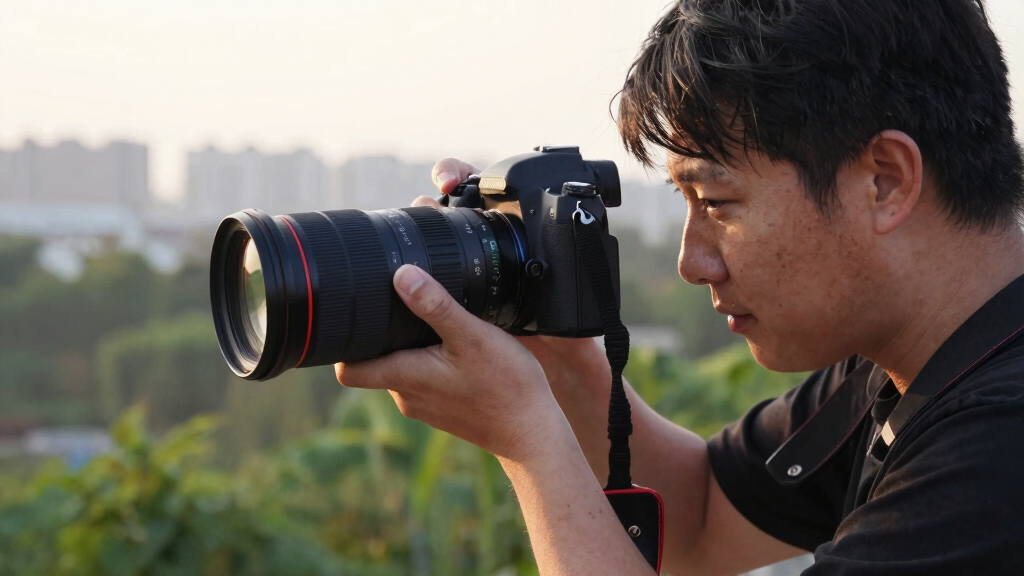

TL;DR

Get audio and creator gear delivered free with Prime
- Fast, free delivery on millions of items
- Prime Video, Amazon Music and more included
- Member-only deals all year
Flattering portrait focal lengths usually range from 50mm to 135mm on a full-frame camera, with 85mm offering a comfortable balance for head-and-shoulders work. Camera distance controls facial perspective, while focal length determines the framing you get from that distance, so choosing a lens means choosing where you will stand.
Your feet shape a face more than the number printed on your lens. Stand close with a wide lens and a nose reaches toward the camera while the ears slip backward; step away and facial features settle into calmer proportions. The focal length decides how tightly you can frame the portrait from that position.
I have watched this difference appear countless times while moving between a cramped home, a busy street, and a long studio. A 35mm lens can make an intimate, energetic portrait when you give the face room in the frame, while an 85mm or 105mm lens can turn a cluttered background into a soft wash of color. Neither choice flatters every person or every setting.
This guide shows you how 35mm, 50mm, 85mm, 105mm, and 135mm affect faces, working distance, and backgrounds. You will also learn how sensor size changes the angle of view, why aperture is only part of the blur story, and how to test your own lenses in less than 15 minutes. The goal is simple: choose your position first, then reach for the focal length that gives you the frame you want.
Choose camera distance for facial perspective first, then select the focal length that gives you the intended framing.
Use 50mm for flexible environmental and waist-up portraits, 85mm for balanced headshots, and 105mm to 135mm when you have space and want stronger background is…
Convert focal lengths by sensor crop factor: about 56mm on 1.5x APS-C or 42.5mm on Micro Four Thirds gives an 85mm-equivalent angle of view.
Move your subject farther from the background before relying on f/1.2 or f/1.4; added distance creates cleaner blur while a slightly smaller aperture protects…
Test several focal lengths at equal head size and ask your subject which working distance felt comfortable.
Portrait Lenses: Focal Lengths That Flatter
Flattering portraits usually live between 50mm and 135mm on full frame—but the decisive variable is where you stand. Choose camera distance for facial perspective first, then choose the focal length that delivers your frame.
Distance changes the face
Focal length does not directly alter facial perspective. When head size stays equal, a longer lens looks “flatter” because it requires the photographer to move farther away.
Near features dominate
The nose occupies more of the image while ears and jaw recede. A wide lens broadcasts the effect when the face fills the frame.
Proportions settle
Nose-to-ear depth becomes small relative to camera distance, producing gentler proportions and a more relaxed headshot.
Move until the face looks right. Then select the focal length that frames the portrait from that exact position.
Five focal lengths, five visual jobs
No lens flatters every person or setting. The room, desired framing, background and conversational distance all influence the best choice.
Groups, interiors and story-rich environmental portraits.
Flexible full-body and waist-up work in modest spaces.
Comfortable head-and-shoulders framing with soft backgrounds.
Tight beauty portraits with calm features and clean framing.
Outdoor headshots and stage work with strong separation.
| Full frame | Where it works | Visual character | Watch for | Tight room |
|---|---|---|---|---|
| 35mm | Groups, interiors, environmental portraits | Energetic, intimate and spacious | Faces stretched near edges | ✓ Strong |
| 50mm | Full-body and waist-up portraits | Natural, connected and flexible | Close headshots exaggerate depth | ✓ Strong |
| 85mm | Head-and-shoulders portraits | Balanced proportions, soft background | May feel long in small interiors | ~ Depends |
| 105mm | Tight portraits and beauty work | Calm features and clean framing | Greater subject distance | ✗ Limited |
| 135mm | Outdoor headshots and stage portraits | Strong isolation and compressed spacing | Long room or open ground required | ✗ Poor |
Fit the room and the conversation
The best lens provides a flattering position without pinning you against a wall or pushing you beyond genuine interaction.
Tell the wider story
Use the surroundings as narrative: a kitchen counter, rehearsal room or busy street. Keep faces away from frame edges.
Stay balanced
A practical middle ground for headshots: enough distance for calm proportions while remaining close enough for quiet direction.
Simplify the background
Use open space to turn clutter into broad, soft shapes. Expect greater directing distance and a narrower shooting lane.
Match the view to your camera
Smaller sensors record a narrower portion of the lens image. Multiply the marked focal length by the crop factor to compare full-frame-equivalent angles of view.
A 56mm lens on 1.5× APS-C frames much like an 84mm lens on full frame.
Blur is more than aperture. Move the subject farther from the background before relying on f/1.2 or f/1.4. Added separation creates cleaner blur, while a slightly smaller aperture can keep both eyes reliably sharp.
Find your lens in 15 minutes
Compare focal lengths at equal head size. The resulting facial differences come from the new camera positions required by each lens.
Choose a face
Seat a willing subject in steady light with space behind them.
Start at 35mm
Frame the portrait, note your position and make the first image.
Move for 50mm
Step back until the head is exactly the same size in the frame.
Repeat at 85mm
Match head size again, keeping height, light and expression stable.
Compare comfort
Review cheeks, nose, jaw, ears, background and subject preference.
Five takeaways to keep
Lens choice is ultimately a decision about position, framing, environment and human connection.
Choose camera distance for the face, then select focal length for framing.
It is comfortable for headshots, while 50mm and 105mm solve different spaces.
About 56mm on 1.5× APS-C or 42.5mm on MFT gives an 85mm-like view.
Subject-to-background separation often improves blur more cleanly than opening wider.
Compare equal-size portraits and ask which shooting distance felt most natural.
Room → position → perspective → focal length → frame → expression.
Why Stepping Back Gives Faces More Natural Proportions
Portrait Lenses: Focal Lengths That Flatter starts with one plain fact: camera distance controls perspective. Moving close exaggerates the distance between the nearest and farthest facial features, while stepping back reduces that difference. A longer lens merely lets you keep a tight composition after you have moved away [1].
Imagine photographing a face from 45 centimeters away. The tip of the nose sits much nearer to the camera than the ears, so it occupies a larger share of the image. Move back to roughly 1.5 or 2 meters, frame the same headshot with a longer lens, and the nose-to-ear distance becomes small compared with the camera-to-subject distance.
This works like watching two runners from beside the track versus from the top of the stadium. Up close, the front runner seems far ahead; from a distant seat, the gap looks modest. Your camera performs the same visual trick, and a wide lens will eagerly broadcast it when you fill the frame from arm’s length.
Perspective belongs to your shooting position, not to the lens. Pick a comfortable facial perspective by moving first, then choose the focal length that produces your preferred framing.
For a practical comparison, photograph a willing subject at 35mm, 50mm, and 85mm, keeping the head the same size in every image by moving backward as the lens gets longer. You will see the cheeks, nose, jaw, and ears change because your distance changed. According to PhotoMocha, shorter focal lengths become risky for close portraits when the photographer crowds the subject, while 85mm and longer lenses naturally encourage greater working distance [1].
As an affiliate, we earn on qualifying purchases.
See What Each Popular Focal Length Gives You
Portrait Lenses: Focal Lengths That Flatter commonly fall between 50mm and 135mm on full frame, but each length solves a different framing problem. A 50mm lens suits environmental and full-length portraits, 85mm balances intimacy with distance, and 105mm to 135mm gives tight portraits strong background separation [1].
| Full-frame focal length | Where it works well | Typical visual character | Watch for |
|---|---|---|---|
| 35mm | Groups, interiors, environmental portraits | Energetic and spacious | Stretched faces near frame edges |
| 50mm | Full-body and waist-up portraits | Natural, connected, flexible | Perspective exaggeration in tight headshots |
| 85mm | Head-and-shoulders portraits | Balanced proportions and soft backgrounds | Limited room indoors |
| 105mm | Tight portraits and beauty work | Calm features and clean framing | Greater photographer-subject distance |
| 135mm | Outdoor headshots and stage portraits | Strong isolation and compressed background spacing | Long rooms or open ground required |
Suppose you are photographing a baker inside a narrow kitchen. A 35mm or 50mm lens lets you include flour on the wooden counter, copper pans, and warm window light, but you should keep the face away from the corners. Outside, where you can step across the pavement, an 85mm or 105mm lens can reduce the shopfront to soft amber shapes.
No row in the table declares a universal winner. A 135mm lens may produce a graceful headshot yet leave you calling directions from the other side of a garden, while a 50mm lens lets you speak softly and react quickly. Choose the working relationship you want as carefully as the background blur.
As an affiliate, we earn on qualifying purchases.
Choose a Lens That Fits the Room and the Conversation
The best portrait focal length is one that gives you flattering distance without pushing you into a wall or away from genuine interaction. Indoors, 50mm or 85mm often fits better than 105mm or 135mm. Outdoors, longer focal lengths gain room to create clean, quiet frames.
I once photographed a musician in a rehearsal room barely wider than a dining table. An 85mm lens forced me against the door and cropped out the battered guitar case that told half the story. Switching to 50mm gave me breathing room, preserved natural proportions in a waist-up frame, and kept the faded red case glowing beside the subject.
Working distance also changes how a person responds to you. At 1 to 2 meters, you can lower the camera, offer a small direction, and catch the expression that arrives a second later. At 5 meters with a long lens, your subject may relax because the camera feels less intrusive, but quiet conversation becomes harder and every instruction lands with more weight.
- Use 35mm to 50mm when the surroundings carry part of the story.
- Use 85mm when you want a head-and-shoulders frame without standing extremely far away.
- Use 105mm to 135mm when you have open space and want the background to appear larger and softer behind the subject.
Before mounting a lens, check your available shooting lane. Count how many steps you can take, look for doorframes behind your elbows, and notice whether people will cross between you and the subject. A flattering lens that cannot physically make the composition is like a beautiful dining table that will not pass through the doorway.
camera lens for flattering headshots
As an affiliate, we earn on qualifying purchases.
As an affiliate, we earn on qualifying purchases.
Get the Same Flattering View on Any Sensor Size
Portrait Lenses: Focal Lengths That Flatter must be matched to your camera’s sensor size. A smaller sensor records a narrower portion of the lens’s image, so photographers use 35mm-equivalent focal lengths to compare angles of view. Multiply the marked focal length by the camera’s crop factor [2].
On an APS-C camera with a 1.5x crop factor, a 56mm lens gives an angle of view close to an 84mm lens on full frame. A 50mm lens behaves like a 75mm equivalent for framing, while a 35mm lens gives a view close to 52.5mm. The lens does not physically become longer; the sensor simply trims the outer image.
On Micro Four Thirds, the usual 2x crop factor makes a 42.5mm lens frame like an 85mm lens on full frame. That compact combination can work beautifully in a small studio. You gain a familiar headshot angle without carrying a long barrel that feels like a black telescope pointed at your subject.
| Desired full-frame view | APS-C at 1.5x | APS-C at 1.6x | Micro Four Thirds at 2x |
|---|---|---|---|
| 50mm | About 33mm | About 31mm | 25mm |
| 85mm | About 56mm | About 53mm | About 42.5mm |
| 105mm | 70mm | About 66mm | About 52.5mm |
| 135mm | 90mm | About 84mm | About 67.5mm |
Keep one distinction clear: equivalent focal length compares framing from the same position, not every part of image rendering. Depth of field also depends on aperture, focus distance, sensor format, and final viewing size. For choosing where you stand and what enters the frame, though, the equivalent angle of view is the useful number.
As an affiliate, we earn on qualifying purchases.
Create Softer Backgrounds Without Losing Both Eyes
Background blur grows when you use a wider aperture, move closer to the subject, place the background farther behind them, or choose a longer focal length while maintaining similar framing. For dependable portraits, subject-to-background distance often matters more than opening an expensive lens to its widest setting.
Put your subject one meter from a leafy hedge at f/1.8 and the leaves may remain busy, with bright circles nibbling at the hair. Move the subject four meters from the hedge, keep your position and framing under control, and the same lens can turn those leaves into a smooth green river. Space does quiet work while aperture gets the applause.
Wide apertures bring a tradeoff. At close range, f/1.2 or f/1.4 may leave one eye crisp and the other visibly soft when the face turns even slightly. I often begin around f/2 to f/2.8 for a single headshot, then close down for couples, families, or any pose with faces on different planes.
Longer lenses also make the background appear larger behind your subject because you stand farther away for the same framing. A distant patch of yellow flowers can fill the frame behind an 85mm portrait, while a 35mm view includes more stems, path, sky, and visual chatter. The long lens acts like a stagehand, drawing the scenery inward and pulling a soft curtain around the face.
Do not chase blur at the expense of expression. A clean background, accurate focus, and connected moment will carry a portrait farther than a paper-thin slice of sharpness.
Find Your Most Flattering Focal Length in 15 Minutes
You can find your most useful portrait focal length with a simple comparison made at equal head size. Photograph one subject at several focal lengths, move to reframe after every change, and compare facial proportions, background rendering, communication distance, and available space. Keep the lighting and pose fixed.
- Choose a textured setting. Place your subject several meters in front of a hedge, bookcase, or row of streetlights so background changes remain easy to see.
- Start at the widest focal length. Make a waist-up portrait, then a head-and-shoulders frame without crowding closer than feels comfortable.
- Repeat at 50mm, 85mm, and 105mm if your lenses cover them. Move backward each time so the head stays roughly the same size.
- Hold aperture and eye position steady. Use f/2.8 when possible, focus on the near eye, and keep the camera close to eye level.
- Compare the full sequence. Study the nose, ears, jawline, frame edges, background size, and the ease of speaking with your subject.
For example, your 35mm image may feel alive because it shows blue evening light spilling across the street, yet the tight version may stretch the face. The 85mm frame may give gentler proportions, while the 105mm version turns traffic lights into broad red and gold discs. The winner depends on whether you need story, intimacy, or isolation.
Ask your subject which distance felt most comfortable. A technically polished frame loses its pulse when someone feels crowded or abandoned. Your final choice should balance facial rendering, background control, and the human exchange happening in front of the camera.
Build a Practical Portrait Kit Without Chasing Specifications
A useful portrait kit covers the distances and spaces where you actually work. One normal lens plus one short telephoto handles most assignments: think 50mm and 85mm on full frame, or their angle-of-view equivalents. A flexible zoom can replace both when speed matters more than maximum aperture.
Prime lenses commonly offer apertures such as f/1.8, f/1.4, or f/1.2, along with compact handling at some focal lengths. A zoom may give you fewer steps to take during an event and let you switch from a waist-up portrait to a tight expression before the moment disappears. Neither design carries an automatic badge of superior portrait quality.
At a wedding reception, a 70–200mm-style zoom can frame candid expressions across a crowded room without interrupting them. In a small family home, that same lens may feel heavy and leave you trapped against the wallpaper. A light 50mm or 85mm prime keeps your movements quieter and your conversation closer.
Modern autofocus, image stabilization, and lens coatings can help with moving faces, dim rooms, and bright backlight. Still, stabilization cannot freeze a laughing child, and fast autofocus cannot rescue focus placed on an eyebrow instead of the eye. Use a shutter speed suited to movement, select dependable eye detection when your camera offers it, and check a few frames at high magnification.
Choose by looking through your own archive. If most of your favorite portraits were made near 50mm, a longer lens will not rewrite your visual instincts. Your photographs leave breadcrumbs; follow the focal lengths that support how you frame, move, and speak.
Frequently Asked Questions
What focal length is most flattering for portrait photography?
85mm on full frame is a dependable starting point for flattering head-and-shoulders portraits because it encourages a comfortable camera distance and provides strong background separation. For full-body or environmental work, 50mm often fits the scene better, while 105mm to 135mm suits tighter portraits in open spaces.
Does an 85mm lens really compress facial features?
An 85mm lens does not create perspective compression by itself. It gives you a tight frame from farther away, and that greater camera distance makes facial features appear flatter and more proportionate. Take an 85mm and 35mm photograph from the exact same position, crop them to match, and their perspective will match as well.
Can I take flattering portraits with a 35mm lens?
Yes, a 35mm lens works beautifully for environmental portraits, groups, and lively scenes. Keep some space around a single face, avoid placing people near the frame edges, and resist moving extremely close for a headshot. A chef surrounded by steel pans and drifting steam may benefit more from context than from a perfectly blurred background.
What portrait lens should I use on an APS-C camera?
For an angle of view close to the classic full-frame 85mm portrait lens, use about 56mm on a 1.5x APS-C camera or roughly 53mm on a 1.6x body [2]. A standard 50mm lens also works well, giving a 75mm or 80mm equivalent view depending on the camera.
Is f/1.2 better than f/1.8 for portraits?
f/1.2 creates stronger blur and gathers more light, but its narrow focus zone can soften the far eye or the tip of the nose at close distances. An f/1.8 lens can produce rich separation when your subject stands well away from the background. For many real portraits, f/2 to f/2.8 gives a safer balance of softness and facial detail.
Can a kit zoom produce professional-looking portraits?
Yes. Set your kit zoom near its longer end, step back for comfortable facial perspective, and place the subject several meters from the background. Soft window light, a clean frame, accurate eye focus, and a genuine expression matter more than a very wide maximum aperture.
Conclusion
Choose where you stand before choosing your lens. Give the face enough distance for natural proportions, decide how much of the setting belongs in the story, and mount the focal length that fits those choices. For many headshots that will be 85mm; for a portrait rich with place and context, it may be 35mm or 50mm.
Run the 15-minute comparison with a friend rather than judging focal lengths from specifications alone. Watch how the nose, jaw, background, and conversation change as you move. The best portrait lens is the one that lets the face breathe, the setting settle, and the person in front of you forget about the glass.
Evergreen bestsellers Picks
bestsellers
As an affiliate, we earn on qualifying purchases.