TL;DR

Get audio and creator gear delivered free with Prime
- Fast, free delivery on millions of items
- Prime Video, Amazon Music and more included
- Member-only deals all year
A fisheye is an ultra-wide-angle lens that records roughly 100° to 180° by allowing lines to curve instead of forcing them straight. Use one when you need close-range context, whole-sky coverage, immersive movement, or deliberate visual exaggeration; keep subjects near the center, inspect every edge, and treat distortion as part of the story.
My shoe ruined what should have been a dramatic photograph. I was crouched inches from a BMX rider as he lifted over a concrete lip, and my fisheye caught the rider, the painted bowl, a row of spectators—and the toe of my sneaker. That frame taught me two lasting lessons: a fisheye sees far more than you expect, and its wild view demands careful edge control.
Used carelessly, a fisheye turns every doorway into a rubber arch and every face into a carnival reflection. Used with purpose, it can hold a skateboarder and the entire ramp in one close-range frame, record an aurora sweeping from horizon to horizon, or show the structure of a cathedral ceiling as a flowing web of stone. The difference lies in where you stand, what you place near the center, and why the curved space helps the photograph.
You are about to learn what the lens actually records, how circular and diagonal designs differ, and why fisheyes remain useful in sports, astronomy, science, immersive video, and tight interiors. I will also show you a field-tested way to compose, check your frame, and reshape files later. The goal is simple: make distortion serve your subject rather than letting novelty control the frame.
Keep the horizon through the optical center when you want it to appear close to straight; tilt the camera only when its arc supports the composition.
Place faces and other shape-sensitive subjects near the center, then scan every border for feet, fingers, straps, lights, and tripod legs.
Choose a circular fisheye for a round 180° hemisphere and a diagonal fisheye for a frame-filling image with 180° corner-to-corner coverage.
Plan defishing during capture by leaving crop room and keeping key details away from corners, where correction causes the strongest stretching.
Use a fisheye when close-range context, sky-wide coverage, immersive movement, or curved structure adds meaning—not simply because the view looks unusual.
Fisheye Lenses:
Beyond the Gimmick
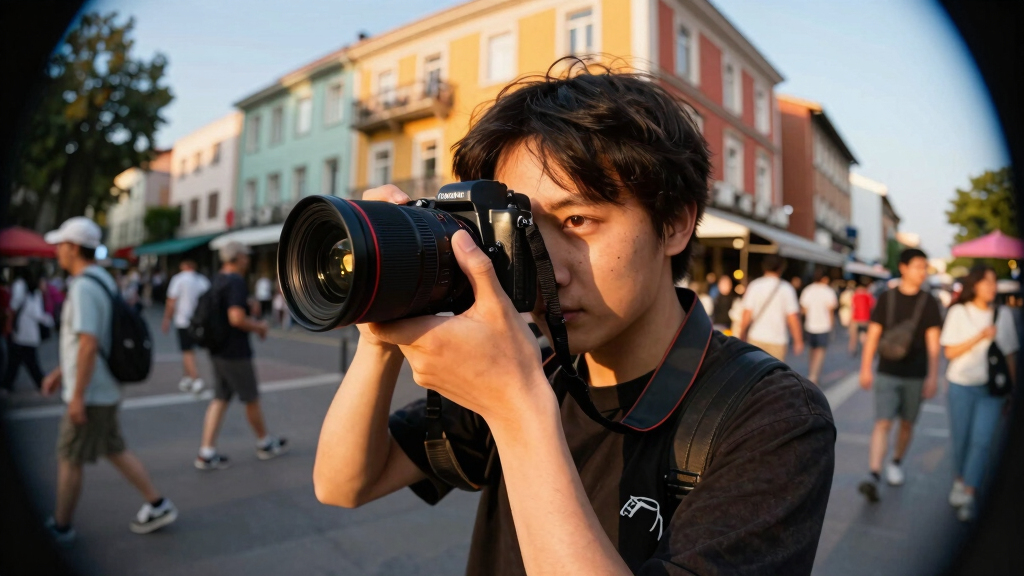
A fisheye records roughly 100° to 180°—and sometimes beyond 200°—by allowing straight lines to curve. The result becomes useful when close-range context, whole-sky coverage, immersive movement, or deliberate exaggeration matters more than geometric restraint.
Two lenses, two ways to contain 180°
“Fisheye” describes a projection family, not one fixed picture shape. Circular designs preserve a complete hemisphere as a round image; diagonal designs trade edge coverage for a sensor-filling result.
A hemisphere inside the frame
Records 180° in every direction and places the complete circular image within the rectangular sensor, leaving dark space around it.
A curved view that fills the sensor
Reaches 180° only from one corner to the opposite corner. It crops the projection to create a conventional, full-frame photograph.
Coverage beyond corrected wide-angle
Rectilinear lenses commonly reach about 114°–120°. A fisheye bends the map to hold substantially more of the scene.
Fisheye or rectilinear?
Name the lines that matter before choosing the lens. If walls must remain straight, reach for a corrected wide-angle. If curves can express speed, scale, enclosure, or motion, the fisheye has the stronger story.
| Decision factor | Fisheye lens | Rectilinear wide-angle |
|---|---|---|
| Line rendering | ✓Lines bow away from the optical center | ✓Straight scene lines remain straight |
| Typical coverage | ✓Roughly 100°–180°, sometimes 200°+ | ~Often up to roughly 114°–120° |
| Edge behavior | ~Curved, but comparatively compact | ~Strong stretching near corners |
| Natural fit | ✓Action, sky, VR, science, curved structures | ✓Architecture, property, documentary, landscape |
| Framing risk | ✗Feet, fingers, straps and tripod legs enter easily | ~Less accidental coverage, but edges still matter |
Make every curve deliberate in five moves
A fisheye sees farther sideways than instinct expects. Control the center, work closer, use one dominant arc, and inspect the complete border before releasing the shutter.
Center the horizon
Run it through the optical center when you want it close to straight. Tilt only when the resulting arc helps the composition.
Protect faces
Keep people and other shape-sensitive subjects near the middle, where proportions remain comparatively natural.
Move much closer
Ultra-wide coverage makes nearby subjects look small. Close the distance until the subject truly commands the frame.
Choose one arc
Let a railing, ramp, road, ceiling rib, or horizon sweep the eye toward the subject without competing curves.
Scan every edge
Check all four borders for shoes, fingers, straps, lights, bystanders, tripod legs, and unwanted empty areas.
Field lesson: a 180° lens may include objects beside you—not only objects in front of you. The frame is never finished until every edge has been inspected.
Where the distortion earns its place
The lens began as a scientific instrument, not a novelty accessory. Modern uses still revolve around the same advantage: capturing an unusually complete environment from one compact viewpoint.
Skateboarding + BMX
Keeps athlete, obstacle, spectators, and setting in frame at close range while exaggerating height, speed, and proximity.
Aurora + astronomy
Fast diagonal fisheyes capture horizon-to-horizon phenomena; permanent all-sky cameras monitor the complete celestial dome.
Canopy + solar studies
Hemispherical images support forest leaf-area analysis, solar-access measurement, meteorology, and environmental observation.
VR + 360° capture
Two opposing 190°+ streams can be stitched into equirectangular media: capture the sphere first, choose the framing later.
Cars + robotics
Surround-view parking and robotic perception combine fisheye optics with calibration software to understand nearby space.
Room-wide surveillance
A single fixed camera can monitor an entire room without a moving head, then digitally extract multiple corrected views.
A practical idea with a long future
Better glass and computational correction have expanded fisheye work from weather observation to low-light astrophotography, immersive media, automotive vision, and real-time remapping.
The underwater idea
Robert W. Wood described a view inspired by the bright circular window a fish sees from beneath the water.
The practical Sky Lens
W.N. Bond’s design, built by Beck, photographed whole-sky cloud cover for meteorological observation.
Stereoscopic VR180
Canon’s RF 5.2mm dual-fisheye system placed two lenses on one full-frame camera for immersive video.
Faster astro glass
Sigma’s 15mm f/1.4 diagonal fisheye pushed low-light and whole-sky imaging into a new optical class.
The complete image-making chain
Use a fisheye when close-range context, sky-wide coverage, immersive movement, or curved structure adds meaning. Keep sensitive subjects near the center, inspect every border, leave crop room for correction, and treat distortion as part of the story—not as decoration.
See What a Fisheye Captures That Other Lenses Miss
Fisheye Lenses: Beyond the Gimmick begins with one useful truth: a fisheye is an ultra-wide-angle lens producing a view of roughly 100° to 180°, and sometimes beyond 200°, by keeping strong, uncorrected barrel distortion rather than the straight-line projection used by a regular wide-angle.
A rectilinear wide-angle stretches its image so architectural lines remain straight. A fisheye uses a different map of the world, with equidistant, stereographic, equisolid-angle, or orthographic projection. Put simply, it bends the map so you can fit more of the scene onto a flat sensor.
The idea is older and more practical than its rock-concert reputation suggests. According to Robert W. Wood’s 1906 description, the concept grew from imagining how a fish sees through the bright circular window above the water [1]. In the 1920s, W.N. Bond’s practical Sky Lens, built by Beck, recorded whole-sky cloud cover for meteorological work.
That history explains the design better than any novelty photograph. If you stand under a glass dome, a normal wide-angle may clip the outer ribs; a fisheye can gather the entire structure into one frame. The center stays relatively natural, while straight beams bow more strongly as they approach the edges.
The lens is not applying a random effect. It is using a different geometric projection to place a hemisphere of visual information inside a rectangle or circle.
The lens also gives you enormous depth of field and often focuses remarkably close. Place a red autumn leaf a few centimeters from the front element, and it can loom like a sail while the woodland still surrounds it. That combination of close focus, deep focus, and huge coverage creates photographs that a corrected wide-angle cannot simply imitate.
As an affiliate, we earn on qualifying purchases.
Choose Fisheye or Wide-Angle Without Regretting It
Choose a rectilinear wide-angle when straight walls, honest proportions, and easy framing matter; choose a fisheye lens when you need extreme coverage or want curves to carry energy through the image. The choice depends on the story, not on which lens records the larger number of degrees.
| Feature | Fisheye lens | Rectilinear wide-angle |
|---|---|---|
| Line rendering | Lines bow away from the center | Straight lines remain straight |
| Typical coverage | Roughly 100°–180° or more | Often up to about 114°–120° |
| Edge appearance | Curved but comparatively compact | Strong stretching near corners |
| Best fit | Action, sky, immersive views, deliberate distortion | Architecture, interiors, landscape, documentary work |
| Framing risk | Feet, straps, fingers, and tripod legs enter easily | Less accidental coverage, but still requires edge checks |
Imagine photographing a narrow kitchen for a property listing. The fisheye includes almost everything, yet it makes the cabinets bow outward and can exaggerate the room beyond recognition. A corrected 14mm or 16mm lens gives you less coverage, but the straight cabinet edges create a more believable sense of space.
Now move to the base of a skateboard ramp. You need the rider, board, coping, and spectators while standing close enough to feel the wheels crack against the concrete. Here, the fisheye’s curved frame and close-following viewpoint make the action feel immediate while preserving the setting.
Is a straighter image automatically more truthful? Not always. A rectilinear lens stretches objects near its corners, sometimes turning a person’s head into a long oval. A fisheye bends lines, but it can keep edge objects from being pulled sideways quite as aggressively.
Before buying or packing either lens, name the lines that matter. If door frames must stay straight, take the rectilinear lens. If the curve of a ramp, horizon, roof, or crowd can become part of the visual rhythm, embrace the fisheye projection and build around it.
As an affiliate, we earn on qualifying purchases.
Make Every Curve Look Deliberate in Five Moves
You make a fisheye photograph feel intentional by controlling the center, moving much closer than feels normal, and inspecting the whole border before pressing the shutter. Treat the curved projection as a set of compositional lines, and the image reads as designed space rather than a filter pasted onto an ordinary view.
- Start with the horizon centered. A horizon through the optical center stays close to straight. Tilt the camera up and it arches upward; tilt down and it bends like the rim of a bowl.
- Place people near the middle. A face at the center can look fairly natural, while a face near a corner stretches and curves. For a group, arrange people around the center instead of lining them across the frame.
- Move close—then move closer. A subject that felt nearby through a 35mm lens may look tiny through a fisheye. For action, I often work within an arm’s length while keeping a safe route away from the rider.
- Use curves as leading lines. Railings, roads, stadium seats, and tree trunks can sweep the eye toward your subject. Choose one strong arc instead of filling every edge with competing shapes.
- Scan all four edges. Check for shoes, fingers, straps, tripod legs, lights, and bystanders. A 180° field can include objects beside you, not merely objects ahead.
On one assignment inside a spiral staircase, standing back made the person at the center look like a speck. I moved to within about 60 centimeters, placed the subject’s face near the middle, and allowed the railing to curl around them. The resulting frame felt architectural and intimate, not merely distorted.
Your camera position matters more than tiny focal-length changes. Raising the lens by 20 centimeters can remove your feet, open a clean gap behind the subject, and change the direction of every curve. Slow down and inspect the frame even when the lens makes the scene feel fast.
Direct challenge: if your fisheye image would tell the same story with a normal wide-angle, move closer, change the center, or choose another lens.
Wide-angle fisheye lens for mirrorless cameras
As an affiliate, we earn on qualifying purchases.
As an affiliate, we earn on qualifying purchases.
Put the 180° View to Work on Serious Assignments
Fisheye Lenses: Beyond the Gimmick earns its title through action sports, whole-sky photography, scientific measurement, immersive video, robotics, and surveillance. These fields use fisheyes because a single camera can see an extraordinary area at once, not because curved lines happen to look unusual.
- Skateboarding and BMX: close-following camera work keeps the athlete and surroundings visible while exaggerating speed, height, and proximity.
- Astronomy and aurora: a fast diagonal fisheye can record a sky-wide display in one exposure, while permanent all-sky cameras track clouds, meteors, and changing conditions.
- Forest research: upward-facing hemispherical photographs help researchers study canopy gaps and estimate leaf-area patterns.
- VR and 360° capture: paired lenses recording about 190° or more can create overlapping views that software stitches into a full sphere.
- Vehicles and robots: fisheye cameras cover blind spots around a car or give a robot broad visual awareness with fewer cameras.
At a skate park, the practical benefit becomes obvious within minutes. A longer lens forces you away from the rider and compresses the surroundings. A fisheye lets you crouch beside the coping, hold the rider large in the frame, and still show the drop into the bowl plus the crowd pressed against the fence.
The same geometry serves a quieter subject. On a cold night beneath an aurora, a 180° diagonal view can catch green ribbons crossing overhead while retaining snow, trees, and both horizons. A fast aperture matters here because shorter exposures preserve structure in moving light instead of smearing it into a soft green patch.
Immersive cameras take this idea further. Dual-fisheye systems such as Ricoh Theta, Insta360, and GoPro Max cameras record overlapping hemispheres, then convert them into equirectangular 360° media. Canon’s RF 5.2mm f/2.8L Dual Fisheye, announced in 2021, places two lenses on one full-frame camera for stereoscopic VR180 capture [2].
This workflow changes when you frame. You can record every direction and select the viewpoint later, but camera placement becomes unforgiving because the viewer can inspect the floor, ceiling, and space behind you. Shoot first, frame later still demands clean placement and controlled lighting.
Professional fisheye lens for landscape photography
As an affiliate, we earn on qualifying purchases.
As an affiliate, we earn on qualifying purchases.
Match Circular or Diagonal Coverage to Your Camera
Fisheye Lenses: Beyond the Gimmick becomes easier to apply once you match image-circle coverage to your sensor: choose a circular fisheye for a round 180° image with black borders, or a diagonal fisheye for a sensor-filling photograph that reaches 180° from corner to corner.
A circular fisheye records 180° upward, downward, left, right, and across every diameter of its round image. It is useful for planet-like compositions, sky studies, virtual tours, and technical work where the full hemisphere matters. The black area around the circle is part of the format, not a failed crop.
A diagonal fisheye fills the rectangular sensor and reaches 180° only along the diagonal. Its horizontal and vertical angles are narrower, which surprises photographers who read 180° on the specification and expect a complete hemisphere. For conventional still photographs, the full-frame result is often easier to compose and print.
Typical full-frame focal lengths run from about 8mm to 16mm. APS-C and Micro Four Thirds systems often use roughly 4.5mm to 8mm, though projection design and intended sensor coverage matter as much as the number printed on the barrel. Mounting a lens on a smaller sensor may crop a circular image or reduce the expected angle.
The Canon EF 8–15mm f/4L is an unusual zoom that can move between circular and diagonal coverage on full frame. Other established designs include 15mm and 16mm diagonal lenses, while compact manual options commonly appear around 4mm, 7.5mm, 8mm, and 12mm for mirrorless cameras. These examples show the range of formats; they are not a ranking.
Do not dismiss manual focus too quickly. At 8mm and f/8, the depth of field can cover a broad stretch from nearby subjects toward the horizon, depending on focus distance and sensor size. For a daylight skate session, I can set focus once, verify with magnified live view, and spend my attention on timing, distance, and edges.
Straighten Fisheye Files Without Wrecking the Edges
Fisheye Lenses: Beyond the Gimmick includes a flexible digital workflow: defishing remaps curved projection into a straighter view, but it cannot create detail the camera never recorded. Expect cropped coverage, stretched corners, and softer-looking edges as software pulls a bowed image toward rectilinear geometry.
Programs with lens profiles can identify a supported lens and apply a correction with one click. Lightroom, DxO, Capture One, Hugin, video editors, and OpenCV-based workflows can also remap known fisheye projections. The exact result depends on the lens profile, crop, chosen output projection, and how accurately you set the image center.
Imagine a curved hotel corridor photographed with the horizon centered. A moderate correction can settle the walls while retaining a broad view. Push the correction until every edge is ruler-straight, though, and the corners stretch like warm taffy; a lamp near the edge may become wide, soft, and distracting.
- Apply the correct lens profile or select the closest projection model.
- Set the optical center before judging symmetry or vertical lines.
- Reduce correction strength until the main lines look believable without tearing apart the corners.
- Crop deliberately and inspect faces, text, and small objects near every edge.
- Compare corrected and original versions before exporting; the curved frame may carry more energy.
Another option is to remap into a cylindrical, stereographic, or panoramic projection rather than forcing a fully rectilinear result. A cylindrical view can straighten vertical lines while allowing horizontal curves, which often suits tall interiors or broad crowds. Restated simply: you do not have to choose between full distortion and full correction.
I prefer to compose for the final projection at the time of capture. I leave extra space around people, avoid putting faces in the far corners, and shoot at a resolution that tolerates cropping. Defishing works best as a planned conversion, not an emergency repair for careless framing.
Know When to Leave the Fisheye in the Bag
Leave the fisheye behind when accurate shape, flattering facial proportions, or architectural honesty carries more weight than extreme coverage. The lens is a poor default for formal portraits, property listings, product photographs, and quiet documentary scenes where distortion distracts from evidence or changes how the subject appears.
For a close portrait, placing a person’s nose near the lens can enlarge it dramatically while the ears retreat. That exaggeration can suit a playful band photograph or an energetic magazine spread, but it rarely flatters a wedding client expecting natural proportions. If you use the lens at an event, treat it as one intentional accent, not the only visual language.
Real-estate work brings another problem: bowed walls can make rooms appear larger or stranger than they are. A carefully defished frame may work when you lack physical space, yet heavily stretched corners can misrepresent furniture and soften details. A rectilinear wide-angle, level camera, and thoughtful camera position usually produce a cleaner, more credible room.
Cheap clip-on phone fisheyes can be amusing, but soft corners, color fringing, flare, and darkened edges often overwhelm the image. Your phone’s native ultrawide camera usually gives you cleaner files because its optics and automatic correction were designed together. Use a clip-on accessory for experimentation, not for work that demands consistent detail and contrast.
You should also weigh physical risk. A bulbous front element can sit beyond the barrel and may not accept a normal protective filter. In a crowded skate park, concert pit, or workshop, use the cap between shots, watch approaching objects, and keep enough distance to avoid turning close-range drama into a collision.
The strongest reason to use a fisheye is not that it fits everything. It is that the extreme viewpoint adds information, motion, scale, or structure that your story needs.
Frequently Asked Questions
What is the difference between a circular and diagonal fisheye?
A circular fisheye records a full 180° in every direction and places a round image inside the rectangular frame, leaving black borders around it. A diagonal fisheye fills the sensor and reaches 180° only from one corner to the opposite corner, with narrower horizontal and vertical coverage.
Can you remove fisheye distortion after taking the photograph?
Yes. Software can defish the image by remapping curved lines toward a rectilinear or cylindrical projection, but the process crops part of the view and stretches the corners. Leave extra space around key subjects during capture, especially when faces or text sit near the edge.
Why do skate videos use fisheye lenses so often?
A fisheye lets the camera operator follow a skateboarder at very close range while keeping the board, body, obstacle, and surrounding park visible. Its exaggerated perspective makes jumps feel higher and movement feel faster, while the curved frame has become part of skate video’s visual language.
Do fisheye lenses need autofocus?
Autofocus helps with close moving subjects, and several first-party fisheyes include it, but many affordable designs use manual focus. The lens’s short focal length creates generous depth of field, so daylight photographers can often set focus once and concentrate on position and timing.
Is a fisheye suitable for portraits, weddings, or real estate?
Use it sparingly. A fisheye can add one energetic wedding frame or a playful environmental portrait, but faces near the edges distort heavily, and bowed walls can misrepresent a property. For dependable coverage, make the main photographs with a rectilinear lens and treat the fisheye as a deliberate accent.
What does 180° diagonal coverage actually mean?
It means the lens sees 180° from one sensor corner to the opposite corner. The horizontal and vertical angles are smaller, so a diagonal fisheye does not record the complete hemisphere captured by a circular design. Sensor size and cropping can also change the usable angle of view.
Are clip-on fisheye lenses for phones worth using?
They are useful for inexpensive experimentation, but many produce soft corners, flare, color fringes, and dark edges. A modern phone’s built-in ultrawide camera usually delivers cleaner detail because the optics and software correction work together. Use a clip-on fisheye for fun, not for technically demanding photographs.
Conclusion
A fisheye rewards commitment. Choose a subject that benefits from extreme coverage, step close enough to make that subject command the center, and use every curve to guide the eye. If the distortion does not help the story, reach for a straighter lens without apology; good craft starts with the right tool.
Take your fisheye somewhere with strong geometry—a skate bowl, spiral staircase, forest canopy, or night sky—and make ten careful frames from different heights. Check the edges after every shot. When the center, distance, and curves finally work together, the lens stops shouting about itself, and the photograph takes over.
Fall Picks
fall essentials
As an affiliate, we earn on qualifying purchases.