The 2pcs Godox MS300V Studio Flash Kit is my best overall choice among the best strobe lighting kits for home studios because it combines capable Bowens-mount heads, useful modifiers, wireless triggering, and a carry bag. The 2pcs Godox MS300 kit offers better value if portability matters less, while the Godox SK400III-V 800Ws kit is the stronger premium pick for photographers who need more output. Choosing between these sets comes down to flash power, room size, modifier compatibility, stand quality, and whether two lights or three will suit the work. Beginners may gain more from a manageable 180W kit than from paying for output they cannot use comfortably in a small room. Continue reading for the full breakdown and buyer-specific recommendations.
Prime for Young Adults — start your free trial
Fast free delivery, streaming and member deals for eligible 18–24 year olds.
Try it freeAs an affiliate, we earn on qualifying purchases.
Complete the kit


Key Takeaways
- The Godox MS300V kit ranks first because its two Bowens-mount heads, broad accessory package, and carry bag form the most balanced home-studio setup.
- The standard 2pcs Godox MS300 kit is the value leader, providing a similar two-light foundation without charging extra for the MS300V package’s portability advantages.
- The SK400III-V 800Ws kit earns the premium role through greater output, but that power is less useful in a short room where lights must remain close to the subject.
- The 180W Godox kits suit beginners better because their lower output is easier to manage for headshots and tabletop work, though they leave less room for large modifiers or higher apertures.
- Three-light kits with boom arms serve a narrower purpose: they simplify hair, rim, or overhead lighting but demand more floor space and sturdier support than most two-light packages.
| Godox MS300 600Ws Two-Light Studio Flash Kit |  | Best Overall | Flash Heads: 2 | Total Output: 600Ws | Power Range: 1/32 to 1/1 in 50 steps | VIEW LATEST PRICE | See Our Full Breakdown |
| Godox 2x180W Beginner Studio Flash Kit | 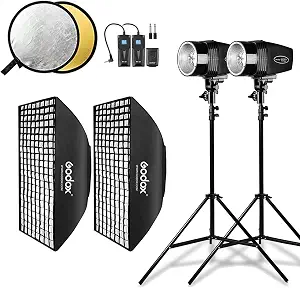 | Best for Beginners | Light Heads: 2 | Output per Head: 180W | Color Temperature: 5600K | VIEW LATEST PRICE | See Our Full Breakdown |
| Godox 750W Three-Light Studio Strobe Kit |  | Best Three-Light Setup | Light Heads: 3 | Output per Head: 250W | Total Output: 750W | VIEW LATEST PRICE | See Our Full Breakdown |
| Godox MS300 600W Bowens-Mount Studio Flash Kit |  | Best for Bright Modeling Light | Flash Heads: 2 | Total Output: 600W | Modeling Lamp: 150W, adjustable from 5% to 100% | VIEW LATEST PRICE | See Our Full Breakdown |
| Godox MS300V 600Ws Two-Light Studio Flash Kit |  | Best LED Modeling-Lamp Kit | Flash Heads: 2 | Output per Head: 300Ws | Total Output: 600Ws | VIEW LATEST PRICE | See Our Full Breakdown |
| GODOX 2-Pack SK400III-V 800Ws Studio Strobe Kit |  | Best High-Power Two-Light Kit | Total output: 800Ws across two 400Ws heads | Guide number: 65m at ISO 100 | Power range: 1/32–1/1 across 5 stops | VIEW LATEST PRICE | See Our Full Breakdown |
| Godox Professional Studio Flash Kit for Photography |  | Best for Small Portrait Studios | Number of lights: 2 monolights | Output per light: 180W | Color temperature: 5600K | VIEW LATEST PRICE | See Our Full Breakdown |
| Godox 750W Studio Strobe Flash Light Kit |  | Best Three-Light Creative Setup | Number of lights: 3 monolights | Output: 750W total / 250W per light | Guide number: 58 | VIEW LATEST PRICE | See Our Full Breakdown |
| NEEWER 600Ws Studio Monolight Flash Light Kit |  | Best for Bowens Modifier Growth | Total output: 600Ws across two 300Ws heads | Guide number: 58 at 1m and ISO 100 | Color temperature: 5600K ± 200K | VIEW LATEST PRICE | See Our Full Breakdown |
| strobe lighting kits for home studio | Modeling Lamp | Total Output | Recycle Time | Color Temperature |
|---|---|---|---|---|
| Godox MS300 600Ws Two-Light St | — | 600Ws | 0.1-1.8 seconds | 5600K ±200K |
| Godox 2x180W Beginner Studio F | 75W, 3200K | — | 0.5-3 seconds | 5600K |
| Godox 750W Three-Light Studio | 75W with 9 brightness levels | 750W | 0.3-2 seconds | — |
| Godox MS300 600W Bowens-Mount | 150W, adjustable from 5% to 100% | 600W | 0.1-1.8 seconds | 5600K |
| Godox MS300V 600Ws Two-Light S | 10W LED, dimmable from 5% to 100% | 600Ws | 0.1-1.8 seconds | — |
| GODOX 2-Pack SK400III-V 800Ws | 10W LED, adjustable from 5%–100% | 800Ws across two 400Ws heads | — | — |
| Godox Professional Studio Flas | — | — | — | 5600K |
| Godox 750W Studio Strobe Flash | 75W with 9 brightness levels | — | — | — |
| NEEWER 600Ws Studio Monolight | 150W, adjustable from 10%–100% | 600Ws across two 300Ws heads | — | 5600K ± 200K |
More Details on Our Top Picks
Godox MS300 600Ws Two-Light Studio Flash Kit
I rank the Godox MS300 Two-Light Kit first because its balance of power, control, and included modifiers fits the widest range of home studios. The two 300Ws heads can cover portraits and tabletop work, while 50-step power adjustment gives me finer exposure control than the simpler Godox 2x180W Beginner Kit. Recycling as quickly as 0.1 second also makes this set better suited to active portrait sessions. Bowens mounts leave room for future modifier upgrades, a benefit the beginner kit cannot match. The tradeoff is a space-hungry setup: two tall stands, softboxes, and umbrellas can crowd a spare bedroom. New users also face a steeper learning curve when configuring the wireless X system.
Pros:- Two 300Ws heads provide ample power for portraits and product photography
- Power adjusts from 1/32 to full output across 50 steps
- Bowens mounts support a broad selection of third-party modifiers
- Softboxes, umbrellas, stands, reflectors, and a wireless trigger are included
Cons:- The complete setup occupies substantial floor and storage space
- Wireless group and channel controls may take beginners time to learn
- AC-powered heads are poorly suited to locations without nearby outlets
Best for: Home portrait and product photographers who want enough power for regular paid work plus room to expand their modifier collection
Not ideal for: Photographers working in very small rooms or carrying their lights between locations, since the complete two-stand setup is bulky
- Flash Heads:2
- Total Output:600Ws
- Power Range:1/32 to 1/1 in 50 steps
- Recycle Time:0.1-1.8 seconds
- Color Temperature:5600K ±200K
- Modifier Mount:Bowens
- Softbox Size:60 x 90 cm
- Wireless System:Godox 2.4GHz X system
- Stand Height:78.7 inches
Our verdict“I recommend this kit to home-studio photographers seeking the strongest balance of power, included equipment, and long-term expandability.”
Godox 2x180W Beginner Studio Flash Kit
I place the Godox 2x180W Beginner Kit ahead of more elaborate sets for buyers who want a manageable first step into flash photography. Two heads, softboxes, stands, and a 30-meter trigger provide a straightforward key-and-fill arrangement without the added complexity of a boom. Compared with the Godox MS300 Two-Light Kit, its lower 180W output is easier to manage in a tight room but leaves less reserve for large modifiers or smaller apertures. The 0.5-to-3-second recycle time can also interrupt rapid portrait sequences. Its biggest long-term compromise is the non-Bowens design, which narrows modifier choices. I see it as an accessible learning kit, rather than a system built for extensive future upgrades.
Pros:- Simple two-light arrangement is approachable for new flash users
- Included softboxes create softer light without a separate modifier purchase
- Wireless trigger operates from up to 30 meters
- Two 180W heads suit portraits and small-product work in confined rooms
Cons:- Non-Bowens mounts restrict future modifier choices
- Recycle time can reach three seconds at higher output
- 110V AC operation confines the kit to compatible indoor power
Best for: First-time strobe users photographing headshots, crafts, or small products in a spare bedroom
Not ideal for: Growing commercial studios that need fast recycling, higher output, or access to a wide Bowens-mount modifier range
- Light Heads:2
- Output per Head:180W
- Color Temperature:5600K
- Modeling Lamp:75W, 3200K
- Guide Number:45
- Recycle Time:0.5-3 seconds
- Softbox Size:20 x 28 inches
- Wireless Range:30 meters
- Power Supply:110V
Our verdict“I recommend this set for beginners who value an uncomplicated first studio kit more than high power or long-term modifier flexibility.”
Godox 750W Three-Light Studio Strobe Kit
I favor the Godox 750W Three-Light Kit for photographers who want key, fill, and hair or background lighting from one package. Its boom arm makes overhead placement practical, giving it a more flexible starting layout than the two-head Godox MS300 Kit. Each 250W monolight is slightly less powerful than an MS300 head, yet the third light adds greater scene control for fashion, full-length portraits, and reflective products. A 50-meter trigger range is generous indoors, and recycling down to 0.3 second supports a steady pace. This is not my choice for a shared living space: three stands, two softboxes, and a boom create a large physical footprint. Balancing three sources also demands more setup knowledge than the beginner kit.
Pros:- Three 250W heads support more controlled multi-light arrangements
- Included boom arm enables hair, rim, and overhead product lighting
- Wireless synchronization reaches up to 50 meters
- Nine-level modeling lamps help preview the placement of each light
Cons:- Three-light setup requires more floor space and configuration time
- Boom arm and multiple stands are cumbersome to transport or store
- Individual heads provide less output than the 300Ws MS300 models
Best for: Photographers with a dedicated home-studio room who need separate key, fill, and overhead or background lights
Not ideal for: Beginners or apartment photographers who need to dismantle their studio after every session
- Light Heads:3
- Output per Head:250W
- Total Output:750W
- Modeling Lamp:75W with 9 brightness levels
- Recycle Time:0.3-2 seconds
- Flash Duration:1/2000-1/800 second
- Wireless Range:50 meters
- Boom Arm Length:53 inches
- Stand Height:190 cm
Our verdict“I recommend this kit for a dedicated home studio where the creative control of a third light outweighs added bulk and complexity.”
Godox MS300 600W Bowens-Mount Studio Flash Kit
I single out this Godox MS300 600W Kit for its 150W modeling lamps, which can make shadow placement easier to judge before a shot. That is a marked difference from the Godox MS300V Kit and its 10W LED lamps. The two 300W heads also deliver substantially more output than the Godox 2x180W Beginner Kit, while Bowens compatibility opens access to grids, beauty dishes, and larger softboxes. A guide number of 58 and recycling down to 0.1 second suit deliberate portrait and product sessions. The brighter lamps draw more power and can add heat to a compact room, however. I would also allow extra setup time for the Godox X-system controls, since full remote operation depends on correct transmitter, channel, and group pairing.
Pros:- Adjustable 150W modeling lamps provide a bright preview of shadow placement
- Two 300W heads offer strong output for portraits and still life
- Bowens mounts accommodate a wide range of lighting modifiers
- Kit includes modifiers, stands, reflectors, an umbrella, a trigger, and a bag
Cons:- High-wattage modeling lamps consume more power and may warm a confined studio
- X-system setup requires correct transmitter and channel configuration
- Mains-powered operation restricts use away from wall outlets
Best for: Portrait and still-life photographers who rely on bright modeling lamps to position shadows precisely in a dedicated indoor workspace
Not ideal for: Small, warm rooms where a lower-power LED modeling lamp would be more comfortable and economical
- Flash Heads:2
- Total Output:600W
- Modeling Lamp:150W, adjustable from 5% to 100%
- Color Temperature:5600K
- Recycle Time:0.1-1.8 seconds
- Flash Duration:1/2000-1/800 second
- Guide Number:58
- Wireless System:Godox 2.4GHz X system
- Modifier Mount:Bowens
Our verdict“I recommend this MS300 package when bright modeling light and Bowens expansion matter more than low heat or grab-and-go portability.”
Godox MS300V 600Ws Two-Light Studio Flash Kit
I choose the Godox MS300V Kit for home studios that keep modeling lights on while composing portraits or product scenes. Its dimmable 10W LEDs use far less power than the 150W modeling lamps supplied with the Godox MS300 600W Bowens-Mount Kit, making the MS300V a better match for confined workspaces. The flash heads still provide 2x300Ws output, 0.1-to-1.8-second recycling, and Bowens modifier support, so the lower modeling-lamp wattage does not reduce flash power. The compromise is preview brightness: a 10W LED may be less visible when the room has strong ambient light. This package also remains heavy and stand-intensive, despite its carry bag, and beginners must learn the X-system controls before making the most of remote triggering.
Pros:- Dimmable 10W LED modeling lamps draw less power than 150W alternatives
- Two 300Ws heads provide strong flash output for portrait and commercial work
- Bowens mounts allow broad modifier compatibility
- Trigger, softboxes, umbrellas, tall stands, and a carry bag form a ready-to-use package
Cons:- 10W modeling lamps may be hard to see against strong ambient light
- Two full-height stands and large softboxes make the kit cumbersome to move
- Wireless groups and channels add setup work for first-time users
Best for: Home product and portrait photographers who spend long sessions composing under modeling lights in a compact room
Not ideal for: Photographers who need an exceptionally bright modeling preview or a lightweight kit for frequent location work
- Flash Heads:2
- Output per Head:300Ws
- Total Output:600Ws
- Modeling Lamp:10W LED, dimmable from 5% to 100%
- Flash Duration:1/2000-1/800 second
- Recycle Time:0.1-1.8 seconds
- Softboxes:2 x 60 x 90 cm
- Stand Height:78.7 inches
- Wireless System:Godox 2.4GHz X system
Our verdict“I recommend the MS300V for photographers who want full 300Ws flash power with lower-draw LED modeling lamps in a permanent home setup.”
GODOX 2-Pack SK400III-V 800Ws Studio Strobe Kit
I place GODOX 2-Pack SK400III-V at the front of this batch because its two 400Ws heads give a home studio more headroom for large softboxes, group portraits, and smaller apertures than the Godox 2x180W Monolight Kit. The 0.1–1.5-second recycle range also favors quicker portrait sequences, while Bowens mounts make later modifier upgrades less restrictive. Its supplied softboxes, umbrellas, reflector, and tall stands create a fuller starting system than the basic 180W package. That capability carries a real cost: the kit occupies more floor and storage space, and its 433MHz AT-16 and built-in 2.4G control choices add setup decisions. I see it as the strongest two-light choice here, but not the simplest first strobe kit for a tight room or a photographer who wants minimal controls.
Pros:- Two 400Ws heads provide ample power for large modifiers and smaller apertures
- Fast 0.1–1.5-second recycling supports active portrait sessions
- Bowens mounts accept a broad range of modifiers
- Softboxes, umbrellas, reflector, and tall stands cover several lighting styles
Cons:- Numerous components demand considerable floor and storage space
- Dual wireless-control options create a steeper learning curve
- A compatible 2.4G transmitter may require a separate purchase
Best for: I recommend it for portrait, fashion, and product photographers who need substantial two-head power and room to expand through Bowens modifiers.
Not ideal for: I would skip it for photographers working in cramped bedrooms or anyone wanting a lightweight kit with very few controls.
- Total output:800Ws across two 400Ws heads
- Guide number:65m at ISO 100
- Power range:1/32–1/1 across 5 stops
- Recycling time:0.1–1.5 seconds
- Flash duration:1/260–1/1170 second
- Modeling lamp:10W LED, adjustable from 5%–100%
- Modifier mount:Bowens
- Wireless systems:433MHz AT-16 and built-in 2.4G
- Included modifiers:Two 60x90cm softboxes, two 33-inch umbrellas, standard reflector, and 80cm 5-in-1 reflector
Our verdict“I would choose this for a permanent home studio that needs powerful, expandable two-light control more than portability.”
Godox Professional Studio Flash Kit for Photography
I rank the Godox Professional Studio Flash Kit for Photography as my small-room pick because its two 180W heads are easier to tame at short working distances. Compared with the GODOX 2-Pack SK400III-V, it gives up more than half the output per head, so it has less latitude for large modifiers, groups, or high f-stops. In a spare-bedroom portrait space, though, lower output can simplify exposure control and reduce light bouncing from nearby walls. The 30-meter trigger and paired 50x70cm softboxes form a coherent basic setup, while the 5600K rating supports predictable color. I keep it below the SK400III-V because its accessory package is narrower and the wireless functions still demand some learning. It is a focused headshot and tabletop kit, not a flexible system for ambitious sets.
Pros:- Lower-powered heads are manageable at short home-studio distances
- Two softboxes provide a practical key-and-fill arrangement
- Wireless trigger operates at distances up to 30 meters
- Straightforward accessory set keeps the initial setup focused
Cons:- 180W per head offers limited power for groups and large modifiers
- Wireless operation requires some technical setup
- Basic accessory selection leaves fewer creative lighting choices
Best for: I recommend it for headshot, passport, and small-product photographers working at short distances in a spare room.
Not ideal for: I would skip it for group portraits, large softboxes, or bright ambient-light work because each head is limited to 180W.
- Number of lights:2 monolights
- Output per light:180W
- Color temperature:5600K
- Softbox size:20×28 inches / 50x70cm
- Trigger range:Up to 30 meters
- Triggering:Wireless synchronization
- Included accessories:Two softboxes, light stands, power cables, and wireless triggers
Our verdict“I would pick this for controlled headshots and tabletop photography in a small room, provided high output is not a priority.”
Godox 750W Studio Strobe Flash Light Kit
I give the Godox 750W Studio Strobe Flash Light Kit the multi-light role because its third head and 135cm boom support a background, hair, or overhead light without an immediate stand purchase. That makes it more compositionally flexible than the GODOX 2-Pack SK400III-V, even though the SK400 pair offers more power per head and a quicker best-case recycle time. The 75W modeling lamps with nine brightness levels help preview layered shadows, and two rectangular softboxes plus an 80cm octagon provide different catchlight shapes. I rank it lower for a typical home studio because three stands and a boom consume substantial floor area, setup takes longer, and extended sessions can create more heat despite the built-in fans. This package rewards planned three-point lighting, but it is excessive for simple headshots in a cramped room.
Pros:- Three 250W lights support key, fill, and background or hair lighting
- A 135cm boom enables overhead placement without another purchase
- Three modifier shapes offer varied coverage and catchlights
- Adjustable 75W modeling lamps help preview layered lighting
Cons:- Three stands and a boom require considerable working space
- More components make assembly and adjustment slower
- Extended use can produce substantial heat despite active cooling
Best for: I recommend it for home-studio photographers who regularly build three-point portraits, overhead product scenes, or separate subject and background lighting.
Not ideal for: I would skip it for narrow rooms and quick one-person shoots because the three stands and boom create a large, time-consuming setup.
- Number of lights:3 monolights
- Output:750W total / 250W per light
- Guide number:58
- Recycling time:0.3–2 seconds
- Flash duration:1/2000–1/800 second
- Modeling lamp:75W with 9 brightness levels
- Cooling:Built-in cooling fan
- Included modifiers:20×28-inch softboxes and 80cm octagonal softbox
- Supports:Three 200cm stands and 135cm boom arm
Our verdict“I would choose this when a dedicated home-studio area can accommodate a versatile three-light arrangement.”
NEEWER 600Ws Studio Monolight Flash Light Kit
I assign the NEEWER 600Ws Studio Monolight Flash Light Kit the modifier-growth role because both 300Ws heads use Bowens mounts, letting a buyer build beyond the supplied softboxes without replacing the flashes. Compared with the Godox 750W Studio Strobe Flash Light Kit, it sacrifices a third lighting position but supplies stronger 150W modeling lamps, which make shadow placement easier in a dim home workspace. Against the GODOX 2-Pack SK400III-V, it also gives up 100Ws per head and comes with less clearly defined trigger inclusion. The 2.4G Q wireless system offers channel-based control, yet a compatible transmitter may be another purchase depending on the bundle. I rank it last in this group because its heavy two-head package needs sturdy support and its listed timing data is ambiguous. I would pick it when modifier compatibility outweighs portability and turnkey simplicity.
Pros:- Two 300Ws heads provide useful power for portraits and product work
- Bowens mounts support a broad modifier upgrade path
- Adjustable 150W modeling lamps provide a bright lighting preview
- Built-in cooling supports longer studio sessions
Cons:- Heavy heads and accessories demand sturdy stands
- A compatible wireless transmitter may be sold separately
- Only two lighting positions are available versus the three-light Godox kit
Best for: I recommend it for product and portrait photographers who want bright modeling lamps and plan to build a collection of Bowens modifiers.
Not ideal for: I would skip it for mobile creators, lightweight stands, or buyers who want every wireless-control component clearly included.
- Total output:600Ws across two 300Ws heads
- Guide number:58 at 1m and ISO 100
- Color temperature:5600K ± 200K
- Listed timing range:1/100–1/1000 second
- Modeling lamp:150W, adjustable from 10%–100%
- Wireless system:2.4G Q system
- Modifier mount:Bowens
- Kit dimensions:28x15x12 inches / 70x39x30cm
- Storage:Large carrying bag included
Our verdict“I would choose this for a fixed studio where Bowens expansion and bright modeling light matter more than low weight or bundle simplicity.”
How We Picked
I ranked these kits around their suitability for a real home studio rather than treating maximum output as the deciding factor. My main criteria were usable flash power, output control, two-light or three-light flexibility, modifier compatibility, wireless triggering, stand stability, and the usefulness of the bundled accessories. I gave extra weight to Bowens-mount support because it lets a buyer add affordable softboxes, reflectors, grids, and beauty dishes later. I also examined whether each package could be stored or moved easily, since spare bedrooms and shared spaces rarely stay set up permanently. Headline wattage received less weight when the listing did not clearly separate energy per head from combined kit output. This approach placed balanced, expandable kits ahead of packages that merely offered more pieces.
The final order reflects buyer fit and tradeoffs. The MS300V package leads because it combines a practical power class with portability and room to expand, while the standard MS300 bundle follows as the stronger value proposition. The SK400III-V ranks as the premium choice rather than the default winner because its additional output brings extra cost and may overwhelm tight spaces. Lower-powered 180W sets score well for accessibility, while three-light kits rise for specialized lighting control but lose ground on storage, setup time, and stand demands.
Factors to Consider When Choosing Best Strobe Lighting Kits For Home Studios
I would choose a home-studio strobe kit by starting with the room, subjects, and modifiers rather than the largest number printed in the listing. Ceiling height and working distance can matter more than raw output because home studios often place lights close to the subject. A useful kit should also leave a clear upgrade path instead of tying the buyer to weak stands or uncommon mounts. The following factors explain where paying more helps and where it simply adds equipment that may stay in storage.
Match Flash Output to the Room and Subject
More power is not automatically better in a home studio. A high-output head can force a photographer toward narrow apertures or heavy diffusion when the light is only a few feet from a portrait subject. Lower-powered heads are often easier to balance with ambient light and wider apertures, though they may struggle when lighting groups, stopping motion, or filling a large softbox. I would look for a wide adjustment range, since minimum power determines flexibility in cramped rooms. Buyers photographing products at small apertures can make better use of 300Ws or 400Ws heads than someone creating shallow-depth-of-field headshots. Treat combined kit labels such as 600W or 750W carefully because they may not describe the energy available from each flash.
Choose Two Lights or Three With a Clear Purpose
A two-light kit covers more home-studio work than its smaller component count suggests. One head can act as the key light while the other supplies fill, separation, or background illumination, and a reflector can replace a third source. Three lights become worthwhile when the buyer repeatedly needs a dedicated hair light, an evenly lit backdrop, or an overhead product light. I would not buy a third head merely because the bundle appears generous; it adds another stand, cable, modifier, and storage problem. A boom-equipped package has greater creative reach but also introduces counterweight and stability demands. In a narrow room, two better-positioned lights usually beat three stands competing for the same floor area.
Prioritize a Modifier Mount With Room to Grow
Bowens-mount compatibility is one of the strongest reasons to choose many of the Godox kits in this roundup. It provides access to a large range of softboxes, grids, snoots, reflectors, and beauty dishes at varied prices. The included softboxes may be adequate for learning, but their size and diffusion quality should not define the system permanently. Portrait photographers can add a larger octabox later, while product photographers may gain more from strip boxes and grids. I would treat umbrellas as fast, broad light sources rather than substitutes for every modifier because they spill more light around a small room. A common buying mistake is valuing a long accessory list over a mount that supports better future modifiers.
Check Wireless Control Beyond Basic Triggering
A bundled trigger may fire every head, yet that does not mean it offers remote power adjustment or separate group control. Basic radio triggering is adequate when the lights remain within easy reach, but changing output from the camera position saves time when a head is raised on a boom. Buyers already using Godox speedlights or transmitters should favor heads that join the same 2.4G X system. I would verify camera compatibility separately because a kit name may not identify the transmitter version or available TTL functions. Manual studio strobes do not need TTL for controlled sessions, but reliable channels and groups make multi-light work cleaner. The meaningful distinction is between wireless firing and wireless control, not simply whether a trigger appears in the box.
Treat Stands and Boom Arms as Safety Equipment
Stand quality can limit the whole kit, especially when a large softbox creates leverage above a crowded floor. Lightweight bundled stands are convenient for compact modifiers, but they may flex or become unstable near their maximum height. A boom arm needs a suitable counterweight and a stand with enough footprint to support an off-center head. I would budget for sandbags even when none are included, particularly in homes with children, pets, or frequent foot traffic. Air cushioning is helpful but does not replace proper load capacity or balanced placement. If a package includes powerful heads and large modifiers on basic supports, plan for stand upgrades before modifier upgrades.
Know When Paying More Changes the Result
A higher price makes sense when it buys greater output range, faster recycling, stronger construction, or a wireless system the buyer will expand. Paying extra for another umbrella, generic reflector, or duplicate carrying pouch rarely changes image quality. Busy portrait photographers may value faster recovery between flashes, while occasional product shooters can accept a slower pace. A carry bag has real value when the studio must be packed away after every session, even though it contributes nothing during exposure. I would also reserve part of the budget for a dependable flash meter, sandbags, or a modifier suited to the intended subject. The best purchase is the kit that removes the buyer’s main limitation without creating unused power or accessory clutter.
Frequently Asked Questions
Is 180W Enough for a Home Portrait Studio?
A 180W monolight can be enough for individual portraits when the modifier sits close to the subject and the room has controlled ambient light. It suits headshots, half-length portraits, and learning sessions better than large groups or full-length work at narrow apertures. I would choose one of the 180W Godox sets for a small room where gentle output control matters more than maximum brightness. Larger softboxes absorb more light, so these heads offer less reserve when the modifier moves farther away. Buyers expecting group portraits or strong motion-stopping performance should move toward 300Ws or 400Ws heads.
Do I Need Two Strobes or a Three-Light Kit?
Two strobes are the better starting point for most buyers because they can produce key-and-fill, key-and-rim, or subject-and-background arrangements. A reflector can supply inexpensive fill without adding another powered head. I would select a three-light kit when hair lighting, pure-white backgrounds, or overhead product illumination appears in nearly every planned session. The third light becomes less valuable if the room cannot accommodate another stand safely. A boom-arm package is a specialized choice for buyers who already know they need light from above or behind.
Will These Godox Kits Work With My Camera?
The strobes can generally fire with many camera systems through a compatible hot-shoe transmitter, but the included trigger version matters. A basic single-pin trigger may fire the flash without offering camera-specific features or remote adjustment. I would verify the transmitter model, hot-shoe fit, sync connection, and supported camera brand before ordering. Manual studio work does not require TTL, so broad firing compatibility may be sufficient for many buyers. Anyone already invested in Godox equipment should favor an X-system kit and matching transmitter for easier group control.
Are the Included Softboxes and Stands Good Enough?
Bundled softboxes and stands are usually starting equipment, not the main reason to select a lighting system. They can handle basic portraits and product photographs, but compact softboxes produce a harder look than larger modifiers at the same distance. Light stands may also become unstable when raised high or fitted with heavier modifiers. I would use the included pieces to learn which shapes and sizes suit the work, then replace the weakest component. Sandbags and a sturdier key-light stand often provide a better early upgrade than buying another flash head.
Should I Buy the MS300V Kit or the More Powerful SK400III-V Kit?
The MS300V kit is the more balanced choice for portraits, products, and mixed home-studio work because its output is easier to manage in modest rooms. Its carry bag also favors buyers who pack the studio away or move between rooms. The SK400III-V kit makes more sense for larger modifiers, group portraits, higher apertures, or photographers who regularly need greater output reserve. I would accept its added cost only when those needs are already clear. For most spare-bedroom studios, control and portability beat maximum power.
Conclusion
For most buyers, I recommend the 2pcs Godox MS300V Studio Flash Kit as the best overall choice because it balances power, Bowens-mount flexibility, wireless triggering, and pack-away convenience. The standard 2pcs Godox MS300 Studio Flash Kit is my best-value pick for buyers who want a similar two-head foundation and can live without the MS300V package’s portability advantages. Beginners should start with the Godox 2x180W beginner kit, which offers a less intimidating power range for headshots and tabletop practice. The Godox SK400III-V 800Ws kit is the premium recommendation for larger modifiers, groups, and photographers who need more output reserve. For overhead product work or repeatable hair-light setups, I would choose the Godox 750W three-light kit with boom arm, provided the room can support its wider footprint safely. Buyers who prefer a non-Godox package should place the NEEWER 600Ws two-pack on the shortlist, while photographers with very limited floor space should stay with a two-light system rather than buying extra stands they cannot position well.
Flea & tick season Picks
flea and tick prevention
As an affiliate, we earn on qualifying purchases.