TL;DR

Get audio and creator gear delivered free with Prime
- Fast, free delivery on millions of items
- Prime Video, Amazon Music and more included
- Member-only deals all year
Sky replacement means changing the sky in a photograph, usually with editing software or an AI tool. It is generally fine for clearly creative work, but it can mislead when viewers expect a faithful record of a place, event, or condition. Keep the original, check the rules for the image’s intended use, and disclose substantial edits where accuracy matters.
A photograph of a house can show the same walls and windows yet tell a different story after one edit: a blue sky suggests a pleasant afternoon, while black storm clouds make the place feel exposed. The sky carries meaning, not just color.
Sky replacement means changing the sky in a photograph, usually with editing software or an AI tool. I use edits to shape mood and solve practical problems, but the right choice depends on what you say the image shows. A harmless creative composite and a misleading documentary image can use the same tool.
Here, you’ll learn where sky replacement works, where it crosses a line, what disclosure can and cannot fix, and how to make a sound call before you publish. The goal is simple: make the image fit its purpose, and let viewers understand what they are looking at.
Decide based on what the image claims and what its audience expects, not on which editing tool you used.
Use sky replacement freely for clearly creative work and personal images that are not presented as exact records.
Treat news, property, travel, scientific, legal, insurance, and safety images with extra care because viewers may rely on them as factual records.
A misleading edit is not automatically legal fraud, though it may still break professional rules, platform standards, contracts, or other laws.
Keep the original, check the applicable rules, and disclose substantial composites where viewers could mistake them for documentary images.
IMAGE ETHICS · EDITING GUIDE
Sky Replacement: When It’s Fine and When It’s Fraud
A swapped sky can shift a photograph’s meaning without changing a single building or person. The sound choice depends on what the image claims, who will rely on it, and what its context promises.
Start with what the image claims.
News, property, travel, evidence, safety.
Purpose, accuracy, disclosure, history.
No. Standards vary by context.
AT A GLANCE
Make the image fit its purpose
Sky replacement can be creative, practical, or deceptive. Keep the original, check the rules for the intended use, and disclose substantial composites when viewers might mistake them for documentary images.
Judge the edit by the image’s message and audience expectations, not by the tool used.
Use it freely in clearly creative work and personal images not presented as exact records.
Apply extra care where people rely on images as records of places, events, or conditions.
A misleading edit is not automatically legal fraud, but may still break other rules.
Retain the original, check applicable standards, and disclose when accuracy matters.
01 / THE CONTEXT TEST
Where it works—and where it can mislead
The same technique can serve visual storytelling or create a false impression. Ask what a reasonable viewer would conclude from the image and its caption.
Art & fiction
Composites, mood pieces, and imagined scenes can use skies that never existed when presented as creative work.
Everyday photos
A vacation image can reflect your taste when you share it as an edited picture, not proof of exact weather.
Commercial styling
Dramatic skies may suit advertising, subject to applicable rules and promises about the product or location.
News & public interest
Changing weather, time, or atmosphere can alter what viewers believe happened. Editorial policies may prohibit it.
Property & travel
A replacement may misrepresent the view, setting, or conditions people expect at a named place.
Evidence & safety
Legal, insurance, scientific, and safety images can shape judgments about damage, hazards, or events.
02 / A FOUR-STEP CHECK
Make a defensible edit before you publish
Before exporting, consider what the photograph promises, how accurate it needs to be, whether context is clear, and whether you can show its history.
Purpose
Is this art, illustration, or a record someone may rely on?
Accuracy
Could the sky change a viewer’s conclusion about weather, time, safety, or place?
Disclosure
Would “composite” or “illustrative image” clarify what viewers are seeing?
File history
Keep the original and check the brief, policy, platform rules, and local law.
Disclosure helps set expectations; it is not a universal cure. A label may not make a composite appropriate as evidence or satisfy a publication’s rules.
03 / THE LEGAL DISTINCTION
Misleading does not automatically mean fraud
“Fraud” has a specific legal meaning. A questionable edit can raise ethical or professional concerns even when it does not meet that legal test.
“Not proven fraud” is not the same as “fair to the viewer.”
Legal consequences depend on circumstances and jurisdiction, including factors such as intent, materiality, reliance, and harm. The edit alone does not settle the question.
An image may still violate professional standards, platform rules, a contract, or consumer-protection requirements. Client briefs can set stricter terms than the law.
04 / TRACE THE DECISION
From image to responsible publication
Use this simple chain when the context is unclear. Each step makes the image’s promise easier to assess.
Claim
What does the caption say?
Audience
What will viewers reasonably expect?
Rules
Check the brief and relevant standards.
Record
Retain the original and edit history.
Disclose
Label substantial composites where needed.
THE PRACTICAL RULE
Let viewers know what they are looking at.
Creative freedom and documentary accuracy serve different purposes. Match the edit to the image’s claim, preserve the original, and be transparent when the distinction matters.
Judge the sky by what the photograph promises
Sky replacement is acceptable when the image’s purpose makes clear that it is creative or illustrative; it becomes deceptive when viewers reasonably treat it as a record of real conditions. The editing method alone does not settle the question. A sunset added to a fantasy composite sends a different message from a sunset added to a news photograph.
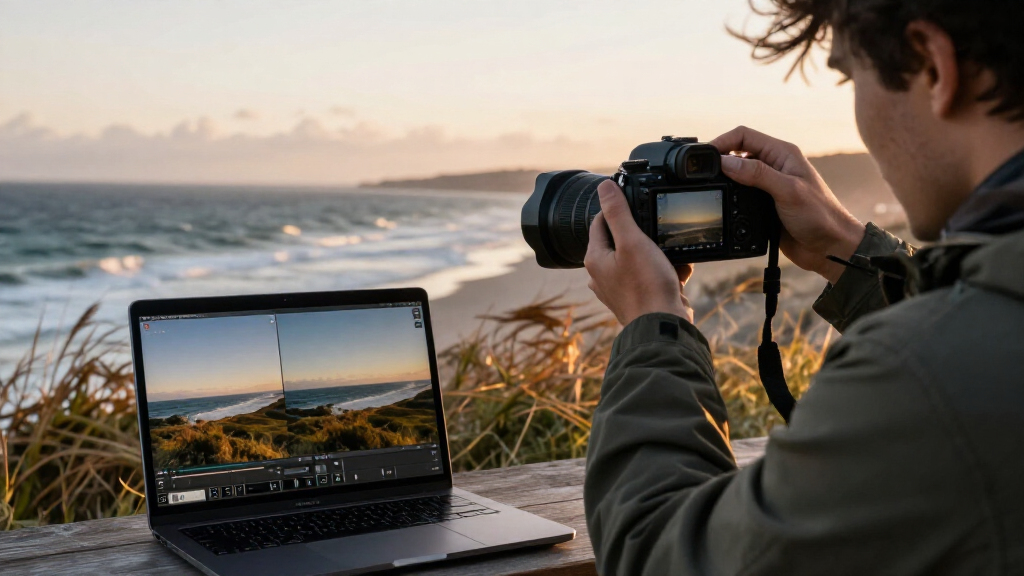
When I edit a landscape for a personal portfolio, I think about the promise the caption and setting make. “A quiet study of the coast” gives me room to shape color and mood. “The beach at noon during yesterday’s storm” makes a factual claim about time and weather, so substituting a sky would change what the picture says.
Think of the sky as stage lighting: you can use it freely in a play, but a documentary claiming to record a real emergency has a different duty. A harmless creative choice can become a practical correction when it addresses a dull or blown-out sky without changing what the scene means. The dividing line is the viewer’s expectation.
Before you export, ask: What does this image claim? Who will see it, and what might they reasonably conclude? A dramatic cloud bank may make a travel scene more appealing, but if you present it as proof of the weather visitors will encounter, the edit can give them a false impression.
Products Worth Considering

LG UltraGear 27-Inch QHD OLED Gaming Monitor, 240Hz, 0.03ms, G-SYNC Compatible, FreeSync Premium Pro, HDMI 2.1

Samsung 27-inch Odyssey OLED G6 QD-OLED QHD Gaming Monitor

LG 34GX90SA-W 34-inch Ultragear WQHD OLED Curved Gaming Monitor
As an affiliate, we earn on qualifying purchases.
Use a replacement freely in art and personal photos
Creative work and personal sharing generally allow sky replacement when you do not present the result as documentary proof. Art, composites, mood pieces, and fictional scenes can use a sky that never existed. A vacation photo can also be edited for your own taste, provided the way you share it does not imply that it records exact conditions.
Imagine your family reaches a lookout after a long drive, but the sky has gone flat and gray. You replace it with a warmer evening sky to match the mood you remember. That can be a personal keepsake rather than a factual record, especially if you share it as an edited picture. If a friend asks whether the sunset really looked that way, answer plainly.
In a portfolio, a composite can show what you wanted to create rather than what the camera recorded. I might combine a portrait with a more expressive sky to support a visual idea; the craft then lies in believable light, edges, and color. The image should not be mistaken for an unaltered scene if that distinction matters to the audience.
Context still matters. A visibly surreal purple sky reads as fantasy more readily than a photorealistic blue sky over a named landmark. Captions, portfolio labels, and the surrounding work all help set expectations. If a realistic edit could be mistaken for a faithful record, call it a composite or illustrative image.
Know when the edit changes a factual claim
Sky replacement can mislead when the image is used as evidence of weather, time, safety, location, or an event. The concern is not simply that pixels changed. It is that viewers may make a decision based on a scene that did not happen as shown.
A news photo with a sunny sky substituted for a stormy one changes the atmosphere and possibly the event’s meaning. A real-estate listing that replaces a neighboring building or an obstructed view with a clear horizon can misrepresent the property. A tourism image can make a destination look reliably sunny when it records no such conditions. In each case, viewers may reasonably expect a faithful depiction.
The same caution applies to legal, insurance, scientific, and public-safety contexts. If a photograph supports a claim about damage, an accident, a measurement, or a hazard, changing the sky may affect interpretation. For example, storm clouds added over a road could imply dangerous weather at the time of a crash; a sunny replacement might suggest conditions were clear.
Disclosure is not a universal cure. A label such as “illustrative composite” helps, but it may not make an image appropriate as evidence or meet a publication’s rules. Before you submit or publish, check the relevant editorial policy, client brief, platform standards, contract, and local law. Standards vary by setting.
Separate misleading editing from legal fraud
A misleading sky edit is not automatically fraud. “Fraud” has a specific legal meaning, and whether conduct meets it depends on the circumstances and the applicable jurisdiction. A photograph can still violate professional standards, platform rules, a contract, or consumer-protection requirements without meeting a legal test for fraud.
For example, a photographer might add clouds to a property listing to make a flat sky more attractive. That edit raises an honesty concern if it changes the impression of the view or conditions, but legal consequences depend on facts such as intent, materiality, reliance, and harm. A buyer’s decision and the listing’s claims may matter; the edit alone does not resolve the legal question.
In my work, I separate two questions. First: Is this fair to the viewer? Second: Do the rules for this use permit it? The first is an ethical judgment; the second may require checking a publication’s standards or getting qualified legal advice. Do not treat “not proven fraud” as a green light for an image that misleads.
A client may also set stricter terms than the law. An editorial assignment can prohibit replacing skies even when the image is intended to look polished. Ask for the brief before editing, and retain the original file so you can show what the camera recorded if questions arise.
Check the light, reflections, and edges before you share
A believable composite needs consistent light, clean edges, and reflections that agree with the new sky. These visual checks can reveal a sloppy edit, but they cannot prove authenticity. A polished image can still misrepresent reality, and an apparent artifact can have an innocent explanation.
Start at the horizon, where the new sky meets rooftops, trees, hair, or mountain ridges. Zoom in around fine branches and wisps of hair; halos, leftover color, and hard cutout lines stand out against a bright sky. Then look at the scene’s light: if the replacement sky glows orange on one side but the subject’s shadows point toward a different light source, the image may feel wrong even if you cannot name why.
Check glass, water, and shiny surfaces too. A lake that reflects the original gray sky beneath a vivid blue replacement is a giveaway. So is a window that holds a bright sunset when the new sky shows a cloudless midday blue. On a real-estate photo, those mismatches can distract from the room and raise doubts about the whole listing.
Visual inspection has limits. Metadata can be removed or changed, and image artifacts are not definitive proof of manipulation. Provenance systems and content credentials may record editing history, but availability and adoption vary. Missing credentials do not prove an image was altered; credentials alone do not prove its factual claims are true.
Make a defensible edit with four simple checks
You can make a better decision by checking purpose, accuracy, disclosure, and file history before you publish. This quick process works whether you use a manual mask, a preset, or an AI sky tool. It helps you judge both the image’s look and the claim attached to it.
- Name the purpose. Is this art, a personal memory, advertising, editorial coverage, a listing, or evidence? Write down what the audience should understand.
- Compare the claim with the original. Ask whether the new sky changes an apparent time, weather condition, location, hazard, or event. If it does, the edit changes the message.
- Check the rules and label the result. Follow the client or publication’s policy. Where the audience might expect a factual record, disclose a substantial composite clearly; do not rely on a small label to make an unsuitable use acceptable.
- Keep both versions. Save the camera original and the edited file, with a note about what changed. If someone asks later, you can explain the edit rather than reconstructing your process from memory.
Consider a travel image edited for a hotel brochure. If the goal is an illustrative mood, the client can label it accordingly and avoid implying that it shows typical weather. If the same image appears in a visitor guide promising conditions at a particular time and place, the substitution needs much closer scrutiny.
When the image supports a decision, pause. For a news desk, evidence submission, scientific record, or property listing, ask the relevant editor or client before you alter the sky. A quick question up front can spare you a damaged reputation or a rejected submission later.
Frequently Asked Questions
Is replacing the sky always dishonest?
No. Sky replacement is usually acceptable in art, fictional composites, and personal sharing when the image is not presented as an exact record. The context and the claims around the photograph determine whether viewers may be misled.
Is sky replacement fraud?
Not automatically. Fraud is a legal determination that depends on the facts and applicable law, including matters such as intent, materiality, reliance, and harm. A deceptive edit can still breach professional standards, platform rules, or a contract even if it does not meet that legal definition.
Do I have to disclose a replaced sky?
It depends on the setting. Disclosure matters especially in journalism, evidence, science, property listings, and other uses where people expect a faithful record. Check the rules for the publication, client, platform, or assignment.
Can people tell if I replaced the sky?
Sometimes. Mismatched lighting, reflections, shadows, cutout edges, and halos may reveal an edit, but visual clues cannot reliably settle every case. A realistic image is not necessarily authentic, and an apparent artifact does not prove deception.
Does an AI content label solve the problem?
A label helps people understand how an image was made, but it does not make a false claim harmless. Labeling rules vary, and some uses may not allow composites even when disclosed. Follow the standard for the image’s intended use.
What is the safest practice for a sky replacement?
Keep the camera original, check the rules, and disclose substantial edits when the context could mislead. Do not use a composite to support a factual claim it does not accurately show. If you are unsure, ask the editor or client before publishing.
Conclusion
Let the purpose decide the edit. A replacement sky can help you express a mood or finish a personal photograph, but it can also change what viewers believe happened. Keep your original, follow the rules for the image’s use, and make the composite clear whenever accuracy matters.
When you publish, give the viewer enough context to know what the camera saw and what you added. A beautiful sky can hold a whole scene together; honesty is what lets the photograph stand on solid ground.