For most musicians, the Zoom H4essential is the best overall portable audio recorder in this roundup: it combines built-in stereo microphones with XLR inputs, so it can capture rehearsals and connect external mics. The Zoom R4 suits players who want multitrack recording without a computer, while the Zoom H1essential is a simpler choice for quick stereo demos. The main tradeoff is between grab-and-go simplicity, greater input and track flexibility, and specialized setups that may take more planning. Bundle contents can also differ even when recorder names are nearly identical. Read on for the full breakdown, ranking logic, and help matching a recorder to your music-making habits.

Get audio and creator gear delivered free with Prime
- Fast, free delivery on millions of items
- Prime Video, Amazon Music and more included
- Member-only deals all year
Complete the kit


Key Takeaways
- The H4essential earns the overall lead by covering both quick stereo capture and external-microphone recording, avoiding the limits of a recorder built for only one job.
- The H1essential models are a family of closely related simple stereo options; bundles may add useful accessories, but buyers should compare included items rather than assume the recorder itself is different.
- The Zoom R4 and TASCAM DR-40XP favor hands-on track and input flexibility, while compact stereo models are easier to carry and quicker to set up.
- The Zoom F3 is a focused choice for musicians recording through external microphones, not a substitute for a pocket recorder with built-in stereo mics.
- The PodTrak P4 and DR-10X solve narrower recording problems: the former centers on multiple hosted or remote voices, and the latter attaches directly to an XLR microphone.
| Zoom H1essential Portable Stereo Audio Recorder with 64GB microSD Card and Accessories |  | Best Compact Starter Kit | Recording format: WAV | Recording bit depth: 32-bit float | Microphones: Built-in stereo X/Y condenser microphones | VIEW LATEST PRICE | See Our Full Breakdown |
| Zoom H4essential Handheld Recorder |  | Best for Multisource Music Recording | Recording tracks: 4 | Recording format and resolution: WAV, 32-bit float | Maximum sample rate: 96 kHz | VIEW LATEST PRICE | See Our Full Breakdown |
| Zoom H1essential Portable Stereo Audio Recorder Bundle with 64GB microSD Card and Accessories |  | Best for Mic-and-Recorder Convenience | Recording format: WAV | Recording resolution: 32-bit float | Microphones: Built-in stereo condenser microphones in X/Y configuration | VIEW LATEST PRICE | See Our Full Breakdown |
| Zoom H1essential Stereo Recorder |  | Best for USB-C Recording and Monitoring | Microphones: Built-in X/Y stereo microphones | Recording format: WAV | Recording mode: 32-bit float | VIEW LATEST PRICE | See Our Full Breakdown |
| TASCAM DR-40XP 4-Channel 32-Bit Float Portable Field Recorder and USB-C Audio Interface |  | Best for Flexible Four-Channel Capture | Channels: Up to 4 | Recording formats: 32-bit float, 24-bit, and 16-bit WAV | Sample rates: 96 kHz, 48 kHz, and 44.1 kHz | VIEW LATEST PRICE | See Our Full Breakdown |
| Zoom R4 32-Bit Float Multi-Track Recorder |  | Best for Building Songs on the Go | Recording tracks: Up to 4 | Audio resolution: 32-bit float | Inputs: 2 XLR/TS combo | VIEW LATEST PRICE | See Our Full Breakdown |
| Zoom F3 Professional Field Recorder |  | Best for Two-Mic Field Recording | Channels: 2 | Recording format: WAV | Recording bit depth: 32-bit float | VIEW LATEST PRICE | See Our Full Breakdown |
| Zoom H1 XLR 2-Channel Recorder for Filmmakers, Musicians & Podcasters |  | Best Compact Recorder for External Mics | Recording resolution: 32-bit/96 kHz | Inputs: 2 locking XLR/TRS combo | Display: OLED waveform display, 0.96-inch screen | VIEW LATEST PRICE | See Our Full Breakdown |
| TASCAM DR-10X Portable XLR Microphone Recorder |  | Best for Recording a Single Mic | Microphone connection: Captive XLR | Recording mode: Mono | Recording formats: WAV and MP3 | VIEW LATEST PRICE | See Our Full Breakdown |
| Zoom H1essential Recorder Bundle with Case, Windscreens & Tripod |  | Best Ready-to-Record Stereo Bundle | Recorder: Zoom H1essential | Recording: 32-bit float, up to 96 kHz | Built-in microphones: X/Y stereo | VIEW LATEST PRICE | See Our Full Breakdown |
| Xvive XV1-R Portable Stereo Audio Recorder with 32-Bit Float and X/Y Microphones |  | Best for Loud Rehearsals and Flexible File Formats | Recording formats: WAV (32-bit float or 24-bit PCM), AAC | Maximum sample rate: 96 kHz | Microphones: Built-in X/Y directional microphones | VIEW LATEST PRICE | See Our Full Breakdown |
| Zoom PodTrak P4 Podcast Recorder with 4 XLR Mic Inputs, 4 Headphone Outputs, Phone & USB Input for Remote Interviews, Sound Pads, 2-In/2-Out USB Audio Interface, Battery Powered |  | Best for Small Ensembles and Mic’d Sessions | Microphone inputs: 4 XLR inputs with phantom power | Headphone outputs: 4 outputs with individual volume control | Recording: Multitrack recording for inputs and sound pads | VIEW LATEST PRICE | See Our Full Breakdown |
| Zoom H1essential 2-Track 32-Bit Float Portable Audio Recorder Bundle |  | Best Ready-to-Record Bundle | Recording format and channels: WAV; 2-track | Recording method: 32-bit float | Microphone: Built-in X/Y; mono and stereo modes | VIEW LATEST PRICE | See Our Full Breakdown |
| portable audio recorders for musician | Weight |
|---|---|
| Zoom H1essential Portable Ster | 14.4 ounces |
| Zoom H4essential Handheld Reco | 243g |
| Zoom H1essential Portable Ster | — |
| Zoom H1essential Stereo Record | 92g |
| TASCAM DR-40XP 4-Channel 32-Bi | 6.1 ounces |
| Zoom R4 32-Bit Float Multi-Tra | 9.6 ounces |
| Zoom F3 Professional Field Rec | 8.48 ounces |
| Zoom H1 XLR 2-Channel Recorder | 6.4 ounces |
| TASCAM DR-10X Portable XLR Mic | 2.56 ounces |
| Zoom H1essential Recorder Bund | — |
| Xvive XV1-R Portable Stereo Au | — |
| Zoom PodTrak P4 Podcast Record | — |
| Zoom H1essential 2-Track 32-Bi | — |
More Details on Our Top Picks
Zoom H1essential Portable Stereo Audio Recorder with 64GB microSD Card and Accessories
For musicians who want to capture rehearsals, song ideas, or room sound without packing extra recording gear, this H1essential kit is a practical starting point. Its built-in X/Y stereo microphones and 32-bit float WAV recording make quick recordings simpler: you can focus on playing rather than setting input gain before a performance. The included 64GB card, tripod, and batteries also mean fewer essentials to source separately. Compared with the Zoom H4essential, this model is lighter on inputs and cannot connect XLR microphones, mixers, or instruments through dedicated inputs. That keeps the setup straightforward, but limits its usefulness for multichannel tracking. It runs on AAA batteries, and the included card is smaller than its 1TB maximum capacity. Choose it for portable stereo capture, not for building a multi-mic recording setup.
Pros:- 32-bit float WAV recording reduces the need to set gain before unpredictable performances.
- Built-in X/Y microphones capture stereo rehearsal and ambient sound in a compact setup.
- Includes a 64GB microSDXC card, tripod, and four AAA batteries.
- Overdubbing, pre-recording, auto-recording, and timer modes support different recording routines.
Cons:- No dedicated XLR/TRS inputs for external microphones, instruments, or mixers.
- Standalone operation depends on AAA batteries.
- The included 64GB card uses only part of the recorder’s supported storage capacity.
Best for: Songwriters and instrumentalists who want a simple, ready-to-record stereo device for rehearsals, demos, and musical ideas.
Not ideal for: Musicians who need XLR/TRS connections for microphones or instruments, or who want to record several sources as separate tracks.
- Recording format:WAV
- Recording bit depth:32-bit float
- Microphones:Built-in stereo X/Y condenser microphones
- Supported storage:Up to 1TB
- Included memory card:64GB microSDXC
- Battery life:Up to 10 hours
- Connectivity:USB-C; 3.5mm headphone jack
- Weight:14.4 ounces
Our verdict“Choose this H1essential kit for uncomplicated, portable stereo recording; pick the Zoom H4essential if your music setup needs external inputs.”
Zoom H4essential Handheld Recorder
The Zoom H4essential makes more sense than a pocket stereo recorder when a musical idea involves several sources. Its built-in stereo microphones can capture a room or ensemble, while two XLR/TRS inputs let you add external microphones, instruments, or a mixer; the recorder supports four tracks. That flexibility makes it a stronger fit for small-session demos than the Zoom H1essential, which is simpler and more portable but lacks those inputs. 32-bit float recording up to 96 kHz also helps handle a performance that moves from quiet passages to loud peaks without constant gain adjustment. USB-C recording and streaming with SD-card backup widen its studio and mobile roles. The tradeoff is a more involved setup, AA-battery power, and a listed recording time of up to 10 hours. It is not the pick for musicians who only need quick stereo notes.
Pros:- Two XLR/TRS inputs work alongside the built-in stereo microphones for varied recording setups.
- Four-track recording supports more sources than a basic stereo recorder.
- 32-bit float WAV recording supports changing performance levels without manual gain adjustments.
- USB-C recording and streaming can be paired with SD-card backup.
Cons:- AA batteries are required for portable operation.
- The listed battery life is up to 10 hours, which may not suit extended sessions without a power plan.
- More inputs and recording options make it less simple than the Zoom H1essential for quick stereo capture.
Best for: Solo performers and small ensembles recording room sound alongside external microphones, instruments, or mixer outputs.
Not ideal for: Musicians seeking the smallest, simplest recorder for occasional stereo memos or who do not need external inputs.
- Recording tracks:4
- Recording format and resolution:WAV, 32-bit float
- Maximum sample rate:96 kHz
- Inputs:2 XLR/TRS
- Microphones:Built-in stereo microphones
- Storage:SD card, up to 1TB
- Connectivity:USB-C; 3.5mm headphone jack
- Power and recording time:2 AA batteries; up to 10 hours
- Weight:243g
Our verdict“Pick the H4essential when your demos need built-in stereo capture plus external sources; skip it if a compact two-microphone recorder is enough.”
Zoom H1essential Portable Stereo Audio Recorder Bundle with 64GB microSD Card and Accessories
This H1essential bundle is aimed at musicians who want a portable stereo recorder but also expect to make close-miked or voice-led recordings. It keeps the base model’s X/Y microphones and 32-bit float recording, then adds a lavalier microphone, mic muff, tripod, and 64GB card. The extras broaden its usefulness for spoken introductions, practice notes, or capturing a performer in a less controlled setting; the muff can help when recording outdoors. Compared with the Zoom H1essential kit with a tabletop tripod and cleaning cloth, this bundle gives up the listed 3.5mm headphone jack while adding a lavalier and wind protection. That missing jack matters when you want to monitor a take directly from the recorder. It remains a stereo-focused option, not a substitute for the H4essential’s XLR/TRS inputs and four-track capability.
Pros:- 32-bit float recording reduces the need to set gain before capturing changing performance levels.
- Built-in X/Y stereo microphones provide a quick way to record rehearsals and room sound.
- Bundle includes a 64GB microSDXC card, lavalier microphone, mic muff, and tripod.
- Supports overdubbing, pre-record, auto-record, and timer modes.
Cons:- No headphone jack is listed, limiting direct monitoring from the recorder.
- Two AAA batteries provide a listed recording time of up to 10 hours.
- The stereo-only design lacks the external XLR/TRS inputs available on the Zoom H4essential.
Best for: Performers who want a compact stereo recorder with a lavalier and wind protection for practice clips, demos, or spoken notes.
Not ideal for: Musicians who need headphone monitoring from the recorder or external XLR/TRS inputs for studio microphones and instruments.
- Recording format:WAV
- Recording resolution:32-bit float
- Microphones:Built-in stereo condenser microphones in X/Y configuration
- Included storage:64GB microSDXC card
- Maximum storage:1TB
- Power and recording time:2 AAA batteries; up to 10 hours
- Display:OLED
- Included accessories:Lavalier microphone, mic muff, handgrip tabletop tripod, microfiber cloth, four AAA batteries
Our verdict“Choose this bundle if the included lavalier and mic muff suit your recording routine; choose the other H1essential kit if direct headphone monitoring matters.”
Zoom H1essential Stereo Recorder
Among these compact stereo recorders, this H1essential is the clearest fit for musicians who want to move between standalone recording and a computer or mobile device. Its USB-C connection lets it serve as a microphone, while the built-in X/Y pair, 32-bit float recording, and 3.5mm headphone jack cover straightforward stereo capture and monitoring. Against the bundled H1essential options, this listing focuses on the recorder’s own connections and capabilities rather than emphasizing an included memory card or accessory kit. It is also far lighter than the Zoom H4essential, but that portability comes with no listed XLR/TRS inputs or four-track workflow. Musicians who record several microphones at once should look to the H4essential or TASCAM DR-40XP instead. For solo practice, ambient recordings, and USB-based demos, its small 92g body is an advantage.
Pros:- Built-in X/Y microphones capture stereo sound without an external mic setup.
- 32-bit float recording helps accommodate sudden changes in performance volume.
- USB-C operation supports use as a microphone with computers and mobile devices.
- A 3.5mm headphone jack supports direct monitoring.
Cons:- No XLR/TRS inputs are listed for connecting external microphones or instruments.
- Two AAA batteries are required for standalone power.
- A card and recording accessories are not listed as included with this product.
Best for: Solo musicians who want a lightweight stereo recorder that can also connect to a computer, smartphone, or camera.
Not ideal for: Bands or home recordists who need multiple external mic inputs, four-channel recording, or a bundled card and accessory set.
- Microphones:Built-in X/Y stereo microphones
- Recording format:WAV
- Recording mode:32-bit float
- USB interface:USB-C
- Headphone jack:3.5mm
- Supported storage:Up to 1TB
- Power and recording time:2 AAA batteries; up to 10 hours
- Dimensions:5.38 × 2.12 × 1.14 inches
- Weight:92g
Our verdict“Choose this H1essential for lightweight stereo recording with USB-C and headphone monitoring; step up to the H4essential for external sources.”
TASCAM DR-40XP 4-Channel 32-Bit Float Portable Field Recorder and USB-C Audio Interface
The TASCAM DR-40XP is the most adaptable choice here for musicians who want to combine room sound with external microphones or other sources. Its adjustable A-B or X-Y microphones let you change the stereo pickup approach, and two XLR/TRS inputs add the option to capture external sources at the same time, for up to four channels. That makes it a more flexible field recorder than the stereo-focused Zoom H1essential models, while its 2-in/2-out USB-C interface gives it a role at a computer as well. Recording options include 32-bit float as well as 24-bit and 16-bit WAV, up to 96 kHz. The tradeoff is preparation: microSD card and batteries are sold separately. Its stated 125 dB SPL capability also gives musicians a defined ceiling for loud sources, rather than a reason to place it anywhere without checking levels or placement.
Pros:- Records up to four channels using built-in microphones and external inputs together.
- Adjustable A-B and X-Y microphone configurations suit different stereo recording setups.
- Offers 32-bit float, 24-bit, and 16-bit WAV recording up to 96 kHz.
- Works as a 2-in/2-out USB-C audio interface.
Cons:- microSD card and batteries are not included.
- Its input and microphone options involve more setup than the stereo-only Zoom H1essential.
- Built-in microphones have a stated maximum SPL of 125 dB.
Best for: Small-ensemble recordists and musicians who want adjustable stereo mics, two external inputs, and USB-C interface use in one portable unit.
Not ideal for: Beginners who want an immediately complete kit, or players who only need simple stereo capture and do not want to buy batteries and a card separately.
- Channels:Up to 4
- Recording formats:32-bit float, 24-bit, and 16-bit WAV
- Sample rates:96 kHz, 48 kHz, and 44.1 kHz
- Microphones:Adjustable A-B or X-Y unidirectional condenser microphones
- Maximum SPL:125 dB
- Inputs:2 XLR/TRS
- USB interface:2-in/2-out USB-C
- Weight:6.1 ounces
- Dimensions:1.38 × 2.76 × 6.13 inches
Our verdict“Pick the DR-40XP for flexible four-channel field recording and USB-C interface duties, provided you are prepared to supply its card and batteries.”
Zoom R4 32-Bit Float Multi-Track Recorder
I’d choose the Zoom R4 when a portable recorder needs to function as a small songwriting workstation, not just capture a performance. It records up to four tracks, then lets you bounce and layer parts with undo support—useful for developing a demo without carrying a laptop. Its built-in stereo mics and more than 80 rhythm patterns also make it easier to sketch ideas on the spot. Compared with the Zoom F3, the R4 favors hands-on multitrack creation over a stripped-down, two-channel XLR recording setup. That flexibility has limits: there are only two combo inputs, and battery operation calls for four AA cells. Musicians recording a full band at once should look toward a recorder with more simultaneous inputs.
Pros:- Four-track recording with bouncing, continued layering, and undo support
- 32-bit float recording reduces the need to set input gain precisely
- Built-in stereo microphones and over 80 rhythm patterns support quick songwriting sessions
- Works as a 2-in/2-out USB audio interface and can run from USB-C
Cons:- Two combo inputs limit how many external sources can be recorded simultaneously
- Battery-powered use requires four AA batteries
Best for: Songwriters and solo musicians who want to layer demos, capture scratch ideas with built-in mics, and record without a computer.
Not ideal for: Bands that need more than two external inputs at once or musicians who want a compact recorder focused only on clean field capture.
- Recording tracks:Up to 4
- Audio resolution:32-bit float
- Inputs:2 XLR/TS combo
- Built-in microphones:Stereo
- USB interface:2-in/2-out
- Rhythm patterns:Over 80
- Power:4 AA batteries or USB-C
- Weight:9.6 ounces
Our verdict“Choose the R4 if portable multitrack songwriting matters more than recording many sources at once.”
Zoom F3 Professional Field Recorder
The Zoom F3 suits musicians who bring their own microphones and want a dependable two-channel recorder with minimal level-setting fuss. Its 32-bit float capture and dual A/D converters help preserve both quiet passages and sudden peaks, while low-noise preamps support clean recordings from suitable XLR microphones. Locking inputs are a practical advantage when cables may get tugged during a rehearsal, location session, or live capture. Compared with the Zoom R4, the F3 gives up built-in stereo mics and multitrack layering in favor of a simpler, focused XLR workflow. That makes it less useful for spontaneous recording without external mics, and it remains a two-channel device. It also relies on two AA batteries for battery operation, so musicians planning long sessions should pack spares or use a USB power workflow.
Pros:- 32-bit float recording with dual A/D converters reduces manual gain adjustment
- Two locking XLR/TRS inputs help keep cables connected
- Low-noise preamps are suited to clean external-mic recording
- Supports wireless control and battery-powered or USB workflows
Cons:- Only two channels, with no multitrack layering like the Zoom R4
- Two AA batteries are required for battery-powered use
- A less natural fit for musicians who need built-in mics for quick sketches
Best for: Musicians recording two external microphones or line sources in the field who value secure connections and 32-bit float capture.
Not ideal for: Songwriters who want built-in microphones, rhythm tools, or multitrack layering in the recorder itself.
- Channels:2
- Recording format:WAV
- Recording bit depth:32-bit float
- Inputs:2 locking XLR/TRS
- Storage:MicroSD, up to 512 GB
- Power:2 AA batteries
- Digital recording time:Up to 73 hours
- Weight:8.48 ounces
Our verdict“Pick the F3 for straightforward two-mic field capture; choose the R4 instead if you need built-in recording and song-building tools.”
Zoom H1 XLR 2-Channel Recorder for Filmmakers, Musicians & Podcasters
I’d put the Zoom H1 XLR on the shortlist for musicians who want a small recorder built around external microphones or instruments. Its two locking XLR/TRS combo inputs provide a secure way to connect sources, and the OLED waveform display gives a quick visual check while recording. It supports 32-bit recording at up to 96 kHz and accepts SDXC cards up to 1 TB, so long sessions need not be constrained by a small card. Unlike the Zoom H1essential bundle, this model emphasizes external inputs rather than built-in X/Y microphones and bundled placement accessories. That’s a meaningful distinction: it is better for connected sources, but less convenient for capturing a room or acoustic idea without extra gear. The small screen and AA-battery power also make it less appealing for extended menu work or sessions without spare batteries.
Pros:- Two locking XLR/TRS combo inputs connect microphones and instruments
- 32-bit/96 kHz recording supports high-resolution capture
- OLED waveform display makes recording activity easy to check
- Supports SDXC cards up to 1 TB
Cons:- No built-in stereo microphones are specified, unlike the H1essential bundle
- Small display can make detailed navigation less comfortable
- Two AA batteries are required, with stated average life of 10 hours
Best for: Musicians who need a compact, two-input recorder for microphones, instruments, or other connected sources and want waveform monitoring.
Not ideal for: Acoustic players seeking an all-in-one recorder with built-in stereo mics, or anyone who prefers rechargeable power and a larger display.
- Recording resolution:32-bit/96 kHz
- Inputs:2 locking XLR/TRS combo
- Display:OLED waveform display, 0.96-inch screen
- Supported card capacity:SDXC up to 1 TB
- Battery type:2 AA batteries
- Average battery life:Up to 10 hours
- Audio format:WAV
- Weight:6.4 ounces
Our verdict“Choose the H1 XLR if external connections and a compact footprint matter more than built-in microphones or bundled accessories.”
TASCAM DR-10X Portable XLR Microphone Recorder
The TASCAM DR-10X has a narrowly useful design: it plugs directly into a handheld XLR microphone, turning that mic into a self-contained mono recorder. For musicians capturing a vocalist, spoken notes, or a single mic source without a cable run to a separate recorder, that direct microphone attachment keeps the setup exceptionally small. Dual recording creates a lower-level backup, while the limiter, low-cut filter, and automatic file closing help protect a take from common recording problems. This is a very different tool from the Zoom H1 XLR, which accepts two inputs and supports stereo workflows. The DR-10X’s tradeoff is its mono-only recording and captive XLR connection; it is not a flexible recorder for stereo instruments or multiple sources. Storage also depends on a microSD card, which is not included in the provided product details.
Pros:- Captive XLR connector attaches directly to a handheld microphone
- Dual recording keeps a lower-level backup track
- Limiter and low-cut filter help manage peaks and unwanted low-frequency noise
- Automatically closes the file if the battery runs out
Cons:- Mono recording only, unlike the stereo-capable Zoom H1 XLR
- Captive connector limits placement and use with sources other than a compatible XLR mic
- Requires a microSD card for storage
Best for: Vocalists and musicians who want to record one handheld XLR microphone directly, without carrying a separate cable-connected recorder.
Not ideal for: Players recording stereo instruments, two microphones, or any session where flexible input placement and multichannel capture matter.
- Microphone connection:Captive XLR
- Recording mode:Mono
- Recording formats:WAV and MP3
- Gain settings:Manual and automatic
- Storage:MicroSD, up to 32 GB
- Headphone jack:3.5 mm
- Weight:2.56 ounces
- Battery:1 included lithium metal battery
Our verdict“Choose the DR-10X for a compact single-microphone setup, not for stereo or multi-source music recording.”
Zoom H1essential Recorder Bundle with Case, Windscreens & Tripod
This Zoom H1essential bundle is the most ready-to-place option here for musicians who record acoustic ideas, rehearsals, or ambient stereo sound. The recorder’s X/Y microphones capture a stereo image without requiring external mics, while 32-bit float recording reduces the risk of a take being spoiled by unexpected peaks. The included hard case, foam and furry windscreens, and flexible tripod add useful placement and protection options—particularly for recording outdoors or setting up hands-free. Compared with the Zoom H1 XLR, this bundle prioritizes built-in stereo capture and accessories over two locking external inputs. The limitation is that the listed bundle details do not specify input count or battery life, and the accessories cannot turn its built-in microphones into a multitrack setup. Musicians needing several microphones should look at the R4 or another multichannel recorder instead.
Pros:- Built-in X/Y microphones capture stereo sound without extra microphones
- 32-bit float recording helps handle changes in performance level
- Furry and foam windscreens suit outdoor and indoor recording conditions
- Hard case and flexible tripod support transport and hands-free placement
Cons:- Built-in microphone focus is less suited to sessions requiring multiple external inputs than the Zoom H1 XLR
- The supplied information does not specify battery life or supported card capacity
- Bundle accessories add little value to musicians who already have a case, windscreens, and a stand
Best for: Acoustic musicians and songwriters who want a portable stereo recorder with built-in mics, wind protection, a case, and flexible placement.
Not ideal for: Bands needing multiple external mic inputs, or musicians who want a compact XLR recorder rather than built-in stereo microphones.
- Recorder:Zoom H1essential
- Recording:32-bit float, up to 96 kHz
- Built-in microphones:X/Y stereo
- Audio format:WAV
- USB connection:USB-C
- Included accessories:Hard EVA case, furry windscreen, foam windscreen, flexible tripod
- Microphone SPL capability:Up to 120 dB SPL
- Screen size:0.96 inches
Our verdict“Choose this bundle for convenient stereo sketching with useful placement accessories, but pick a multichannel recorder for ensemble sessions.”
Xvive XV1-R Portable Stereo Audio Recorder with 32-Bit Float and X/Y Microphones
The Xvive XV1-R suits musicians who want to capture a full rehearsal or a loud amp with its built-in X/Y microphones, rated for sources up to 130 dB SPL. Its 32-bit float WAV option helps preserve recordings when performance levels vary, while AAC gives you a smaller-file alternative for quick references. Compared with the Zoom H1essential, the XV1-R has a higher stated maximum SPL and offers AAC, but the H1essential includes a headphone jack for monitoring; this Xvive has none. USB-C also lets it serve as a microphone with computers and mobile devices, though that mode is fixed at 48 kHz rather than its maximum 96 kHz recording rate. Automatic file splitting supports long takes, but the 4 GB limit means a single performance may become multiple files.
Pros:- Built-in X/Y microphones handle sound levels up to 130 dB SPL, giving more headroom for loud sources than the Zoom H1essential’s stated 120 dB SPL.
- 32-bit float WAV recording reduces the need to set input gain precisely before an unpredictable performance.
- AAC recording offers a smaller-file option for rehearsal notes and reference takes.
- USB-C microphone mode works with PCs, Macs, iOS devices, and Android devices.
Cons:- No headphone jack, so direct monitoring from the recorder is unavailable.
- USB microphone mode is limited to a fixed 48 kHz sample rate.
- Two AA batteries are required, and recordings are split automatically at the 4 GB file limit.
Best for: Musicians recording loud band rehearsals, amplified instruments, or stage sound who want 32-bit float capture and both WAV and AAC options.
Not ideal for: Players who need to monitor directly from the recorder while recording, or who want USB audio at sample rates above 48 kHz.
- Recording formats:WAV (32-bit float or 24-bit PCM), AAC
- Maximum sample rate:96 kHz
- Microphones:Built-in X/Y directional microphones
- Maximum sound pressure level:130 dB SPL
- Storage:MicroSD cards up to 128 GB
- Maximum file size:4 GB per file; recordings split automatically
- USB audio compatibility:PC, Mac, iOS, and Android; 48 kHz
- Power and recording time:2 AA batteries; up to 12 hours
Our verdict“Choose the XV1-R for loud musical sources and flexible file formats, but pick the Zoom H1essential if headphone monitoring matters more.”
Zoom PodTrak P4 Podcast Recorder with 4 XLR Mic Inputs, 4 Headphone Outputs, Phone & USB Input for Remote Interviews, Sound Pads, 2-In/2-Out USB Audio Interface, Battery Powered
The Zoom PodTrak P4 is the lineup’s practical choice for musicians who record several close-miked sources rather than rely on a handheld recorder’s built-in stereo pair. Four XLR inputs with phantom power let you connect microphones for a small ensemble, while four independently controlled headphone outputs make shared listening easier during a session. That makes it a different kind of tool from the Xvive XV1-R or Zoom H1essential, both of which are simpler for quickly placing in a room to capture a performance. The P4 instead adds multitrack recording, sound pads, and phone or USB connections geared toward remote guests and production workflows. The tradeoff is mobility: it needs external microphones and cables to record instruments, and its stated battery life is only up to 3.5 hours on two AA batteries.
Pros:- Four XLR microphone inputs with phantom power support a small multi-mic recording setup.
- Four headphone outputs with individual volume controls let several musicians monitor together.
- Multitrack recording keeps inputs and sound-pad material available as separate sources.
- Phone and USB connectivity support remote contributions and computer-based recording.
Cons:- Does not provide the built-in X/Y microphones found on the Zoom H1essential and Xvive XV1-R, so recording instruments requires external microphones.
- Up to 3.5 hours of battery life on two AA batteries is limiting for extended location sessions.
- Its multitrack and interview features add setup complexity for musicians who only need a quick stereo recording.
Best for: Songwriters and small groups recording multiple microphones at once, especially when each performer needs a separate headphone level.
Not ideal for: Musicians who want a pocketable recorder for spontaneous room recordings or long sessions away from power.
- Microphone inputs:4 XLR inputs with phantom power
- Headphone outputs:4 outputs with individual volume control
- Recording:Multitrack recording for inputs and sound pads
- Sound pads:4 programmable pads
- Remote interview connections:TRRS phone input and USB audio interface mode
- USB interface:2-in/2-out
- Power:2 AA batteries
- Battery life:Up to 3.5 hours
Our verdict“Choose the PodTrak P4 when your music sessions need several XLR mics and shared headphone monitoring, not a grab-and-go stereo recorder.”
Zoom H1essential 2-Track 32-Bit Float Portable Audio Recorder Bundle
This Zoom H1essential bundle is a straightforward fit for musicians who want a compact stereo recorder and the basic accessories to start capturing ideas right away. Its built-in X/Y microphones record two tracks, while 32-bit float WAV helps manage sudden level changes without requiring careful gain setting before a take. The included 64GB microSD card, windscreen, case, and accessory pack make it more session-ready than a recorder sold without those extras. Compared with the Xvive XV1-R, the H1essential offers a 3.5 mm headphone jack and accessibility features, but its microphones are rated to 120 dB SPL rather than the Xvive’s 130 dB SPL. That makes it a better match for practice, songwriting, and moderate-volume performances than especially loud stages. Two AAA batteries power it for up to 10 hours.
Pros:- 32-bit float recording helps capture changing performance levels without precise manual gain adjustment.
- Built-in X/Y microphones and a 3.5 mm headphone jack support simple stereo recording with monitoring.
- The bundle includes a 64GB microSD card, windscreen, padded case, and accessory pack.
- Accessibility features include audible menu descriptions and multiple languages.
Cons:- The 120 dB SPL microphone rating is lower than the Xvive XV1-R’s 130 dB SPL rating for loud sources.
- Two AAA batteries are required, with stated battery life of up to 10 hours.
- The product data lists 32 GB of memory capacity while also including a 64GB microSD card, which may cause confusion about onboard versus removable storage.
Best for: Songwriters and musicians who want a compact stereo recorder with a memory card, windscreen, and carrying accessories included.
Not ideal for: Musicians recording very loud amps or stage sources who want more stated microphone SPL headroom, or players who prefer AA-powered gear.
- Recording format and channels:WAV; 2-track
- Recording method:32-bit float
- Microphone:Built-in X/Y; mono and stereo modes
- Maximum sound pressure level:120 dB SPL
- Included memory card:64GB microSD
- Headphone jack:3.5 mm
- Power and battery life:2 AAA batteries; up to 10 hours
- Dimensions:1.1 × 2.1 × 5.4 inches
Our verdict“Pick this H1essential bundle for accessible, ready-to-use stereo capture of songwriting and rehearsals; choose the XV1-R for louder sources.”
How We Picked
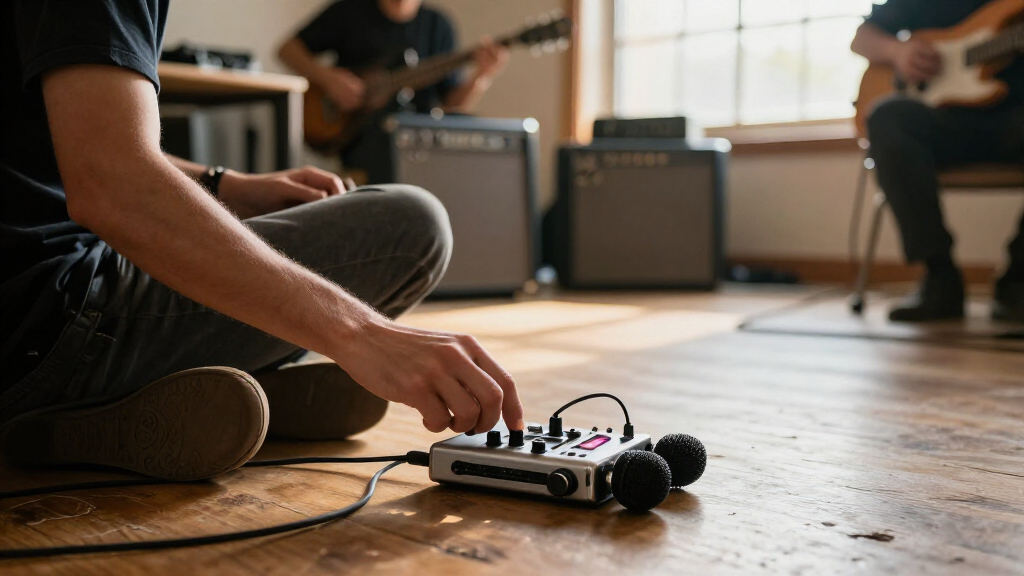
I ranked these recorders by how well they serve real musician workflows: capturing rehearsal ideas, recording instruments with external microphones, building multitrack arrangements, and making recordings without a computer. I weighed input and track flexibility against setup time, portability, monitoring options, and the likelihood that a musician would need extra gear. A feature earns its place here when it changes what a buyer can record or how easily they can do it.
The ranking favors useful versatility, but not at any cost. The H4essential leads because it can handle both quick stereo recording and external-mic work; simpler H1essential models rank lower for narrower use, though they may suit a beginner better. The R4, DR-40XP, and F3 rise for distinct recording tasks, while the PodTrak P4 and DR-10X sit lower for general music use because their strengths target more specialized setups. Bundle versions are treated as accessory variations, not as different recorder designs.
Factors to Consider When Choosing Portable Audio Recorders For Musicians
Before choosing a recorder, match its workflow to what you actually record. More inputs and tracks can expand a session, but they also bring extra setup decisions; a small stereo recorder may capture a useful idea faster. These broader checks can help you avoid buying capacity you will not use—or missing a feature your recording routine depends on.
Choose Between Built-In Microphones and External Inputs
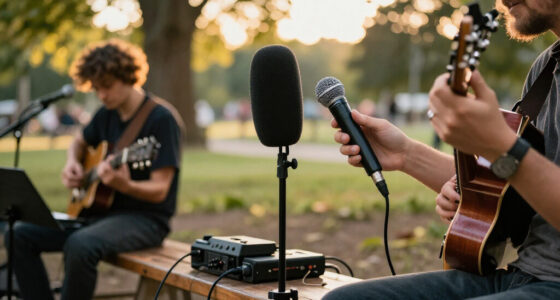
Built-in stereo microphones are handy when you want to record a song idea, rehearsal, or acoustic performance without bringing a separate mic. They also set a limit: mic placement and the room become part of the recording, and you have less control over the sound source. External XLR inputs make it possible to choose microphones suited to vocals, amps, or a stereo pair, but that means carrying cables and possibly stands or power accessories. A common mistake is buying an XLR recorder before deciding which microphones you will use with it. If spontaneity matters most, start with built-in mics; if mic choice and placement matter more, prioritize the inputs.
Buy Track Capacity for a Defined Workflow
A stereo recording captures a blended performance, while multitrack recording can keep parts separate for later balance and editing. Separate tracks are useful when a band member may need to redo a part or when instruments need different levels, but the extra flexibility takes time to organize. More channels do not automatically make a better demo if you mainly need to preserve a rehearsal as it sounded in the room. Before paying for multitrack capability, decide whether you will mix recordings later or simply share quick references. If you want to overdub or shape arrangements on the recorder itself, a multitrack-focused design is a more natural fit than a basic stereo unit.
Treat 32-Bit Float as Headroom, Not a Substitute for Placement
32-bit float recording can provide extra flexibility when a performance changes in loudness and you cannot set the input level perfectly in advance. That can help with unpredictable rehearsal peaks, but it does not repair distortion already created by a microphone, preamp, or source. Nor does it make a distant microphone sound close or remove room noise. Musicians sometimes focus on bit depth while overlooking mic distance, instrument balance, and the acoustics of the space. Choose this feature when recording levels are hard to predict, then still spend time placing the recorder where the performance sounds balanced.
Check Monitoring and Controls for Your Recording Style
Monitoring matters when you need to confirm that a microphone is connected, a channel is receiving signal, or a performance is not clipping. A recorder used for quick voice memos can get by with a simpler setup than one handling multiple microphones during a band session. Think about whether you will operate the device while playing, leave it on a stand across the room, or manage several inputs between takes. Small screens and limited controls can slow down adjustments, while a larger control layout may add bulk. Test the imagined setup before buying: a feature that is hard to reach during a session may not be useful in practice.
Plan for Power, Storage, and Session Length
Portable recording is only convenient if the recorder can stay powered and has room for the session. Check what power options the model supports and whether your usual recording length fits its storage setup. Long rehearsals, multitrack sessions, and remote recordings can create different demands from a quick demo, so do not judge capacity only by a short test recording. Bring spare power or storage when a session cannot be repeated, and confirm how files move to your editing device. Bundles can include practical accessories, but check whether they solve a need you have rather than adding items that will stay unused.
Match Portability to How You Actually Carry Gear
A compact recorder is easy to keep in a gig bag, but compact size can mean fewer controls or connections. A larger model may be easier to operate and support more recording tasks, yet it can be less appealing for spontaneous practice-room capture. Decide whether the recorder will live in a pocket, sit on a stand, mount on a microphone, or travel with a full recording kit. Buyers often overvalue the smallest option without checking how it will be positioned or operated during a session. Choose for the complete setup—including microphones, cables, and support—not just the recorder alone.
Frequently Asked Questions
Is the Zoom H1essential enough for recording a band rehearsal?
It can work well when your goal is a quick stereo reference of the whole room, rather than separate control over each musician. Placement and room balance will strongly affect the result, so put it where the ensemble sounds even instead of leaving it beside one instrument. If you want separate microphones, independent tracks, or more control over loud sources, a recorder with external inputs or multitrack facilities is a better match. For a first recorder, the H1essential keeps the process simple, but it does not replace a multichannel setup.
Should I choose the H4essential or the Zoom R4 for home demos?
Choose the H4essential if you want one device that can make quick stereo recordings and also accept external microphones. The R4 makes more sense when your demo process depends on recording and managing multiple parts on the recorder. The key question is whether you need flexible capture or a more track-centered workflow. If you already plan to edit and mix on a computer, a stereo recording or external-input recorder may be enough. If you want to build an arrangement without relying on a computer, prioritize the R4-style workflow.
Do I need external microphones, or are built-in recorder mics enough?
Built-in microphones are often enough for songwriting notes, room sound, and rehearsal references where speed matters more than precise isolation. External microphones are useful when you need to place a mic close to a vocal or instrument, choose a particular pickup pattern, or record sources separately. They also add cost, setup time, and equipment to carry, so buying an XLR recorder alone will not deliver those benefits. Start with the recordings you want to improve, then identify whether microphone choice or placement is the limiting factor. If neither is, a built-in stereo recorder may be the more practical choice.
Is a recorder bundle worth choosing over the same recorder by itself?
A bundle is useful when its included items support your actual recording setup, such as a case for transport or a windscreen for outdoor use. Similar H1essential listings may include different accessories while sharing the same basic recorder, so compare the contents carefully. Do not assume a bundle adds better recording performance or extra inputs. Check whether you already own the accessories and whether the bundle includes the specific items you need. If you would buy those pieces separately anyway, a bundle can simplify setup; otherwise, choose based on the recorder itself.
Which recorder should I choose if I want to record a live set without a computer?
For a simple stereo document of a set, a portable recorder with built-in microphones can be the least complicated choice, provided the room position gives a balanced sound. For a set that needs external microphones or separate sources, look at models with the inputs and track workflow to match your plan. The F3 is aimed at external-mic field recording, while the DR-40XP and H4essential offer different routes to more flexible input capture. A PodTrak P4 is more suited to several spoken contributors than to general music recording. Decide how many sources you need and how you will mix them before choosing.
Conclusion
For the widest range of musician use, I recommend the Zoom H4essential as best overall, since it bridges quick stereo capture and external-mic recording. My best value direction is the basic H1essential when the priority is a straightforward stereo recorder; compare bundle contents if accessories matter. For beginners, the H1essential is the easiest starting point, while the Zoom R4 is my best premium-style pick for multitrack creation without making the recorder just a stereo sketchpad. Choose the Zoom F3 for a focused external-microphone setup, the TASCAM DR-10X when a recorder that connects to an XLR mic fits the job, and the PodTrak P4 for multi-person spoken sessions. Match the recorder to the number of sources and the way you work, rather than buying the longest feature list.