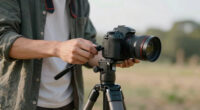
The best monopods for sports photography balance fast repositioning, dependable support, and enough capacity for a camera paired with a long lens. My best overall pick is the Manfrotto XPRO Carbon Fiber 4-Section Monopod because its rigid carbon construction and four-section design suit demanding sideline work without the bulk of a video base. The Manfrotto Xpro 5-Section Carbon Fiber Video Monopod is the stronger premium choice for hybrid shooters, while the Altura Photo 62-Inch Monopod offers better value for lighter setups. The main tradeoffs are carbon fiber versus aluminum, four sections versus a shorter packed size, and a simple foot versus a fluid or tripod-style base. Read on for my full breakdown of which model fits each type of sports photographer.

Get audio and creator gear delivered free with Prime
- Fast, free delivery on millions of items
- Prime Video, Amazon Music and more included
- Member-only deals all year
Complete the kit


Key Takeaways
- The Manfrotto XPRO Carbon Fiber 4-Section ranks first because it offers a cleaner balance of rigidity, portability, and rapid handling than the heavier fluid-base models.
- Footed monopods are specialized rather than universally better: the Manfrotto Xpro Video and Neewer models favor controlled panning, but their bases add weight and occupy more sideline space.
- Five-section construction improves packed portability, yet the four-section XPRO and 290 models make more sense with long lenses because fewer joints generally produce a firmer support.
- Aluminum delivers the strongest budget value: the Altura and Manfrotto Element MII cover lighter sports kits without charging for the weight savings of carbon fiber.
- The KODAK PhotoGear prioritizes height and accessory versatility, while the ULANZI TB12 favors multipurpose travel use; neither is as sports-focused as the leading Manfrotto options.
| Manfrotto Xpro 5-Section Carbon Fiber Video Monopod |  | Best for Fluid Sideline Panning | Material: Carbon fiber | Leg Sections: 5 | Base: FLUIDTECH | VIEW LATEST PRICE | See Our Full Breakdown |
| ULANZI TB12 61-Inch Camera Monopod |  | Best Compact Travel Pick | Maximum Height: 61 inches (155 cm) | Folded Height: 16.9 inches (43 cm) | Weight: 0.83 pounds (378 g) | VIEW LATEST PRICE | See Our Full Breakdown |
| Manfrotto Element Aluminum 5-Section Monopod |  | Best Value Pick | Material: Aluminum | Leg Sections: 5 | Locking System: Twist locks | VIEW LATEST PRICE | See Our Full Breakdown |
| Manfrotto XPRO Carbon Fiber 4-Section Monopod |  | Best Overall | Material: Carbon fiber | Leg Sections: 4 | Payload Capacity: 20 kg | VIEW LATEST PRICE | See Our Full Breakdown |
| KODAK PhotoGear 72-Inch Portable Monopod |  | Best for Smartphone Sports Coverage | Maximum Height: 72 inches | Minimum Height: 21 inches | Folded Length: 22 inches | VIEW LATEST PRICE | See Our Full Breakdown |
| Manfrotto 290 Carbon Fiber 4-Section Monopod |  | Best Lightweight Carbon Fiber Pick | Brand: Manfrotto | Model: MM290C4US | Material: Carbon fiber | VIEW LATEST PRICE | See Our Full Breakdown |
| Neewer Professional Camera Monopod with Feet |  | Best for Hybrid Photo and Video | Material: Aluminum | Maximum Height: 70.5 inches / 179 cm | Collapsed Length: 24.8 inches / 63 cm | VIEW LATEST PRICE | See Our Full Breakdown |
| Altura Photo 62-Inch Camera Monopod |  | Best Budget Travel Pick | Material: Aluminum | Maximum Height: 62 inches | Collapsed Length: 16.75 inches | VIEW LATEST PRICE | See Our Full Breakdown |
| Manfrotto Element MII 5-Section Aluminum Monopod |  | Best Compact High-Capacity Pick | Material: Aluminum | Maximum Height: 62.6 inches | Collapsed Length: 16.9 inches | VIEW LATEST PRICE | See Our Full Breakdown |
| monopods for sports photography | Material | Maximum Height |
|---|---|---|
| Manfrotto Xpro 5-Section Carbo | Carbon fiber | — |
| ULANZI TB12 61-Inch Camera Mon | Aluminum alloy | 61 inches (155 cm) |
| Manfrotto Element Aluminum 5-S | Aluminum | — |
| Manfrotto XPRO Carbon Fiber 4- | Carbon fiber | — |
| KODAK PhotoGear 72-Inch Portab | Aluminum | 72 inches |
| Manfrotto 290 Carbon Fiber 4-S | Carbon fiber | — |
| Neewer Professional Camera Mon | Aluminum | 70.5 inches / 179 cm |
| Altura Photo 62-Inch Camera Mo | Aluminum | 62 inches |
| Manfrotto Element MII 5-Sectio | Aluminum | 62.6 inches |
More Details on Our Top Picks
Manfrotto Xpro 5-Section Carbon Fiber Video Monopod
I rank the Manfrotto Xpro 5-Section Video Monopod as the specialist choice for photographers who track runners, motorsports, or field action with long lenses. Its FLUIDTECH base supports smoother pivots than the fixed foot on the Manfrotto Element Aluminum, while Quick Power Locks help shorten setup time between shooting positions. The five-section carbon-fiber design also packs smaller than a four-section support. Compared with the Manfrotto XPRO Carbon Fiber 4-Section, however, this model has more leg joints and lacks the same stated 20 kg payload, making the four-section XPRO my stronger all-around recommendation for heavy telephoto kits. The fluid base is not a substitute for a tripod, either: uneven ground remains a weakness, and the movement-focused design carries less value for photographers who mostly shoot from fixed angles.
Pros:- FLUIDTECH base supports smooth tracking of moving athletes
- Carbon-fiber construction keeps transport weight manageable
- Five sections create a travel-friendly collapsed profile
- Quick Power Locks allow rapid height changes
Cons:- Less reassuring on uneven surfaces than a tripod or wide-footed base
- Five leg sections introduce more flex points than a four-section design
- Movement-focused design may be excessive for static shooting positions
Best for: Sideline photographers who need smooth horizontal tracking and a packable support for medium-weight camera and telephoto combinations
Not ideal for: Photographers working on steep or irregular ground, where the fluid base cannot match the planted stability of a tripod
- Material:Carbon fiber
- Leg Sections:5
- Base:FLUIDTECH
- Locking System:Quick Power Lock
- Grip:Rubber leg warmer
- Color:Black
Our verdict“This is my fluid-panning pick for mobile sports shooters who value smooth tracking more than maximum planted stability.”
ULANZI TB12 61-Inch Camera Monopod
The ULANZI TB12 earns my compact-travel slot because its 16.9-inch folded length and 0.83-pound weight suit photographers covering tournaments that require long walks between fields. It reaches 61 inches and supports 11.02 pounds, enough for many mirrorless bodies with moderate telephoto lenses. That capacity also gives it more camera flexibility than the taller KODAK PhotoGear, which stops at 6.6 pounds. The tradeoff is less confidence with heavy professional glass than the 20 kg-rated Manfrotto XPRO Carbon Fiber 4-Section. Its five aluminum sections favor packability over maximum rigidity, and switching among its adjustable modes takes manual input when play is moving quickly. I would choose it for portability and price-conscious mobility, not as the primary support for a large 400mm or 600mm setup. Its 61-inch ceiling may also feel low for taller photographers.
Pros:- Weighs only 0.83 pounds for easy all-day carrying
- Folds to 16.9 inches for compact transport
- 11.02-pound capacity accommodates many DSLR and mirrorless kits
- Five-section height adjustment supports varied shooting positions
Cons:- 61-inch maximum height may be insufficient for taller users
- Five aluminum sections are less rigid than four-section carbon-fiber alternatives
- Manual mode changes can slow repositioning during fast play
Best for: Traveling youth-sports and amateur tournament photographers carrying mirrorless cameras with moderate telephoto lenses
Not ideal for: Tall photographers or professionals using large super-telephoto lenses that approach or exceed the 11.02-pound capacity
- Maximum Height:61 inches (155 cm)
- Folded Height:16.9 inches (43 cm)
- Weight:0.83 pounds (378 g)
- Payload Capacity:11.02 pounds (5 kg)
- Material:Aluminum alloy
- Leg Sections:5
- Adjustable Levels:4
Our verdict“I recommend the TB12 to mobile hobbyists who need minimal packed size and do not shoot with heavyweight super-telephoto gear.”
Manfrotto Element Aluminum 5-Section Monopod
I give the Manfrotto Element Aluminum Monopod the value position because it combines a straightforward twist-lock leg with interchangeable rubber and spiked feet. The spike offers a firmer purchase on grass beside a football or soccer field, an advantage over the ULANZI TB12 when ground conditions vary. Its dual 1/4-inch and 3/8-inch connection also accepts a broad range of cameras and separate heads. Yet this is a basic support rather than a tracking system: unlike the Manfrotto Xpro 5-Section Video Monopod, it has no FLUIDTECH base for controlled pans, and no head is supplied. Aluminum also gives up some weight savings and vibration damping to the carbon-fiber XPRO models. I rank it below those models for demanding professional kits, but its simple field-ready footing, wrist strap, and ergonomic grip make it a sensible entry point for occasional sports coverage.
Pros:- Interchangeable rubber and spiked feet suit hard surfaces and grass
- Twist locks provide uncomplicated height adjustment
- Dual mounting screw supports 1/4-inch and 3/8-inch connections
- Ergonomic grip and wrist strap improve handling while moving
Cons:- No camera head or fluid base is included
- Aluminum is less weight-efficient than carbon fiber
- Five-section construction can be less rigid than a four-section support
Best for: Budget-minded photographers shooting school or club sports on a mix of pavement, turf, and natural grass
Not ideal for: Video-oriented shooters who need fluid panning or buyers expecting a mounting head in the box
- Material:Aluminum
- Leg Sections:5
- Locking System:Twist locks
- Mounting Connection:1/4-inch and 3/8-inch screw
- Foot Options:Interchangeable rubber and spiked feet
- Grip:Ergonomic hand grip
- Safety Feature:Wrist strap
- Color:Red
Our verdict“This is my value choice for occasional sports photographers who want adaptable footing without paying for a fluid or carbon-fiber system.”
Manfrotto XPRO Carbon Fiber 4-Section Monopod
The Manfrotto XPRO Carbon Fiber 4-Section takes my top ranking because its 20 kg payload, carbon-fiber tubes, and four-section layout best match the demands of sports bodies paired with heavy telephoto lenses. Fewer sections give it a rigidity advantage over the five-section ULANZI TB12 and KODAK PhotoGear, while Quick Power Locks speed up height changes when the action moves from one end of a venue to the other. Its dual mounting screw adds head compatibility, and support for a FLUIDTECH base leaves room for smoother panning later. That modularity creates its biggest drawback: the fluid base requires an added purchase, so the Manfrotto Xpro 5-Section Video Monopod is more complete for movement straight from the box. It is also costlier than aluminum picks. Even so, the combination of high load capacity, portability, and upgrade potential makes this the most balanced sports option here.
Pros:- 20 kg payload supports demanding professional telephoto combinations
- Four-section carbon-fiber construction balances rigidity and portability
- Quick Power Locks support fast height changes
- Compatible with FLUIDTECH and full fluid video bases
Cons:- Costs more than the aluminum alternatives
- Fluid base and other accessories are separate purchases
- Higher capacity is unnecessary for lightweight camera kits
Best for: Serious sports photographers carrying professional camera bodies and heavy telephoto lenses who want a rigid, upgradeable support
Not ideal for: Casual shooters with lightweight kits who will not benefit from the high payload or want to purchase a separate fluid base
- Material:Carbon fiber
- Leg Sections:4
- Payload Capacity:20 kg
- Locking System:Quick Power Lock
- Compatible Bases:FLUIDTECH base and full fluid video monopod base
- Mounting Screw:Dual 1/4-inch and 3/8-inch
- Grip:Rubber leg warmer
- Color:Black
Our verdict“I rank this first for serious sports work because it offers the strongest balance of payload, rigidity, portability, and future expansion.”
KODAK PhotoGear 72-Inch Portable Monopod
I assign the KODAK PhotoGear 72-Inch Monopod to smartphone and lightweight-camera coverage because it includes a phone adapter and reaches higher than the 61-inch ULANZI TB12. That extra height can help a parent record over a standing crowd or frame athletes from behind a barrier. Flip locks also provide quick, visible adjustments, while the retractable spike gives the rubber foot more grip on grass. The compromises become clear with larger equipment: its 6.6-pound capacity is the lowest stated limit in this group and falls well short of the Manfrotto XPRO Carbon Fiber 4-Section’s 20 kg rating. At 22 inches folded, it is also less packable than the ULANZI, and repeated hard use may expose more wear in the flip-lock hardware. I see it as an accessible hybrid for phones and small cameras, not a support for professional sideline telephotos. The included case adds practical carry value.
Pros:- 72-inch extension helps shoot above crowds and barriers
- Included smartphone adapter supports phone-based sports recording
- Rubber foot with retractable spike works on pavement or grass
- Carrying case and wrist strap simplify transport
Cons:- 6.6-pound capacity excludes many professional telephoto kits
- 22-inch folded length is bulkier than the ULANZI TB12
- Flip locks may face more wear during frequent field use
Best for: Parents, coaches, and content creators recording outdoor sports with a smartphone, compact camera, or lightweight mirrorless kit
Not ideal for: Professional sideline photographers using heavy camera bodies and long telephoto lenses beyond the 6.6-pound limit
- Maximum Height:72 inches
- Minimum Height:21 inches
- Folded Length:22 inches
- Payload Capacity:6.6 pounds
- Material:Aluminum
- Locking System:Flip locks
- Foot:Rubber foot with retractable spike
- Included Accessories:Smartphone adapter, carrying case, wrist strap, and E-Guide
Our verdict“I would choose this for elevated smartphone or small-camera coverage, while heavy telephoto users should move to a higher-capacity Manfrotto.”
Manfrotto 290 Carbon Fiber 4-Section Monopod
I rank the Manfrotto 290 Carbon Fiber as the best choice here for sideline photographers who want low carry weight without dropping to an entry-level load rating. Its four-section carbon-fiber construction supports up to 10 kg, giving long telephoto setups more breathing room than the 5 lb Altura Photo monopod. Four sections also mean fewer locks to operate than a five-section design, which can help during rapid position changes. Compared with the Manfrotto Xpro 5-Section Carbon Fiber Video Monopod, this is a simpler, photography-focused support without a fluid head or stabilizing base. That simplicity reduces setup fuss, but buyers must supply any head they need. It is also costlier than aluminum, and carbon-fiber components call for careful handling around impacts and overtightened locks.
Pros:- Carbon-fiber tubing reduces carrying burden during long events
- 10 kg payload accommodates many professional camera and telephoto combinations
- Four sections allow quick height changes with fewer locks
- Rubber grip and wrist strap provide more secure handling
Cons:- Costs more than comparable aluminum supports
- No fluid head or stabilizing base is included
- Carbon-fiber parts require care around hard impacts and excessive clamp pressure
Best for: Sideline photographers carrying a DSLR or mirrorless body with a moderately heavy telephoto lens who prioritize low weight and fast height changes
Not ideal for: Hybrid sports videographers who need built-in fluid panning or a stabilizing foot base
- Brand:Manfrotto
- Model:MM290C4US
- Material:Carbon fiber
- Length:59.45 inches
- Load Capacity:10 kg
- Sections:4
- Included Handling Features:Rubber leg warmer and ergonomic wrist strap
- Warranty:2 years
Our verdict“I would choose this for lightweight still-photography support when a fluid video system would add needless bulk.”
Neewer Professional Camera Monopod with Feet
The Neewer Professional Monopod with Feet earns its place by serving shooters who alternate between touchline photos and panning video. Its fluid head supplies controlled pan-and-tilt movement, while the detachable three-foot base swivels through 360 degrees and tilts up to 45 degrees for low angles or smoother tracking. Neither the Manfrotto 290 Carbon Fiber nor the Altura Photo 62-Inch offers that complete support system out of the box. The Neewer also reaches 70.5 inches, useful when shooting over barriers or crowded sidelines. Yet its 6 kg load ceiling trails the Manfrotto models, and the 24.8-inch folded length is less bag-friendly than the Altura. More moving parts mean slower setup, while limited water resistance makes uncovered rainy matches a poor fit.
Pros:- Fluid head supports smoother pans when following athletes
- Detachable tripod base provides swivel, tilt, and low-angle flexibility
- 70.5-inch maximum height helps clear barriers and spectators
- Quick-release plate speeds camera attachment and removal
Cons:- 24.8-inch collapsed length is bulky beside compact travel models
- 6 kg payload may exclude the heaviest professional lens combinations
- Limited water resistance and added moving parts demand care outdoors
Best for: Hybrid sports creators who shoot both stills and smooth sideline video with DSLR, mirrorless, or camcorder kits under 6 kg
Not ideal for: Rain-exposed field photographers or travelers who need a very short folded support
- Material:Aluminum
- Maximum Height:70.5 inches / 179 cm
- Collapsed Length:24.8 inches / 63 cm
- Load Capacity:13.2 lbs / 6 kg
- Sections:5
- Head:Fluid head with pan and tilt
- Base:Detachable tripod base with 360-degree swivel and 45-degree tilt
- Compatibility:DSLRs, mirrorless cameras, camcorders, and gimbals
- Included Accessories:L-shaped hex key, carrying bag, and lanyard
Our verdict“I would pick the Neewer for mixed sports photography and video, provided portability and wet-weather use are secondary concerns.”
Altura Photo 62-Inch Camera Monopod
I place the Altura Photo 62-Inch Monopod in the budget travel slot because its 0.59 lb weight and 16.75-inch folded size make it easy to carry between fields. The rubber foot handles hard surfaces, while a retractable spike adds grip on grass or packed soil. Compared with the Manfrotto Element MII, it weighs roughly half as much, but that advantage comes with a steep capacity cut: the Altura supports only 5 lbs rather than 35.3 lbs. That makes it suitable for lighter mirrorless bodies, modest zooms, or compact DSLRs, not large professional telephotos. The universal 1/4-inch mount and 3/8-inch adapter add flexibility, though buyers wanting smooth panning must add a suitable head. This is a portability-first choice, not a heavy-duty sideline platform despite the product name.
Pros:- Very low 0.59 lb weight reduces fatigue during multi-field events
- 16.75-inch collapsed size fits easily into travel bags
- Rubber foot and retractable spike adapt to pavement or turf
- Dual thread compatibility accepts common cameras and accessories
Cons:- 5 lb load limit rules out many professional sports setups
- No fluid or tilting head is included
- Light aluminum construction offers less reserve for demanding sideline gear
Best for: Traveling youth-sports parents and hobbyists using lightweight mirrorless or DSLR kits below 5 lbs
Not ideal for: Professional field photographers using large-aperture super-telephoto lenses that exceed its 5 lb capacity
- Material:Aluminum
- Maximum Height:62 inches
- Collapsed Length:16.75 inches
- Weight:0.59 lbs
- Load Capacity:5 lbs
- Mount:1/4-inch thread with 3/8-inch adapter
- Foot:Non-skid rubber foot with retractable spike
- Handling Features:Foam grip and safety wrist strap
Our verdict“I recommend the Altura to mobile hobbyists with light equipment, but not to buyers building around a heavy telephoto lens.”
Manfrotto Element MII 5-Section Aluminum Monopod
The Manfrotto Element MII occupies a useful middle ground: it folds to 16.9 inches yet carries a stated 35.3 lbs. That capacity gives sports photographers far more room for heavy lenses than the 5 lb Altura Photo, while its compact dimensions remain easier to pack than the 24.8-inch Neewer. I also favor the dual 1/4-inch and 3/8-inch attachment for buyers who may switch between a camera, lens collar, and separate head. Five twist-lock sections extend quickly to 62.6 inches, though more joints can feel less direct than the four-section Manfrotto 290 Carbon Fiber. At 1.1 lbs, it is light but not as light as the Altura, and aluminum lacks carbon fiber’s weight-to-stiffness appeal. The bright red finish may also draw unwanted attention at professional venues.
Pros:- 35.3 lb capacity provides ample support for heavy telephoto kits
- 16.9-inch collapsed length is easy to pack
- Twist locks permit quick extension across five sections
- Dual attachment screw works with common cameras, lens collars, and heads
Cons:- Five-section aluminum design may feel less rigid than a four-section carbon model
- No fluid head or smartphone clamp is included
- Red finish is conspicuous and may not suit professional preferences
Best for: Traveling sports photographers who carry heavy camera-and-lens combinations but need a monopod that fits into compact luggage
Not ideal for: Buyers seeking a discreet black support, built-in video head, or carbon-fiber construction
- Material:Aluminum
- Maximum Height:62.6 inches
- Collapsed Length:16.9 inches
- Weight:1.1 lbs
- Load Capacity:35.3 lbs / 15 kg
- Sections:5
- Lock Type:Twist lock
- Attachment Screw:Dual 1/4-inch and 3/8-inch
- Color:Red
Our verdict“I would buy the Element MII when compact storage and heavy-kit capacity matter more than carbon construction or built-in video controls.”
How We Picked
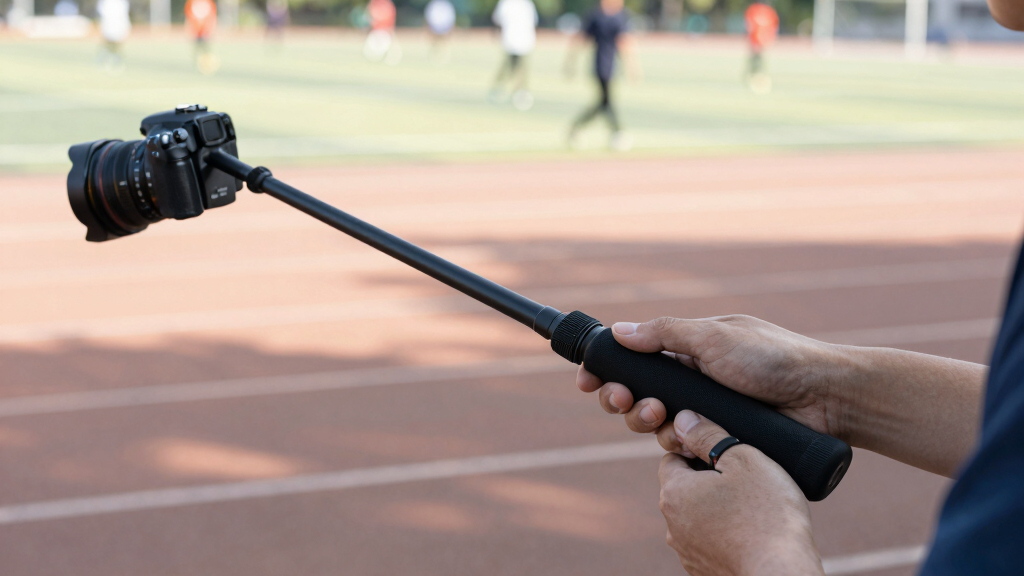
I ranked these monopods around the demands of sideline and trackside photography, where a support must carry a long-lens kit yet move quickly when play changes direction. My main criteria were torsional rigidity, stated load capacity, locking speed, usable height, and the balance between carrying weight and packed length. I gave four-section carbon models an advantage for heavy telephoto work, while compact five-section designs earned credit when their portability served a clear buyer type.
I also weighed foot design and movement control, since a pivoting or fluid base helps smooth panning but can slow relocation and create a larger footprint. Build materials, grip comfort, wrist straps, mounting compatibility, maintenance needs, and price shaped the remaining order. The leading picks offer the fewest compromises for sports, while lower-ranked models remain here for specific budget, travel, height, or hybrid-video needs. Manufacturer-stated specifications informed the comparison, so I recommend matching any load rating against the combined weight of the camera, lens, adapter, and head.
| monopods for sports photography | Material |
|---|---|
| Manfrotto Xpro 5-Section Carbo | Carbon fiber |
| ULANZI TB12 61-Inch Camera Mon | Aluminum alloy |
| Manfrotto Element Aluminum 5-S | Aluminum |
| Manfrotto XPRO Carbon Fiber 4- | Carbon fiber |
| KODAK PhotoGear 72-Inch Portab | Aluminum |
| Manfrotto 290 Carbon Fiber 4-S | Carbon fiber |
| Neewer Professional Camera Mon | Aluminum |
| Altura Photo 62-Inch Camera Mo | Aluminum |
| Manfrotto Element MII 5-Sectio | Aluminum |
Factors to Consider When Choosing Best Monopods For Sports Photography
A sports monopod should match the way a photographer moves, not merely the weight printed on a lens specification sheet. I would start with the complete mounted kit, then compare rigidity, section count, foot design, and working height. The right choice may be a plain four-section carbon monopod for field sports or a footed fluid-base model for repeated panning from one position.
Match Capacity to the Entire Camera Kit
I treat the combined weight of the camera, lens, collar, head, and accessories as the real working load. A published maximum describes what a monopod can hold, but it does not reveal how firmly the leg resists twisting when a long lens changes direction. Heavy telephotos apply leverage well beyond their scale weight, especially when the monopod is extended. I prefer a generous capacity margin rather than choosing a model that barely clears the total. Buyers using compact mirrorless bodies and modest zooms can save money with aluminum, while large-aperture telephotos benefit more from a rigid carbon design. Mounting through the lens collar also creates better balance and faster rotation than attaching a long-lens setup through the camera body.
Choose Four or Five Sections Based on Movement
Section count changes both packed size and shooting behavior. A four-section monopod usually has fewer locks to operate and fewer joints that can flex, which suits photographers who repeatedly relocate along a touchline. Five-section models pack shorter and fit more easily beside other equipment in a travel bag. That convenience comes with another lock and narrower lower tubes, which may feel less planted under a front-heavy lens. I would favor five sections for flights, public transport, and occasional use, but four for regular work with substantial telephoto glass. The common mistake is buying the shortest folded model without accounting for setup speed during live play.
Decide Whether a Footed Base Helps
A monopod with small feet can support smoother pans and steadier framing when a photographer remains in one assigned position. It is especially useful for hybrid coverage that mixes stills with video. The base does not turn a monopod into a hands-free tripod, and leaving a mounted camera unattended remains risky. Feet also take more ground space, collect dirt, and can catch on bags or nearby photographers in a crowded area. A simple rubber foot is quicker to plant, lift, and reposition during unpredictable field action. I would pay for a fluid or pivoting base only when controlled movement outweighs maximum mobility.
Balance Carbon Fiber Against Aluminum
Carbon fiber earns its price through lower carrying weight and better vibration damping, benefits that become clearer during long events or when a large lens stays mounted for hours. Aluminum costs less and can be entirely suitable for school sports, casual motorsports, or lighter mirrorless combinations. The difference matters less when the monopod spends most of an event planted in one location. It matters more when covering multiple fields, climbing grandstands, or carrying several bodies. I would direct budget toward a stronger lens or reliable mounting hardware before buying carbon solely for prestige. Pay extra when the weight reduction solves a repeated problem, not when aluminum already fits the workload.
Check Height, Locks, and Sideline Ergonomics
Maximum height should let the viewfinder reach the eye while the photographer maintains a relaxed stance. Extending a monopod far above that point adds little value and may increase flex. Very tall models help on sloped ground or behind barriers, but a comfortable working height matters more than the largest advertised number. Lock design also affects whether the monopod can be adjusted before a moment passes; large, well-spaced controls are easier to handle with gloves. I look for a secure wrist strap, grippy upper section, and locks that can be checked by touch. Venue rules deserve an advance check because some stadiums restrict monopods, footed supports, or equipment that obstructs walkways, making compactness part of access planning.
Frequently Asked Questions
Is Carbon Fiber Worth Paying More for in Sports Photography?
Carbon fiber makes the strongest case when a photographer carries a heavy telephoto kit for several hours or moves between distant shooting positions. Its lower weight reduces the burden without giving up the stiffness needed for long-lens support. Aluminum remains the better purchase for occasional events, smaller zooms, and buyers working within a firm budget. In this lineup, the Manfrotto XPRO Carbon Fiber 4-Section earns the overall lead, while the Altura and Element MII provide more economical support for lighter equipment. I would choose carbon for frequent use and mobility, not simply because it is the more expensive material.
Should I Buy a Monopod With Feet for Sideline Sports?
Feet make sense when the assignment involves repeated panning from one position, particularly for motorsports or hybrid stills-and-video coverage. The Manfrotto Xpro Video and Neewer designs are better aligned with that job than a plain single-foot model. For football, soccer, or field hockey, a simpler monopod is often quicker to lift when the action changes ends. Small bases also require more awareness around other photographers and do not safely support an unattended camera. I would choose feet for controlled movement and a plain foot for fast relocation.
How Much Load Capacity Does a Sports Monopod Need?
Add the weight of the camera, lens, lens collar, head, and any adapter, then choose a rating comfortably above that figure. The extra margin accounts for the leverage created when a long lens tilts or swings, something a simple weight total cannot fully describe. A model that technically holds the kit may still flex enough to make tracking less comfortable. I would prioritize tube rigidity and joint quality alongside the published capacity. For large telephotos, the XPRO and 290 carbon models are more convincing choices than the lineup’s lighter-duty travel and smartphone-oriented options.
Is a Four-Section Monopod Better Than a Five-Section Model?
Four sections are generally better for a dedicated sports setup because they provide fewer locks, faster deployment, and a firmer lower leg. Five sections reduce folded length, which helps when flying or fitting the monopod inside compact luggage. The tradeoff becomes more noticeable with a heavy, front-biased lens than with a small mirrorless zoom. My ranking places the four-section XPRO ahead of the five-section models for that reason, while the Element MII and ULANZI TB12 remain appealing for portable kits. I would base the choice on how often the monopod travels packed versus how often it supports demanding glass.
Can a Monopod Replace a Tripod at a Sports Event?
A monopod replaces much of a tripod’s weight support while preserving the freedom to follow moving subjects, but it does not provide the same hands-free stability. Even a model with feet requires the photographer to maintain control of the mounted equipment. Tripods remain better for locked-off remote cameras, fixed video angles, and long exposures when venue rules permit them. Monopods are better for live-action positions where space is tight and framing changes quickly. For mixed still and video work, the Manfrotto Xpro Video or Neewer fluid-base model offers a useful middle ground without becoming a true tripod substitute.
Conclusion
For most dedicated sports photographers, I recommend the Manfrotto XPRO Carbon Fiber 4-Section Monopod as the best overall choice because it pairs a rigid long-lens platform with straightforward sideline mobility. The Altura Photo 62-Inch Monopod is my value pick for lighter kits, while the Manfrotto Element MII gives beginners a simple, portable entry point. Buyers seeking premium hybrid performance should choose the Manfrotto Xpro 5-Section Carbon Fiber Video Monopod, especially when smooth panning matters alongside still photography.
For narrower needs, the Neewer Professional Monopod is the more affordable fluid-head and removable-base option, and the Manfrotto 290 Carbon Fiber suits photographers who want a lighter carbon alternative without the XPRO positioning. The ULANZI TB12 fits multipurpose travel kits, the original Manfrotto Element 5-Section works as a compact backup, and the KODAK PhotoGear 72-inch serves buyers prioritizing height, phone compatibility, and a low entry price. My final choice would follow the assignment: XPRO 4-Section for mobile stills, Xpro Video or Neewer for panning, and Altura or Element MII when budget carries more weight than carbon construction.
Halloween Picks
halloween
As an affiliate, we earn on qualifying purchases.