
For most field recordists, I’d start with the Zoom F3: its two XLR inputs and 32-bit float recording make it a strong choice for unpredictable sounds and demanding microphone setups. The TASCAM FR-AV2 stands out for compact work that benefits from timecode, while the Zoom H1 Essential is a simpler pick for lightweight, everyday recording. The main tradeoff is between pocketable convenience and the input control, connections, and workflow features that larger recorders offer. I also weigh how each model handles changing sound levels, external microphones, and location work. Read on for the full breakdown and a guide to choosing the recorder that fits your field setup.

Get audio and creator gear delivered free with Prime
- Fast, free delivery on millions of items
- Prime Video, Amazon Music and more included
- Member-only deals all year
Complete the kit


Key Takeaways
- The Zoom F3 leads for external-mic field work: two XLR inputs and 32-bit float recording favor unpredictable locations, though it lacks the built-in stereo mic convenience of handheld models.
- The TASCAM FR-AV2 serves a different production need: compact recording with dual combo inputs and timecode suits workflows tied to video, while the F3 is a more direct fit for audio-first capture.
- The H1 Essential and H4 Essential are not interchangeable: the H1 Essential favors simple, light recording; the H4 Essential adds more input flexibility for people who need to connect external sources.
- The DR-70D prioritizes multi-input video production: four combo inputs can support more sources than the two-input handheld options, but its form and controls make most sense in a camera-oriented setup.
- The DR-10X is a specialist, not a general-purpose recorder: its XLR-mounted design can suit news gathering and interviews, while recordists needing stereo ambience or several microphone inputs should choose another model.
| TASCAM DR-70D 4-Channel Portable Audio Recorder |  | Best for Multi-Mic Video Shoots | Inputs: 4 XLR/TRS combo inputs | Built-in microphones: 2 | Recording safeguards: Limiter, high-pass filter, and safety recording mode | VIEW LATEST PRICE | See Our Full Breakdown |
| Zoom H1 Essential Recorder |  | Best for Beginners | Microphones: Built-in X/Y microphone pair | Recording: 32-bit float | Format: WAV | VIEW LATEST PRICE | See Our Full Breakdown |
| TASCAM FR-AV2 Compact 32-Bit Float Field Recorder and Timecode Generator |  | Best for Timecode Video Work | Recording: 32-bit float | XLR/TRS inputs: 2 combo inputs | Additional input: 3.5 mm | VIEW LATEST PRICE | See Our Full Breakdown |
| Zoom H4 Essential Handheld Recorder |  | Best Hybrid Handheld | Track count: 4 | Built-in microphones: Stereo microphones | XLR/TRS inputs: 2 | VIEW LATEST PRICE | See Our Full Breakdown |
| Roland R-07 High-Resolution Handheld Audio Recorder |  | Best for Long Recording Sessions | Microphones: Built-in stereo microphones | Formats: MP3 and WAV | Wireless features: Bluetooth control and monitoring | VIEW LATEST PRICE | See Our Full Breakdown |
| Zoom H1 XLR 2-Channel Recorder for Filmmakers, Musicians & Podcasters |  | Best Compact Recorder for External Mics | Recording quality: 32-bit / 96kHz | Inputs: 2 XLR/TRS combo inputs | Additional audio input: 3.5mm stereo input | VIEW LATEST PRICE | See Our Full Breakdown |
| Zoom F3 Professional Field Recorder for Filmmakers & Musicians |  | Best for Demanding Field Recording | Model: F3 | Channels: 2 | Recording format: WAV | VIEW LATEST PRICE | See Our Full Breakdown |
| Zoom H5 Handy Recorder for Filmmakers & Musicians |  | Best All-in-One Multitrack Recorder | Built-in microphones: 19.4mm X/Y stereo microphones | Recording format: WAV | Maximum sampling rate: 192kHz | VIEW LATEST PRICE | See Our Full Breakdown |
| TASCAM XLR Micro Audio Portable Digital Recorder for XLR Microphones, Voice Recorder, Interview and News Gathering, Black (DR-10X) |  | Best Clip-On Recorder for Interviews | Microphone connection: XLR | Recording modes: Mono | Audio formats: WAV, MP3 | VIEW LATEST PRICE | See Our Full Breakdown |
| digital audio recorders for field recording | Weight |
|---|---|
| TASCAM DR-70D 4-Channel Portab | 1.2 lb |
| Zoom H1 Essential Recorder | 92 g |
| TASCAM FR-AV2 Compact 32-Bit F | 9.5 oz |
| Zoom H4 Essential Handheld Rec | — |
| Roland R-07 High-Resolution Ha | 150 g |
| Zoom H1 XLR 2-Channel Recorder | 6.4 ounces |
| Zoom F3 Professional Field Rec | 8.48 ounces |
| Zoom H5 Handy Recorder for Fil | 14.4 ounces |
| TASCAM XLR Micro Audio Portabl | 2.56 ounces |
More Details on Our Top Picks
TASCAM DR-70D 4-Channel Portable Audio Recorder
The TASCAM DR-70D is the strongest fit here when a field recording needs several wired microphones at once. Its four XLR/TRS combo inputs, individual gain controls, and phantom power support give a video crew more routing flexibility than the two-input TASCAM FR-AV2 or Zoom H4 Essential. Built-in stereo microphones also let me capture a reference track without bringing a separate mic. A limiter, high-pass filter, and safety recording mode add useful protection for unpredictable location sound. The tradeoff is a more involved interface: solo recordists who want quick setup may prefer the Zoom H1 Essential. The DR-70D also relies on SD media rather than its listed 1 GB internal storage, and its battery life is not specified, making spare AAs sensible for long shoots.
Pros:- Four XLR/TRS combo inputs support multi-mic field setups.
- Individual gain controls and safety recording mode help manage changing levels.
- Built-in stereo microphones provide a convenient reference or quick ambient recording.
- Limiter and high-pass filter offer practical tools for location sound.
Cons:- The interface may take longer to learn than the Zoom H1 Essential.
- The listed 1 GB internal storage makes SD, SDHC, or SDXC media necessary for extended recording.
- Battery life is not specified, so planning power for long field days is less straightforward.
Best for: Small film crews and field recordists who need to capture several XLR microphones or wireless receivers in one take.
Not ideal for: Solo recordists seeking the smallest, simplest recorder, or crews who need built-in timecode synchronization.
- Inputs:4 XLR/TRS combo inputs
- Built-in microphones:2
- Recording safeguards:Limiter, high-pass filter, and safety recording mode
- Supported media:SD, SDHC, and SDXC up to 128 GB
- Battery:4 AA batteries
- Weight:1.2 lb
- Internal storage listed:1 GB
Our verdict“Choose the DR-70D when your field setup needs four wired inputs more than a beginner-friendly interface or built-in timecode.”
Zoom H1 Essential Recorder
The Zoom H1 Essential keeps field recording approachable: its built-in X/Y microphones, compact 92 g body, and spoken menu guidance suit someone who wants to start recording without assembling a larger rig. Its 32-bit float recording offers more room to handle changing levels than a basic fixed-level workflow, while USB-C lets it serve as a microphone for a computer or compatible setup. Compared with the four-input TASCAM DR-70D, the H1 Essential is far easier to carry and set up, but it cannot accommodate the same multi-mic production. It also lacks the TASCAM FR-AV2’s timecode tools and professional XLR inputs. The listed 1 TB storage capacity should be checked against the intended media setup; the supplied details do not specify a card format. Two AAA batteries are another practical limit for extended outings.
Pros:- Spoken menu guidance helps new users operate the recorder.
- 32-bit float recording provides latitude for changing sound levels.
- Built-in X/Y microphones capture stereo sound without extra gear.
- USB-C supports use as a microphone with compatible devices.
Cons:- No XLR inputs for professional microphones or wireless receiver outputs.
- Two AAA batteries may need replacing during longer field sessions.
- The supplied specifications do not identify a recording media format for the listed storage capacity.
Best for: First-time field recordists, students, and solo creators who want a lightweight stereo recorder with guided operation.
Not ideal for: Film crews needing XLR microphone inputs, timecode synchronization, or several isolated recording channels.
- Microphones:Built-in X/Y microphone pair
- Recording:32-bit float
- Format:WAV
- USB interface:USB-C
- Headphone jack:3.5 mm
- Power:2 AAA batteries
- Weight:92 g
- Dimensions:5.38 × 2.12 × 1.14 in
Our verdict“Pick the H1 Essential for simple, portable stereo capture, but choose the DR-70D or FR-AV2 if your field kit needs professional inputs.”
TASCAM FR-AV2 Compact 32-Bit Float Field Recorder and Timecode Generator
The TASCAM FR-AV2 stands apart for field crews who need timecode generation and synchronization alongside location audio. Its dual XLR/TRS inputs and 32-bit float recording make it a more video-focused choice than the Zoom H1 Essential, which is built around a simple stereo microphone setup. Compared with the four-input TASCAM DR-70D, the FR-AV2 offers fewer wired channels but adds timecode and a notably compact 9.5-ounce body. That tradeoff makes sense when syncing sound to cameras matters more than recording several microphones independently. It records at 48, 96, or 192 kHz and adds a 3.5 mm input. Wireless monitoring requires the optional AK-BT2 adapter, so it is not the best pick for buyers who expect Bluetooth monitoring straight out of the box.
Pros:- Built-in timecode supports synchronization with video equipment.
- 32-bit float recording helps accommodate changing field levels.
- Dual XLR/TRS inputs provide connections for professional microphones and line sources.
- Compact 9.5-ounce design is easier to carry than the DR-70D.
Cons:- Two XLR/TRS inputs offer fewer simultaneous wired channels than the DR-70D.
- Bluetooth monitoring requires the separately specified AK-BT2 adapter.
- Requires three AA batteries, adding consumables to a portable kit.
Best for: Videographers and location-sound operators who need a compact recorder with timecode to sync audio and camera footage.
Not ideal for: Crews needing four or more XLR microphone inputs, or buyers who require built-in Bluetooth monitoring without an accessory.
- Recording:32-bit float
- XLR/TRS inputs:2 combo inputs
- Additional input:3.5 mm
- Sample rates:48, 96, and 192 kHz
- Timecode:Input/output, generation, and sync
- Wireless monitoring:Optional AK-BT2 Bluetooth adapter
- Power:3 AA batteries
- Weight:9.5 oz
- Dimensions:3.9 × 3.15 × 1.57 in
Our verdict“Choose the FR-AV2 when timecode and compact XLR recording matter more than the DR-70D’s extra inputs.”
Zoom H4 Essential Handheld Recorder
The Zoom H4 Essential is a flexible middle ground for field recordists who want built-in stereo capture and the option to plug in external microphones or instruments. Its four-track recording and two XLR/TRS inputs give it more expansion than the Zoom H1 Essential, while its handheld design avoids the larger, more multi-input focus of the TASCAM DR-70D. That makes the H4 a practical choice for musicians recording outdoors, interviewers adding external mics, or filmmakers who want one device for ambient sound and a pair of wired sources. USB-C connection and recording to an SD card or device add useful workflow options. The available specs do not list 32-bit float or timecode, so buyers who need those specific protections or camera-sync features should compare the TASCAM FR-AV2. Its four-track setup may also take more learning than the H1 Essential.
Pros:- Four-track recording supports more flexible field arrangements than a basic stereo recorder.
- Two XLR/TRS inputs accommodate external microphones and other sources.
- Built-in stereo microphones allow quick ambient recording without extra equipment.
- USB-C supports connection to compatible devices for recording or streaming.
Cons:- The four-track feature set may be harder for beginners to manage than the Zoom H1 Essential.
- Two XLR/TRS inputs provide fewer wired channels than the TASCAM DR-70D.
- The supplied specifications do not list 32-bit float recording or timecode.
Best for: Musicians, interviewers, and independent filmmakers who want built-in stereo microphones plus two external XLR/TRS inputs.
Not ideal for: New users seeking the simplest recorder, or video crews that require built-in timecode or four XLR inputs.
- Track count:4
- Built-in microphones:Stereo microphones
- XLR/TRS inputs:2
- Other input options:External microphones, instruments, and mixer connection
- USB connection:USB-C
- Recording media:SD card and device storage
Our verdict“Choose the H4 Essential if you want one handheld recorder for stereo ambience and two external sources without needing timecode.”
Roland R-07 High-Resolution Handheld Audio Recorder
The Roland R-07 is a compact choice for field recordists who value long battery life and wireless control over XLR expansion. Its integrated stereo microphones, Bluetooth control and monitoring, and listed 30-hour battery average make it appealing for unattended ambience capture or long walks where frequent battery changes are unwelcome. Compared with the Zoom H1 Essential, the R-07 offers Bluetooth features and a stated battery-life figure, while the H1 Essential adds 32-bit float recording and spoken menu guidance. Neither replaces the dual-XLR TASCAM FR-AV2 for professional mic connections or timecode work. The R-07 records MP3 and WAV, but its listed 32 GB storage capacity and lack of stated rugged or weather protection limit its appeal for remote, exposed locations. Its controls may also take some getting used to.
Pros:- Listed 30-hour average battery life suits extended field sessions.
- Bluetooth supports wireless control and monitoring.
- Built-in stereo microphones keep the recording setup compact.
- MP3 and WAV recording offer format choices for different workflows.
Cons:- No XLR inputs for direct connection of professional microphones.
- Listed 32 GB storage may require additional microSD media for longer sessions.
- No waterproofing or rugged protection is specified.
Best for: Ambient sound recordists and solo creators who want a compact stereo recorder with Bluetooth control and extended battery runtime.
Not ideal for: Field crews working with XLR microphones, needing 32-bit float recording, or recording in wet or rough conditions without protective gear.
- Microphones:Built-in stereo microphones
- Formats:MP3 and WAV
- Wireless features:Bluetooth control and monitoring
- Headphone jack:3.5 mm
- Battery:2 AA batteries
- Listed average battery life:30 hours
- Listed storage capacity:32 GB
- Weight:150 g
- Dimensions:1.02 × 2.4 × 4.06 in
Our verdict“Pick the R-07 for long, wireless stereo recording sessions, but choose the FR-AV2 if your field work needs XLR inputs or timecode.”
Zoom H1 XLR 2-Channel Recorder for Filmmakers, Musicians & Podcasters
The Zoom H1 XLR makes the most sense when a small recorder needs to take feeds from external microphones rather than supply its own. Its two XLR/TRS combo inputs and 32-bit float recording at up to 96kHz suit location interviews, camera audio, and music capture where unpredictable levels can be hard to manage. At 6.4 ounces, it is easier to carry than the four-AA Zoom H5, though the H5 adds built-in X/Y microphones and up to six tracks for a more self-contained setup. The H1 XLR’s tradeoff is that it has no built-in microphone and records only mono or stereo, so it is not a grab-and-record ambience tool. Its waveform OLED and 1TB SDXC support are useful, but field users must plan for AA battery changes.
Pros:- Two XLR/TRS inputs accommodate professional microphones and line-level sources.
- 32-bit float recording helps manage sudden changes in sound level.
- Compact 6.4-ounce body is easy to carry in a small field kit.
- Supports SDXC cards up to 1TB for long recording sessions.
Cons:- No built-in microphones, so recording requires an external mic or source.
- Limited to mono and stereo modes rather than multitrack capture.
- Runs on two AA batteries, requiring spare cells for longer outings.
Best for: Field videographers and interview recordists who already own XLR microphones and want a lightweight two-input recorder with 32-bit float capture.
Not ideal for: Solo ambience recordists or travelers who need built-in microphones, multitrack recording, or a recorder that does not rely on AA batteries.
- Recording quality:32-bit / 96kHz
- Inputs:2 XLR/TRS combo inputs
- Additional audio input:3.5mm stereo input
- Display:OLED waveform display
- Supported storage:SDXC up to 1TB
- Battery life:Up to 10 hours
- Battery type:2 AA batteries
- Weight:6.4 ounces
Our verdict“Choose the H1 XLR for compact, two-input field recording with external microphones; pick the Zoom H5 if built-in mics and additional tracks matter more.”
Zoom F3 Professional Field Recorder for Filmmakers & Musicians
For field work where input reliability and clean preamps matter more than built-in microphones, the Zoom F3 is the strongest specialist pick here. Its dual locking XLR inputs help keep cables secure in a moving production rig, while 32-bit float recording and ultra-low-noise preamps address two common location problems: sudden peaks and quiet sources. Compared with the more handheld Zoom H5, the F3 is a focused two-channel recorder rather than an all-in-one unit with onboard stereo mics and six-track capacity. That makes it a better fit for externally miked dialogue or effects, but less convenient for quickly capturing ambient sound on its own. It weighs 8.48 ounces and uses two AA batteries; the listed storage capacity is 512GB, and file transfer lacks built-in Wi-Fi or Bluetooth.
Pros:- 32-bit float recording accommodates wide, unpredictable changes in level.
- Locking XLR inputs help prevent accidental cable disconnects in field rigs.
- Ultra-low-noise preamps support clean recording of quieter sources.
- Compact body weighs 8.48 ounces.
Cons:- No built-in microphones, so it needs external mics or another audio source.
- Two-channel design offers less track capacity than the Zoom H5.
- Requires two AA batteries and does not include built-in wireless file transfer.
Best for: Film sound recordists and location musicians using external XLR microphones who need secure connections and clean two-channel capture in unpredictable conditions.
Not ideal for: Beginners seeking a self-contained handheld recorder, or crews who need built-in microphones, multitrack recording, or wireless file transfer.
- Model:F3
- Channels:2
- Recording format:WAV
- Recording:32-bit float
- Inputs:2 XLR/TRS
- Storage capacity:512GB
- Battery:2 AA batteries required
- Weight:8.48 ounces
Our verdict“Choose the F3 when secure XLR connections and clean two-channel capture matter more than onboard microphones or extra tracks.”
Zoom H5 Handy Recorder for Filmmakers & Musicians
The Zoom H5 is the most flexible choice in this group for recordists who want to capture sound immediately and still have room to expand a session. Its 19.4mm X/Y stereo microphones make it more self-contained than the H1 XLR or F3, both of which rely on external microphones, while its two XLR/TRS inputs and six-track capacity suit layered location work. The listed maximum sampling rate reaches 192kHz, and the recorder also offers a headphone jack and USB audio-interface use. That versatility comes with more setup complexity and a 14.4-ounce weight; the F3 is lighter and more purpose-built when two external channels are enough. Four AA batteries are another practical cost for long days away from power, so this is not the smallest carry option.
Pros:- Built-in X/Y stereo microphones allow quick recording without external gear.
- Two XLR/TRS inputs add options for external microphones and sources.
- Up to six tracks support layered field recordings and production workflows.
- USB audio-interface capability adds use beyond standalone recording.
Cons:- At 14.4 ounces, it is heavier than the H1 XLR and Zoom F3.
- Four AA batteries add weight and require more spares for extended sessions.
- Its broader feature set may take more setup than a simple two-channel recorder.
Best for: Field musicians, documentary crews, and sound collectors who want onboard stereo microphones, external inputs, and multitrack flexibility in one recorder.
Not ideal for: Minimalist travelers or first-time recordists who want the lightest, simplest device and do not need multitrack recording.
- Built-in microphones:19.4mm X/Y stereo microphones
- Recording format:WAV
- Maximum sampling rate:192kHz
- Tracks:Up to 6
- Inputs:2 XLR/TRS
- Recording:32-bit float
- Battery type:4 AA batteries
- Weight:14.4 ounces
Our verdict“Choose the H5 if onboard stereo mics and multitrack flexibility justify carrying a larger recorder and managing four AA batteries.”
TASCAM XLR Micro Audio Portable Digital Recorder for XLR Microphones, Voice Recorder, Interview and News Gathering, Black (DR-10X)
The TASCAM DR-10X takes a different approach from the handheld Zoom models: it connects directly to an XLR microphone, creating a compact recording setup for interviews, news gathering, and run-and-gun dialogue. At 2.56 ounces, it is far lighter than the H5 and avoids the cables and separate recorder placement a conventional field rig may require. Manual and automatic gain control, plus dual recording modes, offer a backup-minded workflow, while WAV and MP3 support provide a choice between higher-quality files and smaller recordings. Its mono-only operation is the key limitation: it cannot match the stereo ambience capture of the H5 or the two-input flexibility of the H1 XLR and F3. It also depends on a microSD card for recording and uses a small display, making it a focused mic-mounted tool rather than a general field recorder.
Pros:- Very light 2.56-ounce body connects directly to an XLR microphone.
- Manual and automatic gain control support different recording situations.
- Dual recording modes provide a backup option against distorted peaks.
- Records in WAV or MP3, with up to 120 hours listed on a 32GB microSD card.
Cons:- Mono-only recording is unsuitable for stereo ambience or multi-mic capture.
- Requires a microSD card for extended recording.
- Its 0.75-inch screen offers less at-a-glance information than larger recorder displays.
Best for: Reporters and interview recordists who want a tiny recorder attached directly to an XLR microphone for single-person dialogue capture.
Not ideal for: Soundscape collectors, stereo music recordists, or crews needing multiple inputs and the flexible external-mic routing of the Zoom H1 XLR.
- Microphone connection:XLR
- Recording modes:Mono
- Audio formats:WAV, MP3
- Gain control:Manual and automatic
- Headphone jack:3.5mm
- Storage capacity:32GB
- Recording time:Up to 120 hours on a 32GB microSD card
- Weight:2.56 ounces
Our verdict“Choose the DR-10X for lightweight, single-microphone interview capture, not for stereo field recordings or multi-input productions.”
How We Picked
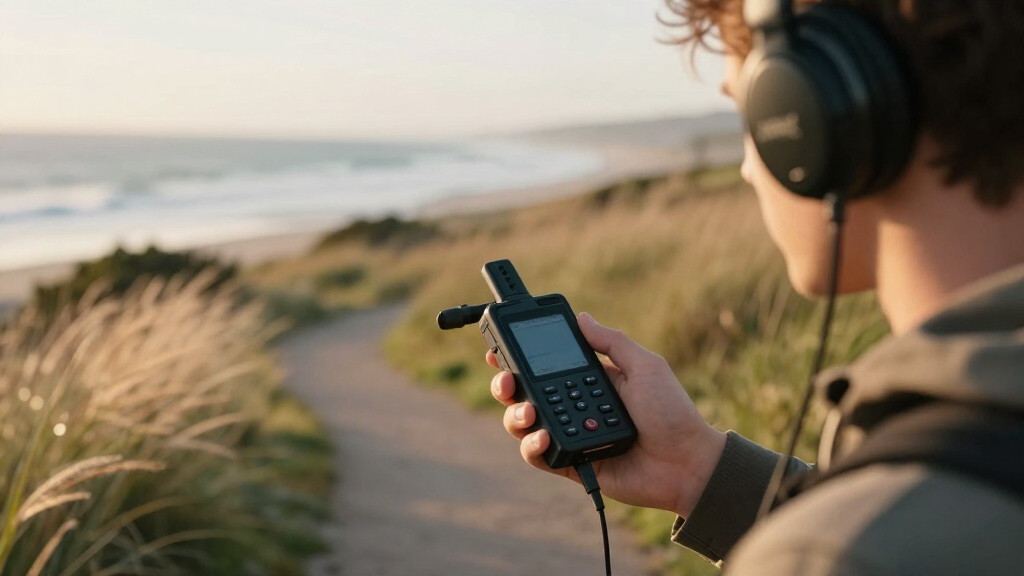
I ranked these recorders for field recording rather than studio use, focusing on the tasks buyers are likely to face outdoors or on location: capturing ambience and effects, recording interviews, and feeding one or more external microphones. I compared each model’s input options, built-in microphone utility, recording format features, portability, and the amount of control it offers when conditions change. A capability only counted as an advantage when it served a clear field workflow; for example, timecode matters more to video crews than to someone collecting natural sound.
The order reflects versatility for common field jobs first, then specialization, ease of use, and the compromises each design imposes. Models with more connections or production features rank well when those features solve real location problems, but extra complexity does not automatically make a recorder better. Compact and focused devices remain strong choices for the right user, while options with narrower roles rank lower for buyers seeking one recorder for many kinds of field work.
Factors to Consider When Choosing Digital Audio Recorders For Field Recording
Before choosing a model, I’d map the recorder to the sound source, microphone, and production workflow—not just the location. A quiet nature recording, a street interview, and a multi-mic film scene place different demands on inputs, monitoring, and file handling. These broader checks can help prevent buying extra features you won’t use or discovering that a compact recorder cannot connect to your planned microphone.
Match Inputs to the Microphones You Own
Count the microphones and other sources you expect to record at the same time, then check the recorder’s connectors and input types. A built-in stereo pair can be enough for ambience, but it does not replace XLR inputs when your field microphones require them. Also check how many inputs can record independently; a recorder with several sockets may still have limits on simultaneous tracks or routing. A common mistake is to buy around a future microphone setup without checking the connections and power needs of that gear. If you only record one source, carrying extra inputs adds bulk without improving the capture.
Understand What 32-Bit Float Can and Cannot Do
32-bit float recording can give more room to recover level changes in post, which is useful when loudness is difficult to predict. It does not remove microphone self-noise, wind, handling noise, or poor placement, and it cannot restore detail that the microphone never captured. Traditional formats can work well when gain is set carefully and levels are monitored. Think about the sound source: sudden, irregular events favor extra level flexibility, while a controlled interview may benefit more from reliable monitoring and a practiced setup. Do not treat a recording format as a substitute for wind protection and good mic positioning.
Decide Whether Timecode Belongs in Your Workflow
Timecode can make it easier to align recorder audio with camera footage, especially across longer shoots or multiple devices. For solo sound-effects work, interviews that will be edited by ear, or standalone recordings, it may add little value. Check how the recorder fits the rest of the production chain, including camera support and the editor’s sync process, before paying attention to timecode features. A recorder designed for camera mounting or video crews can also bring useful connection choices, but may be less comfortable for handheld walking recordings. Choose timecode because your workflow uses it, not because it sounds like a general upgrade.
Balance Portability Against Hands-On Control
A smaller recorder is easier to carry and deploy quickly, but compact controls can be harder to operate when wearing gloves or working in poor light. Larger bodies may provide more direct access to input, monitoring, and transport controls, along with room for more connections. Consider where the recorder will sit: in a pocket, on a camera rig, on a tripod, or in a bag connected to a microphone. Handling noise and cable strain can matter as much as body size when recording while moving. If you expect long sessions, check how the device’s layout supports monitoring and adjustment without interrupting the take.
Plan for Power, Storage, and File Management
Field reliability depends on more than the recorder: batteries, memory cards, cables, and a safe way to back up files all shape a workable kit. Check the battery format and expected runtime against the length of your outings, especially if you record in remote locations. High-quality or multichannel recording can create more data, so confirm that your cards and file-transfer routine can keep pace. Bring spare power and storage rather than assuming a short test session reflects a full day in the field. A simple, repeatable file-naming and backup habit can save more time than a feature you rarely use.
Choose the Right Form for the Recording Job
Handheld recorders with built-in microphones suit quick ambience, reference tracks, and grab-and-go recording, while XLR-focused units make more sense when microphone choice is central. Camera-oriented recorders can help with multi-source production, whereas an XLR-mounted design is tailored to a narrower interview or news workflow. Before buying, decide whether you need stereo capture, separate mic feeds, or a single direct connection. Buying a specialist can reduce setup friction when its role matches your work, but it can become an awkward general recorder if your projects vary. The best fit is the one that can be placed and operated properly for your regular sound sources.
Frequently Asked Questions
Is a 32-bit float recorder necessary for field recording?
No; it is most useful when sound levels may change sharply and you cannot adjust gain easily during a take. It can make level recovery more forgiving, but it does not fix noisy microphones, clipped analog stages, wind, or poor placement. For planned interviews or steady ambience, a recorder without 32-bit float can still capture clean results when levels are set and monitored well. I’d prioritize the feature when recording unpredictable events or working alone, rather than treating it as a requirement for every field kit.
Should I choose a recorder with built-in microphones or XLR inputs?
Choose built-in microphones when speed, low weight, and recording stereo ambience matter more than selecting a separate microphone. XLR inputs are the better fit when you already own external mics, need a particular pickup pattern, or want to record separate sources. Some field workflows benefit from both, but adding connection flexibility can mean a larger body and more setup. Start with the microphone you expect to use most often, then confirm the recorder supports its connector and power requirements.
Do I need timecode to record audio for video?
Not always. Timecode can simplify syncing when a shoot uses several cameras or recording devices, but a small project may be handled through a conventional sync workflow. Ask how the editor will match sound and picture, and whether the camera or production system can use the recorder’s timecode features. If the answer is no, those features may add complexity without solving a current problem. For audio-only field work, prioritize suitable microphones, monitoring, and reliable file handling instead.
Can one recorder handle interviews and nature sound?
It can, but the microphone and input requirements may differ more than the recorder itself. Interviews often call for an external mic, clear input control, and straightforward monitoring; nature recording may favor quiet operation, stereo capture, and a way to protect the microphones from wind. A handheld recorder with built-in mics is convenient for quick ambience, while an XLR model offers more freedom to choose microphones. If both jobs are regular, check that the recorder supports your interview setup without making spontaneous stereo recording cumbersome.
Is a four-input recorder worth carrying if I usually record one or two sources?
Only if you expect to need the extra channels for simultaneous microphones, separate feeds, or a camera-focused production. More inputs can reduce the need to swap connections during a complex take, but they can also add size and make a simple recording session less convenient. For one or two sources, a compact dual-input model may be easier to place and operate. Consider the largest setup you genuinely expect to record, not every setup you might someday try.
Conclusion
For the broadest fit across external-mic field jobs, I recommend the Zoom F3 as best overall; it pairs dual XLR inputs with 32-bit float capture, though buyers wanting built-in microphones should look elsewhere. The Zoom H1 Essential is my best value-style pick for simple, portable recording, while the TASCAM FR-AV2 is the premium workflow choice for compact video work that benefits from timecode. Beginners who want a straightforward handheld starting point should compare the H1 Essential with the Zoom H4 Essential if external inputs are part of the plan. For camera crews needing more simultaneous connections, the TASCAM DR-70D has a clearer role; for XLR-mounted interview or news capture, choose the TASCAM DR-10X. Match the recorder to your microphones and recording routine, and the right pick should be clear.
Halloween Picks
halloween
As an affiliate, we earn on qualifying purchases.