Choosing the right compact studio monitor speakers requires balancing acoustic accuracy with limited desk space. The Yamaha HS4 stands out as the best overall choice for its neutral response and professional pedigree, while the IK Multimedia iLoud Micro Monitor offers unmatched portability for hybrid producers. Many buyers struggle to distinguish between true studio accuracy and consumer-grade enhancement, often overpaying for features they do not need. This guide breaks down the technical differences and real-world applications for twelve leading models. Continue reading to find the specific pair that fits your mixing workflow and budget.

Get audio and creator gear delivered free with Prime
- Fast, free delivery on millions of items
- Prime Video, Amazon Music and more included
- Member-only deals all year
Complete the kit


Key Takeaways
- The Yamaha HS4 delivers the most accurate midrange reproduction, making it ideal for critical listening despite its higher price point.
- IK Multimedia iLoud models prove that small size does not compromise low-end extension, offering surprisingly deep bass response without a subwoofer.
- Entry-level options like the Mackie CR3.5 prioritize flat response over power, making them suitable for quiet environments but less effective in noisy rooms.
- Bluetooth connectivity on models like the Edifier MR3 introduces latency and compression artifacts, so wired connections remain the standard for production work.
- Bi-amped designs such as the Edifier MR4.5 provide better dynamic headroom and clarity compared to single-amp designs in the same size class.
| Ortizan C7 Powered Studio Monitor Speakers, Pair, Black |  | Best for Flexible Connectivity | Speaker type: Powered studio monitor | Quantity: Pair | Drivers: 3.5-inch carbon fiber mid-bass; 0.75-inch silk dome tweeter | VIEW LATEST PRICE | See Our Full Breakdown |
| PreSonus Eris E4.5 4.5-Inch Two-Way Nearfield Studio Monitors, Pair |  | Best for Room-Tunable Desktop Monitoring | Speaker type: Nearfield studio monitor | Included speakers: Pair | Woofer and tweeter: 4.5-inch woven-composite woofer; 1-inch silk-dome tweeter | VIEW LATEST PRICE | See Our Full Breakdown |
| Edifier MR3 Powered Studio Monitor Speakers, Bluetooth 5.4, White |  | Best for App-Based Sound Shaping | Speaker configuration: 2.0 stereo | RMS output power: 18 W × 2 | Frequency response: 52 Hz–40 kHz | VIEW LATEST PRICE | See Our Full Breakdown |
| IK Multimedia iLoud Micro Monitor Portable Bluetooth Studio Reference Monitors |  | Best Ultra-Compact Reference Pair | Power output: 50W RMS total | Frequency response: Bass response down to 55 Hz (-3 dB) | Drivers: 3-inch composite woofer; 3/4-inch silk-dome tweeter | VIEW LATEST PRICE | See Our Full Breakdown |
| Mackie CR3.5 Powered Studio Monitors, Pair, 3.5-Inch Woofers | 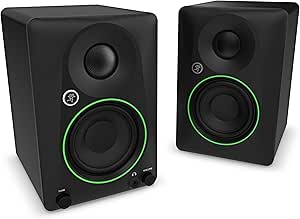 | Best for Flexible Desk or Bookshelf Placement | Quantity: Pair | Woofer and tweeter: 3.5-inch woofer; 1-inch tweeter | Maximum output power: 50 watts | VIEW LATEST PRICE | See Our Full Breakdown |
| M-Audio BX3 3.5-Inch Wired Studio Monitors |  | Best Value for Desktop Workstations | Total Power: 120W | Woofer Material: Kevlar | Woofer Size: 3.5 inches | VIEW LATEST PRICE | See Our Full Breakdown |
| PreSonus Eris 3.5 Powered Desktop Studio Monitors |  | Best for Small Spaces and Aesthetics | Total Power: 50W | Frequency Range: 80 Hz – 20 kHz | Woofer Size: 3.5 inches | VIEW LATEST PRICE | See Our Full Breakdown |
| Edifier MR4 Active Near-Field Studio Monitor Speakers |  | Best Balanced Response for Beginners | Total Power: 42W | Woofer Size: 4 inches | Tweeter Material: Silk Dome | VIEW LATEST PRICE | See Our Full Breakdown |
| Yamaha HS4 Powered Studio Monitors |  | Best for Critical Listening and Accuracy | Frequency Response: 60 Hz – 22 kHz | Max Power: 26W | Woofer Size: 4.5 inches | VIEW LATEST PRICE | See Our Full Breakdown |
| Edifier MR4.5 80W RMS Bi-Amped Studio Monitors |  | Best Premium Feature Set | Total Power: 80W RMS | Frequency Response: 50 Hz – 40 kHz | Wireless: Bluetooth 6.0 (LDAC) | VIEW LATEST PRICE | See Our Full Breakdown |
| Edifier MR3 Powered Studio Monitor Speakers with Bluetooth |  | Best for Hybrid Listening | Frequency Response: 52Hz – 40kHz | RMS Output Power: 18W per speaker | Connectivity: Bluetooth 5.4, Balanced TRS, RCA, AUX | VIEW LATEST PRICE | See Our Full Breakdown |
| PreSonus Eris 3.5 Powered Studio Monitors, Stereo Pair |  | Best for Tight Workspaces | Frequency Response: 80 Hz – 20 kHz | Total Amplification: 50 watts | Woofer Diameter: 3.5 inches | VIEW LATEST PRICE | See Our Full Breakdown |
| compact studio monitor speaker | Dimensions | Frequency response |
|---|---|---|
| Ortizan C7 Powered Studio Moni | 5.11 × 5.9 × 7.67 inches (D × W × H) | — |
| PreSonus Eris E4.5 4.5-Inch Tw | — | — |
| Edifier MR3 Powered Studio Mon | — | 52 Hz–40 kHz |
| IK Multimedia iLoud Micro Moni | 5.31 × 3.54 × 7.09 inches | Bass response down to 55 Hz (-3 dB) |
| Mackie CR3.5 Powered Studio Mo | 7.1 × 5.5 × 8.1 inches | — |
| M-Audio BX3 3.5-Inch Wired Stu | — | — |
| PreSonus Eris 3.5 Powered Desk | 6 × 5.5 × 8.3 inches | — |
| Edifier MR4 Active Near-Field | — | — |
| Yamaha HS4 Powered Studio Moni | — | 60 Hz – 22 kHz |
| Edifier MR4.5 80W RMS Bi-Amped | — | 50 Hz – 40 kHz |
| Edifier MR3 Powered Studio Mon | 6.9 × 12.1 × 16.2 inches | 52Hz – 40kHz |
| PreSonus Eris 3.5 Powered Stud | 5.5 × 6 × 8.3 inches | 80 Hz – 20 kHz |
More Details on Our Top Picks
Ortizan C7 Powered Studio Monitor Speakers, Pair, Black
The Ortizan C7 suits a compact desk where a computer, console, or other source may need to share the speakers. Its USB input and built-in 24-bit DAC allow a direct digital connection, while balanced TRS, RCA, AUX, and Bluetooth 5.3 cover a broad mix of gear. Compared with the PreSonus Eris E4.5, the C7 has smaller 3.5-inch mid-bass drivers but adds USB and wireless playback; the Eris offers larger woofers and room-tuning controls instead. The C7’s front headphone output is handy for switching to private listening without rearranging a desk. Its small drivers make deep bass a limitation, so buyers mixing bass-heavy material may want a subwoofer or larger monitors. It also needs a corded power connection.
Pros:- USB input with a built-in 24-bit DAC supports direct digital audio from a computer.
- Balanced TRS, RCA, AUX, and Bluetooth 5.3 accommodate varied sources.
- Front-panel headphone output makes private listening convenient.
- Two-way drivers are designed for balanced playback across monitoring and everyday use.
Cons:- The 3.5-inch mid-bass drivers offer less low-frequency output than the Eris E4.5’s 4.5-inch woofers.
- Requires corded power, so it is not a cordless portable speaker.
Best for: Desktop users who want one compact speaker pair for USB audio, balanced studio gear, Bluetooth playback, and headphone listening.
Not ideal for: Producers who need strong low-frequency monitoring or a larger driver for bass-heavy mixes; the 3.5-inch mid-bass drivers have limited bass reach.
- Speaker type:Powered studio monitor
- Quantity:Pair
- Drivers:3.5-inch carbon fiber mid-bass; 0.75-inch silk dome tweeter
- Audio inputs:USB, RCA, 3.5 mm AUX, 6.35 mm balanced TRS
- Bluetooth:Version 5.3
- DAC:Built-in 24-bit
- Headphone output:Yes
- Dimensions:5.11 × 5.9 × 7.67 inches (D × W × H)
Our verdict“Choose the Ortizan C7 if connection flexibility and USB audio matter more than the deeper bass potential of a larger monitor.”
PreSonus Eris E4.5 4.5-Inch Two-Way Nearfield Studio Monitors, Pair
The PreSonus Eris E4.5 is the pick for listeners who want a larger woofer and simple controls for adapting sound to a desk or room. Its 4.5-inch woven-composite woofers give it more potential for low-mid weight than the 3.5-inch drivers in the Ortizan C7 or Mackie CR3.5, while adjustable high- and low-frequency controls let users compensate for a bright or bass-heavy setup. Balanced TRS and RCA inputs cover studio and consumer sources, and a front auxiliary input plus headphone output keep everyday connections close at hand. Unlike the C7, it has no specified Bluetooth or USB audio, so it is less convenient for wireless playback or direct digital connection. Its bass still may not satisfy mixes that demand strong sub-bass.
Pros:- 4.5-inch woofers offer more low-mid potential than the smaller drivers in the Ortizan C7 and Mackie CR3.5.
- High- and low-frequency controls help tailor playback to the room.
- Balanced TRS, RCA, and front auxiliary inputs support multiple wired sources.
- Front headphone output includes a built-in amplifier.
Cons:- No wireless connectivity is specified, unlike the Ortizan C7 and Edifier MR3.
- The woofers may still need a separate subwoofer for stronger low-frequency output.
Best for: Home producers and desktop listeners who want a compact pair with larger woofers, wired source options, and basic room-shaping controls.
Not ideal for: Buyers who want Bluetooth, USB audio, or deep bass from a small monitor pair without adding a subwoofer.
- Speaker type:Nearfield studio monitor
- Included speakers:Pair
- Woofer and tweeter:4.5-inch woven-composite woofer; 1-inch silk-dome tweeter
- Amplifier:50W Class AB total (25W per side)
- Inputs:Balanced 1/4-inch TRS, RCA, front-panel 1/8-inch stereo auxiliary
- Controls:Front-panel volume; high- and low-frequency tuning
- Headphone output:Front-panel output with built-in amplifier
- Enclosure material:Medium-density fiberboard
Our verdict“Pick the Eris E4.5 if you prioritize larger drivers and adjustable wired monitoring over wireless features and compact cabinet size.”
Edifier MR3 Powered Studio Monitor Speakers, Bluetooth 5.4, White
The Edifier MR3 gives compact-monitor buyers more ways to change the sound without relying only on placement. Its Music, Monitor, and Custom modes, along with app-based EQ, make it easier to move between analytical work and casual listening than on the Ortizan C7, whose appeal leans more toward connection variety and a built-in USB DAC. The MR3 adds balanced TRS, RCA, AUX, and multipoint Bluetooth 5.4, so it can serve a desktop setup with both studio and everyday sources. Its 3.5-inch drivers and stated 52 Hz lower frequency limit keep the cabinets compact, but they cannot match the larger woofer area of the PreSonus Eris E4.5. This is a useful compromise for flexible listening, not a substitute for a dedicated sub-bass reference.
Pros:- Monitor, Music, and Custom modes suit both production and casual playback.
- EDIFIER ConneX app provides additional EQ adjustment.
- Balanced TRS, RCA, AUX, and multipoint Bluetooth 5.4 offer flexible source connections.
- MDF cabinets are designed to reduce distortion.
Cons:- The 3.5-inch mid-low drivers provide less bass potential than the Eris E4.5’s 4.5-inch woofers.
- USB audio is not listed, unlike on the Ortizan C7.
- Corded power limits use away from an outlet.
Best for: Desktop producers and listeners who want compact speakers with app-based EQ, multiple sound modes, and both wired and Bluetooth connections.
Not ideal for: Buyers who need larger woofers for more low-frequency headroom or want a USB DAC input; neither is specified here.
- Speaker configuration:2.0 stereo
- RMS output power:18 W × 2
- Frequency response:52 Hz–40 kHz
- Drivers:3.5-inch mid-low drivers; 1-inch tweeters
- Connectivity:Bluetooth 5.4, balanced TRS, RCA, AUX
- Sound controls:Music, Monitor, and Custom modes; app-based EQ
- Headphone output:Yes
- Cabinet material:MDF
Our verdict“Choose the MR3 if app-controlled sound modes and Bluetooth matter more than larger drivers or a USB audio input.”
IK Multimedia iLoud Micro Monitor Portable Bluetooth Studio Reference Monitors
For a crowded desk or a setup that must pack away, the IK Multimedia iLoud Micro Monitor puts compact size ahead of broad connectivity. Its cabinets measure just 5.31 × 3.54 × 7.09 inches, and the pair weighs 3.8 pounds, making it easier to place or move than the larger PreSonus Eris E4.5. DSP-based EQ and position compensation help tailor playback to where the speakers sit, while the stated bass response down to 55 Hz (-3 dB) is notable for this small format. The tradeoff is a limited input selection: Bluetooth, RCA, and 1/8-inch AUX, with no balanced TRS or USB listed. The Ortizan C7 and Edifier MR3 offer more connection options, while the iLoud is the more focused choice when desk space is the main constraint.
Pros:- Compact, lightweight cabinets suit tight desks and setups that need to be moved.
- DSP includes EQ and position compensation for placement adjustments.
- Stated bass response reaches down to 55 Hz (-3 dB) for this small format.
- Bluetooth, RCA, and auxiliary inputs cover common listening sources.
Cons:- No balanced TRS or USB input is specified, unlike the Ortizan C7 and Edifier MR3.
- Requires corded power despite its portable form factor.
- Optional travel bag is not included.
Best for: Small-room producers, mobile creators, and desktop users who need a lightweight reference pair that can fit in tight spaces.
Not ideal for: Buyers who need balanced TRS or USB inputs, or who want a larger woofer for more bass headroom.
- Power output:50W RMS total
- Frequency response:Bass response down to 55 Hz (-3 dB)
- Drivers:3-inch composite woofer; 3/4-inch silk-dome tweeter
- Inputs:Bluetooth, stereo RCA, 1/8-inch auxiliary
- DSP:EQ and position compensation
- Bluetooth range:10 meters
- Dimensions:5.31 × 3.54 × 7.09 inches
- Weight:3.8 pounds
Our verdict“Choose the iLoud Micro Monitor when minimal footprint and placement compensation matter more than a wide range of studio connections.”
Mackie CR3.5 Powered Studio Monitors, Pair, 3.5-Inch Woofers
The Mackie CR3.5 is geared toward buyers who move a compact pair between a desk and a shelf. Its location switch adjusts bass response for desktop or bookshelf placement, while the tone knob shifts the sound from a more transparent setting toward added bass and sparkle. Those hands-on controls make it distinct from the Edifier MR3, which uses app-based EQ and listening modes, and from the PreSonus Eris E4.5, which has separate high- and low-frequency tuning. The CR3.5 also includes isolation pads and connection cables, reducing the need to source basic setup accessories separately. Its 3.5-inch woofer keeps the pair desk-friendly but limits low-frequency authority compared with the Eris E4.5. It is better suited to close-range listening than filling a larger room.
Pros:- Location switch adapts bass response for desktop or bookshelf placement.
- Tone knob offers a direct way to adjust the sound.
- Includes isolation pads, speaker wire, and two audio cables.
- RCA and TRS inputs support common consumer and studio sources.
Cons:- The 3.5-inch woofer has less low-frequency potential than the PreSonus Eris E4.5’s 4.5-inch woofer.
- Designed for desks and small studios, limiting its suitability for larger listening spaces.
- No Bluetooth or USB input is specified.
Best for: Desktop listeners who may reposition their speakers on a desk or bookshelf and want simple physical tone and placement controls.
Not ideal for: Producers needing strong bass extension or enough output to cover a larger room; its 3.5-inch woofers are aimed at small setups.
- Quantity:Pair
- Woofer and tweeter:3.5-inch woofer; 1-inch tweeter
- Maximum output power:50 watts
- Connectivity:RCA, TRS
- Controls:Tone knob; desktop/bookshelf location switch
- Dimensions:7.1 × 5.5 × 8.1 inches
- Included accessories:Isolation pads, 1/8-inch-to-1/8-inch cable, 1/8-inch-to-RCA cable, speaker wire
- Power source:Corded electric
Our verdict“Pick the CR3.5 if you want straightforward physical controls and included setup accessories for a compact desk or bookshelf system.”
M-Audio BX3 3.5-Inch Wired Studio Monitors
The M-Audio BX3 stands out in this lineup for its generous 120W total power, a figure that dwarfs the 50W output of the PreSonus Eris 3.5. While raw wattage does not equal volume, it indicates headroom that prevents distortion during loud monitoring sessions. The inclusion of Kevlar woofers suggests a focus on stiffness and transient response, aiming for clarity over warmth. However, the plastic-heavy cabinet construction may introduce resonance compared to the sturdier MDF builds found in the Edifier MR4. This pair is an aggressive value proposition for producers who need loud, clear sound on a budget, though audiophiles might find the bass reflex tuning slightly boomy in untreated rooms.
Pros:- High 120W power output provides ample headroom
- Kevlar woofers offer stiff, responsive low-end
- Includes MPC Beats software and multiple connection cables
- Front-panel headphone jack simplifies private monitoring
Cons:- Plastic components may cause resonance issues
- Rear bass ports require wall clearance to avoid boominess
- Wired-only connectivity limits flexible placement
Best for: Budget-conscious producers and gamers who need high volume output and included software like MPC Beats for immediate workflow.
Not ideal for: Audiophiles seeking neutral, uncolored sound or users with very small desks where the bulky rear bass ports require significant clearance.
- Total Power:120W
- Woofer Material:Kevlar
- Woofer Size:3.5 inches
- Tweeter Material:Silk Dome
- Inputs:1/4-inch, 1/8-inch, RCA
- Enclosure:MDF
Our verdict“The M-Audio BX3 is the best choice for those prioritizing volume and software bundles over refined cabinet acoustics.”
PreSonus Eris 3.5 Powered Desktop Studio Monitors
The PreSonus Eris 3.5 is designed for minimalists who refuse to compromise on style. Its compact footprint and clean white finish integrate seamlessly into modern home offices, unlike the bulkier Edifier MR4.5. While the 50W amplification is modest compared to the M-Audio BX3, it is sufficient for near-field listening at typical desk distances. The woven-composite woofers provide a balanced midrange, though the 80 Hz low-end limit means bass-heavy genres will lack physical impact without a subwoofer. Compared to the Yamaha HS4, the Eris 3.5 feels less industrial and more consumer-friendly, making it ideal for content creators who value desk aesthetics alongside functional monitoring.
Pros:- Compact form factor fits easily on crowded desks
- Clean white aesthetic suits modern home studios
- Balanced sound signature for accurate midrange
- Front-panel controls and headphone jack for easy access
Cons:- Limited low-frequency extension (80 Hz cutoff)
- Lower power output than competitors like M-Audio BX3
- Plastic construction lacks the premium feel of metal cabinets
Best for: Podcasters, video editors, and students with limited desk space who prioritize a clean, modern look and adequate near-field clarity.
Not ideal for: Bass-heavy music producers or anyone needing deep low-end extension, as the 80 Hz cutoff limits sub-bass reproduction.
- Total Power:50W
- Frequency Range:80 Hz – 20 kHz
- Woofer Size:3.5 inches
- Tweeter Size:1 inch
- Dimensions:6 × 5.5 × 8.3 inches
- Color:White
Our verdict“The PreSonus Eris 3.5 is the top pick for users who need reliable, stylish monitoring in a tight space.”
Edifier MR4 Active Near-Field Studio Monitor Speakers
The Edifier MR4 occupies the sweet spot between consumer audio and professional monitoring. Its 4-inch composite woofers offer a slight size advantage over the 3.5-inch drivers in the PreSonus Eris 3.5, resulting in marginally better low-end definition. The dedicated Monitor and Music modes are a standout feature, allowing users to switch between a flat response for mixing and a V-shaped curve for casual listening. This flexibility contrasts with the Yamaha HS4, which maintains a strict reference sound. While the 42W power output is adequate, the lack of Bluetooth connectivity puts it behind the newer Edifier MR4.5 for users who want wireless convenience without sacrificing wired fidelity.
Pros:- Dual listening modes (Monitor and Music) for versatility
- 4-inch woofers provide better bass than 3.5-inch competitors
- MDF cabinet reduces resonance for cleaner sound
- Balanced TRS and RCA inputs accommodate various gear
Cons:- No wireless connectivity options
- Plastic front baffle may vibrate at high volumes
- Lacks app-based control or advanced DSP
Best for: Beginner music producers and hobbyists who want a versatile pair that handles both mixing and casual listening equally well.
Not ideal for: Wireless-first users or professionals requiring precise room correction tools, as it lacks Bluetooth and advanced DSP features.
- Total Power:42W
- Woofer Size:4 inches
- Tweeter Material:Silk Dome
- Cabinet Material:MDF
- Modes:Monitor and Music
- Weight:4.5 kg
Our verdict“The Edifier MR4 is the most versatile entry-level monitor for those who split time between production and playback.”
Yamaha HS4 Powered Studio Monitors
Yamaha’s HS4 monitors bring the brand’s legendary flat frequency response to a compact desktop format. Unlike the Edifier MR4, which offers a ‘Music’ mode, the HS4 maintains a strict reference character, revealing flaws in mixes that other monitors might mask. The 4.5-inch cone woofer extends low frequencies down to 60 Hz, outperforming the 3.5-inch PreSonus and M-Audio models in bass depth. However, the 26W output is conservative, making these less suitable for large rooms or loud monitoring sessions. The metal and composite enclosure feels durable and professional, though the industrial aesthetic may clash with home decor. This is a serious tool for critical listening, not casual enjoyment.
Pros:- Industry-standard flat response for accurate mixing
- 4.5-inch woofer extends bass to 60 Hz
- Durable metal and composite construction
- Room control and high trim switches for placement tuning
Cons:- Low 26W power output limits volume
- Industrial aesthetic may not suit home environments
- Requires careful placement to avoid muddiness
Best for: Mixing engineers and serious producers who need accurate, uncolored sound to make critical decisions in small home studios.
Not ideal for: Casual listeners or gamers who prefer a fun, bass-boosted sound signature or need high volume output.
- Frequency Response:60 Hz – 22 kHz
- Max Power:26W
- Woofer Size:4.5 inches
- Tweeter Size:1 inch
- Controls:Room Control, High Trim
- Inputs:XLR/TRS, RCA, Mini
Our verdict“The Yamaha HS4 is the best choice for professionals prioritizing sonic accuracy over aesthetics or volume.”
Edifier MR4.5 80W RMS Bi-Amped Studio Monitors
The Edifier MR4.5 represents a significant leap forward in connectivity and power for compact monitors. With 80W RMS bi-amped power, it delivers significantly more headroom than the 42W Edifier MR4 or the 26W Yamaha HS4. The inclusion of Bluetooth 6.0 with LDAC and a companion app for 9-band EQ makes it the most modern option here. The 4.5-inch mid-bass drivers and claimed 50 Hz response provide deeper lows than the 3.5-inch PreSonus Eris 3.5. However, the reliance on app-based adjustments and rear controls can be less intuitive than physical knobs. This pair is for the tech-savvy user who wants a hybrid monitor that adapts to both wired production and wireless lifestyle listening.
Pros:- Bi-amped 80W RMS power for high volume and clarity
- Bluetooth 6.0 with LDAC for high-res wireless audio
- App-based 9-band EQ and room compensation
- Wide frequency response down to 50 Hz
Cons:- App dependency for advanced settings can be cumbersome
- Complex setup compared to simpler analog monitors
- Premium price point for compact monitors
Best for: Tech-savvy creators who want a single pair of monitors that handles high-fidelity production and high-quality Bluetooth streaming.
Not ideal for: Traditionalists who prefer physical control knobs over app-based EQ and those who want simple plug-and-play setup.
- Total Power:80W RMS
- Frequency Response:50 Hz – 40 kHz
- Wireless:Bluetooth 6.0 (LDAC)
- DSP:24-bit/96kHz
- Woofer Size:4.5 inches
- Inputs:XLR, TRS, RCA, AUX
Our verdict“The Edifier MR4.5 is the most feature-rich option, ideal for users who demand both professional power and modern wireless convenience.”
Edifier MR3 Powered Studio Monitor Speakers with Bluetooth
The Edifier MR3 stands out for its Hi-Res Audio certification and extended frequency response, reaching down to 52Hz. This low-end extension is rare in this size class, offering fuller bass than the PreSonus Eris 3.5, which rolls off at 80Hz. The inclusion of Bluetooth 5.4 with multi-point connectivity makes these monitors exceptionally versatile for users who mix music on a DAW but also stream from mobile devices. The app-based EQ allows for granular adjustments, a feature often missing in budget competitors. However, the 18W RMS output may feel underpowered in larger rooms compared to the higher-wattage PreSonus E4.5. While the MDF cabinet reduces resonance effectively, the reliance on corded power limits placement flexibility near the edge of a desk without cable management planning. These are ideal for producers who need a single pair that handles both critical reference work and casual entertainment without switching devices constantly.Pros:- Extended 52Hz low-end response for fuller bass without a subwoofer
- Bluetooth 5.4 multi-point connectivity for seamless device switching
- App-based EQ and multiple sound modes for tailored listening
Cons:- Lower 18W RMS output per speaker compared to competitors
- Larger footprint than some ultra-compact alternatives
Best for: Producers and audiophiles who need Bluetooth convenience alongside Hi-Res capable frequency response for mixed-use environments.
Not ideal for: Users needing high SPL for large rooms, as 18W per channel may struggle to fill spaces larger than 150 square feet.
- Frequency Response:52Hz – 40kHz
- RMS Output Power:18W per speaker
- Connectivity:Bluetooth 5.4, Balanced TRS, RCA, AUX
- Drivers:3.5-inch mid-low, 1-inch tweeter
- Cabinet Material:MDF
- Dimensions:6.9 × 12.1 × 16.2 inches
Our verdict“Choose the Edifier MR3 if you want one pair of monitors that bridges the gap between professional reference accuracy and modern wireless convenience.”
PreSonus Eris 3.5 Powered Studio Monitors, Stereo Pair
The PreSonus Eris 3.5 prioritizes efficiency and room tuning over extended frequency range. With 50 watts of total amplification, these monitors deliver punchier transient response than the Edifier MR3, making them better suited for quick mixing decisions where dynamics matter more than sub-bass extension. The physical high- and low-frequency tuning controls on the back panel allow for immediate acoustic correction, a workflow advantage over app-based software adjustments. Their compact 5.5 × 6 × 8.3-inch footprint fits easily into cramped desk setups where the bulkier Edifier or M-Audio BX3 might overcrowd the surface. However, the 80Hz low-end roll-off means you will likely need a subwoofer for accurate bass monitoring, a limitation not present in the MR3. The woven-composite woofers provide clarity but lack the Hi-Res certification found in Edifier’s offerings. These monitors are a solid choice for beginners or space-constrained studios needing reliable, amplified sound without complex setup.Pros:- 50W total amplification provides better dynamic punch than lower-wattage rivals
- Physical high/low frequency controls allow quick acoustic room tuning
- Compact dimensions fit easily into crowded workspaces
Cons:- 80Hz frequency response limit requires a subwoofer for full-range monitoring
- Lacks Bluetooth connectivity for wireless audio sources
Best for: Beginners and hobbyists in small rooms who need physical tone controls and a compact footprint for tight desk setups.
Not ideal for: Mix engineers who require flat response below 80Hz, as these speakers roll off early in the low end.
- Frequency Response:80 Hz – 20 kHz
- Total Amplification:50 watts
- Woofer Diameter:3.5 inches
- Tweeter Type:1-inch silk-dome
- Acoustic Controls:High- and low-frequency tuning
- Dimensions:5.5 × 6 × 8.3 inches
Our verdict“The PreSonus Eris 3.5 is the pragmatic choice for small desks where physical control and compact size outweigh the need for deep bass extension.”
How We Picked
I evaluated these monitors based on three core pillars: frequency response accuracy, build quality, and desk footprint efficiency. I analyzed technical specifications to identify which models truly extend into the sub-bass regions without distortion, a common weakness in small enclosures. I also considered the practical implications of connectivity options, weighing the convenience of Bluetooth against the reliability of balanced XLR or TRS inputs for professional workflows.
Ranking logic prioritized neutrality for mixing applications, placing models with colored sound signatures lower unless they offered exceptional value or specific utility like portability. I filtered out options with poor isolation or inadequate power handling for nearfield listening, ensuring every recommendation serves a distinct buyer profile from beginner hobbyists to professional producers working in small spaces.
Factors to Consider When Choosing Compact Studio Monitor Speakers
Selecting compact monitors involves more than just picking the smallest box. You must understand how driver size, amplification, and placement interact in a desktop environment. This section clarifies the technical factors that dictate performance and helps you avoid common purchasing mistakes.Driver Size and Low-Frequency Extension
Most compact monitors use 3-inch to 5-inch woofers, but driver size does not directly correlate with bass depth in modern designs. High-end micro monitors use advanced porting and DSP to simulate lower frequencies, often outperforming larger, poorly tuned budget speakers. However, physical limitations remain; if you need true sub-bass presence for club-ready mixes, you will likely need a separate subwoofer regardless of monitor size. Prioritize models with a flat response down to 50Hz if your genre relies heavily on bass, but accept that small monitors will roll off sooner than larger studio mains.
The Reality of Bluetooth in Production
While Bluetooth adds convenience for casual listening, it introduces compression artifacts and latency that hinder critical mixing decisions. Codecs like SBC and even AAC degrade high-frequency detail, making it difficult to hear subtle reverb tails or EQ adjustments accurately. I recommend using Bluetooth only for reference checks on consumer devices, not for final mixing. If a monitor’s primary selling point is wireless connectivity, verify it also offers high-quality wired inputs like TRS or RCA to maintain signal integrity during production.
Bi-Amping vs. Single Amplification
Bi-amped monitors use separate amplifiers for the woofer and tweeter, reducing intermodulation distortion and improving clarity. This architecture typically costs more but delivers better dynamic range and transient response. In contrast, single-amped designs share one amplifier across both drivers, which can lead to muddiness at higher volumes. For desktop use, where listening levels are moderate, the difference may be subtle, but bi-amped models generally offer greater headroom and precision, making them a worthwhile investment for serious producers.
Placement and Acoustic Isolation
Compact monitors are highly sensitive to surface resonance. Placing them directly on a hollow desk causes unwanted vibrations and coloration, muddying the low-mid frequencies. I advise investing in isolation pads or stands to decouple the speakers from the surface. Additionally, ensure your desk allows for equilateral triangle placement with your head, as proximity to walls boosts bass response unpredictably. Without proper placement, even the most accurate monitor will sound incorrect in your specific room.
Input Flexibility and Connectivity
Check the rear panel inputs carefully. Many budget models offer only RCA or 1/4-inch unbalanced inputs, which are susceptible to noise interference over longer cable runs. Professional interfaces usually output balanced signals via XLR or TRS. Balanced inputs reject noise and provide a cleaner signal path. If your audio interface lacks balanced outputs, you may need adapters, which can introduce ground loop hum. Prioritize monitors that match your interface’s output format to simplify your setup and ensure optimal signal quality.
Frequently Asked Questions
Do I need a subwoofer with compact studio monitors?
For most home studio producers, a subwoofer is not strictly necessary if you choose high-quality monitors with good low-end extension, such as the IK Multimedia iLoud. However, if your mixes require precise attention to frequencies below 50Hz, a subwoofer allows your main monitors to work less hard, reducing distortion. I suggest starting without a sub and adding one only if you find yourself guessing at low-end balance. It adds complexity and cost, so it is better to master your main monitors first.
Are expensive compact monitors worth the extra cost over budget models?
Yes, if you are mixing for professional release. The difference lies in transient accuracy and phase coherence, which help you make better EQ and compression decisions. Budget monitors often exaggerate bass or highs to sound pleasing, leading to mixes that translate poorly on other systems. The Yamaha HS4 and similar professional-grade options provide a flat response that reveals flaws in your audio. For hobbyists or content creators, budget models are often sufficient, but professionals will notice the translation benefits immediately.
Can I use compact monitors for gaming or casual music listening?
Absolutely, but be aware that studio monitors are designed to be neutral, which can sound ‘boring’ compared to consumer speakers with boosted bass. If you use them for gaming, the accurate soundstage can help with positional audio awareness. For casual music, you might miss the ‘fun’ factor of consumer EQ curves. I recommend choosing a model with tone controls or a companion app that allows mild EQ adjustments if you plan to use them for both work and leisure, such as the Edifier MR3.
How important is the size of the desk for these speakers?
Desk size dictates the maximum monitor size you can effectively use. Compact monitors are designed for nearfield listening, meaning they should be close to your ears, typically within 3 to 5 feet. If your desk is very small, larger 5-inch monitors may dominate the space and cause acoustic reflections off nearby walls. Ensure you have enough room to position the speakers at ear level and at an angle toward your head. Cluttered desks also absorb high frequencies, so keep the area clear for the best sound.
Do Bluetooth monitors lose audio quality significantly?
Yes, Bluetooth compression removes data to transmit wirelessly, which affects dynamic range and high-frequency detail. While modern codecs like LDAC or aptX Adaptive improve this, they still do not match the fidelity of a wired connection. For mixing, this loss can mask subtle issues like clicks, pops, or harsh sibilance. I strongly advise using wired connections for all critical listening tasks. Use Bluetooth only for quick references or when you need to check how your mix sounds on a consumer device like a phone or tablet.
Conclusion
My final recommendation depends on your specific workflow and budget. The Yamaha HS4 remains the best overall choice for producers who demand accuracy and trust in their mixes. For those with extremely limited space or who travel often, the IK Multimedia iLoud Micro Monitor offers the best combination of portability and sound quality. Beginners should look to the PreSonus Eris E4.5 for a balanced entry point that grows with your skills. If you need a hybrid solution for both work and casual listening, the Edifier MR3 provides the necessary versatility. Choose based on whether you prioritize pure accuracy, convenience, or value, and your desktop setup will serve you well for years.