
TL;DR

Get audio and creator gear delivered free — and shop member deals
- Fast, free delivery on millions of items
- Access to Prime Big Deal Days deals on October 6–7
- Prime Video, Amazon Music and more included
Shoulder strain from camera carry comes mostly from asymmetric loads: a single strap parks 5–10 kg on one trapezius for hours. The fixes rank in this order — carry less total weight (aim near or below ~10% of your body weight), move the load to both shoulders or your hips (backpack, roller, harness), switch sides every 20–30 minutes, and build upper-back strength. A monopod and a cross-body strap handle the rest.
By hour nine of a wedding day, your right shoulder starts to throb with its own pulse. I know that ache well — deep, hot, sitting right under the trap, immune to any amount of neck rolling. For years I treated it as the price of admission. It isn’t.
Carrying camera gear for extended periods is one of the most common occupational hazards in photography, and one of the least discussed. Wedding, event, and documentary shooters routinely haul 5–15 kg of gear for 8–12 hour days. A standard wedding kit — two bodies, a 24–70mm f/2.8, a 70–200mm f/2.8, a flash — runs 6–10 kg before the bag itself. Hang that on one shoulder and your body keeps the receipts.
This guide walks you through why that pain happens, which carry systems actually protect you, and the small habits that matter more than any bag you can buy. No lab coats, no jargon — just what years of long shooting days have taught me, backed by load-carriage research.
Keep prolonged carried loads near or below ~10% of your body weight — a two-body wedding kit at 6–10 kg often pushes you past 15–20% before the bag.
Carry systems rank roller > backpack > hip/harness > sling > single-shoulder bag for long-day ergonomics; pick by terrain and access needs.
Cutting 2 kg of gear beats any strap upgrade: weigh your bag, leave the 5%-usage lens home, and consider small primes or a mirrorless swap.
Switch shoulders every 20–30 minutes, stow the camera between setups, and put a monopod under any long telephoto work — it carries essentially all the lens wei…
Numbness or tingling down the arm signals possible nerve compression: see a physiotherapist early, before strain becomes a career-ending injury.
Shoulder Strain & Camera Carry
Ergonomics for Long Days
By hour nine of a wedding day, your right shoulder starts to throb with its own pulse — deep, hot, sitting right under the trap. For years that ache was treated as the price of admission. It isn’t. Here is why the pain happens, which carry systems actually protect you, and the small habits that matter more than any bag you can buy.
“The bag doesn’t get heavier — you just run out of muscle.”
The number that reframes the acheWhy One Shoulder Always Hurts More Than the Other
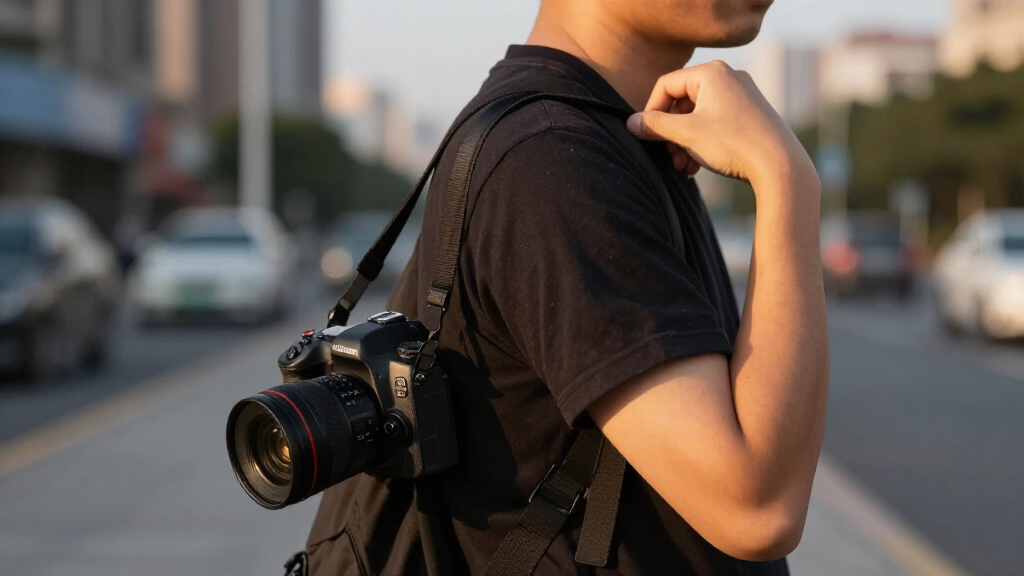
Shoulder strain and camera carry problems almost always trace back to one root cause: asymmetric load. A single-strap bag parks the full weight of your kit on one trapezius, hour after hour — and your body keeps the receipts.
The 10% line
Load-carriage ergonomics guidelines recommend keeping prolonged carried loads near or below ~10% of body weight. At 75 kg body weight, a “light” 9 kg kit is already over the line before lunch. Weigh your loaded bag — many photographers discover they’re at 15–20%.
The micro-correction injury
Walking backward at a ceremony exit, bag sliding off your shoulder for the fortieth time, you hike it back without thinking. That tiny correction, repeated hundreds of times a day, is the injury — not any single lift.
Where it lands
Your spine tilts toward the loaded side while the trapezius and levator scapulae grip constantly to stabilize you. That’s why the classic complaint is one-sided neck and shoulder pain — almost always on your habitual carry side.
Cutting 2 kg beats any strap upgrade. Gold bars mark loads past the prolonged-carry guideline — where trap strain, spinal deviation and muscle imbalance begin to compound with every step.
Every Carry System, Ranked by Kindness to Your Spine
Symmetric, torso-centered loads consistently produce less spinal deviation and muscle fatigue than one-sided carry. Your pelvis and legs handle load far better than your shoulders ever will — the ranking follows that logic. Venue and access needs decide which trade-offs you can live with.
| Rank | Carry System | Where the Weight Goes | Best For | Watch Out For | Verdict |
|---|---|---|---|---|---|
| 1 | Roller bagLoad eliminated | Nowhere — the ground carries it | Airports, studios, smooth venues | Stairs, gravel, trails, crowded dance floors | ✓ Excellent |
| 2 | BackpackSymmetric load | Both shoulders, close to your spine | Travel, hiking, all-day street work | Slow lens access, sweaty back | ✓ Very Good |
| 3 | Dual harness / hip systemHoldFast · Cotton Carrier · Capture | Torso and pelvis — the body’s load-bearing frame | Weddings, events, two working bodies | Looks tactical; takes practice | ✓ Good |
| 4 | Sling bagCompromise | Across the torso — still one-sided | Light kits, quick-access city days | Asymmetric over long hours | ~ Fair |
| 5 | Messenger / shoulder bagStock neck strap included | One trapezius takes everything | Short shoots, minimal kits only | The worst option for heavy loads | ✗ Poor |
The hybrid long-day setup: a backpack for the kit plus a dual harness for the two working bodies. The bag comes off between locations and your shoulders only ever carry what’s in your hands. A roller wins whenever the surfaces allow it — glorious on airport tile, useless on a gravel trail.
The Lightest Lens Is the One You Left at Home
Shoulder strain shrinks fastest when the load itself shrinks. Cutting two kilograms does more for your shoulders than any padded strap, fancy harness, or posture gadget ever will — and it costs nothing.
Weigh your loaded bag once
Most photographers guess low by 2–3 kg. The real number is usually sobering — and it’s the only honest starting point.
Apply the 80/20 rule
The lens you use for 5% of your frames stays home. That “just in case” fisheye has been riding along for three years.
One zoom → two small primes
A 35mm and 85mm f/1.8 pair often weighs half what a 24–70mm f/2.8 does — with a stop of light to spare.
Take the mirrorless dividend
Due for a body swap anyway? Modern mirrorless kits are meaningfully lighter — a real ergonomic benefit, not a marketing one.
Spares live off your spine
One spare battery and card in your pocket. The rest stay in the car or at the venue — not on your back for ten hours.
Fix what touches the trap
Wide, padded, cross-body straps cut peak pressure on the neck. The stock neck strap is the worst option for a heavy body + lens.
Case File · One Off-Season Kit Cut
After cutting a wedding kit from 9 kg to 5.5 kg, the chronic knot in the right trapezius was gone within months. Same hours. Same work. Less mass. The “one body, two primes” minimalist movement isn’t just an aesthetic choice — it’s partly ergonomics-driven.
Field Habits That Save Your Shoulders
Damage accumulates through habits, not single moments. The fix is a rhythm you repeat all day — small behaviors, compounded over ten hours.
Set a Silent Timer
A smartwatch buzzing every 25 minutes is your cue. Movement reminders are the easiest health tech a photographer can adopt.
Switch Carry Sides
Alternate shoulders or positions every 20–30 minutes. Never let one trapezius take the whole day alone.
Stow Between Setups
Walking to the next location? Camera goes back in the bag or on the harness — never hangs from your neck “just in case”.
Plant a Monopod
Under any long telephoto it carries essentially 100% of the lens weight between frames — the static load that wrecks sports shooters.
Lift & Stretch
Hoist the 12 kg roller with legs, not back. Sixty seconds of doorway chest and upper-trap stretches in every lull.
When It’s More Than Soreness
Chronic overload is linked to thoracic-outlet–type symptoms, rotator-cuff tendinopathy, and tension headaches. These four signs mean the load has already won a round.
Numbness or tingling
Running down the arm — a possible nerve-compression warning, not ordinary fatigue.
Persistent trap knots
Knots under the trapezius that never fully release, even after days off.
Ache that lingers
Pain that follows you into rest days instead of fading overnight.
Reduced range of motion
Stiffness or limited shoulder movement — the stage before tendinopathy.
Any of these signals? See a physiotherapist early — load reduction plus targeted upper-back and posterior-chain strength work now is what prevents strain from becoming a career-ending injury later.
Why One Shoulder Always Hurts More Than the Other
Shoulder strain and camera carry problems almost always trace back to one root cause: asymmetric load. A single-strap bag parks the full weight of your kit on one trapezius, hour after hour. Your spine tilts toward the loaded side, those muscles grip constantly to stabilize you, and the imbalance compounds with every step.
Here’s the number that reframed it for me. Ergonomics research on load carriage suggests keeping prolonged carried loads near or below ~10% of your body weight [1]. Weigh your loaded bag sometime — many photographers discover they’re at 15–20%. At 75 kg body weight, that ‘light’ 9 kg kit is already over the line before lunch.
Think of it like carrying a heavy shopping bag in one hand across an entire city. The bag doesn’t get heavier — you just run out of muscle. The trapezius and levator scapulae take the worst of it, which is why the classic complaint is one-sided neck and shoulder pain, almost always on your habitual carry side.
Picture a typical ceremony exit: you’re walking backward, camera up, bag sliding off your left shoulder for the fortieth time. You hike it back without thinking. That tiny correction, repeated hundreds of times a day, is the injury — not any single lift.
As an affiliate, we earn on qualifying purchases.
Every Carry System, Ranked by How Kind It Is to Your Spine
For ergonomics for long shooting days, the ranking is clear: roller bags remove the load entirely, backpacks spread it across both shoulders close to your spine, harness systems shift it to your torso and hips, slings split the difference, and single-shoulder bags finish dead last. Your venue and shooting style decide which trade-offs you can live with.
| Carry system | Where the weight goes | Best for | Watch out for |
|---|---|---|---|
| Roller bag | Nowhere — the ground carries it | Airports, studios, smooth venues | Stairs, gravel, trails, crowded dance floors |
| Backpack | Both shoulders, close to your spine | Travel, hiking, all-day street work | Slow lens access, sweaty back |
| Dual harness / hip system | Torso and pelvis | Weddings, events, two bodies | Looks tactical; takes practice |
| Sling bag | Across the torso, still one-sided | Light kits, quick-access city days | Asymmetric over long hours |
| Messenger / shoulder bag | One trapezius takes everything | Short shoots, minimal kits | The worst option for heavy loads |
Symmetric, torso-centered loads consistently produce less spinal deviation and muscle fatigue than one-sided carry [1]. Your pelvis and legs handle load far better than your shoulders ever will — that’s why hip-based systems like dual harnesses (HoldFast, Cotton Carrier style) and clip mounts (Peak Design Capture) have gone mainstream with wedding shooters.
My own long-day setup is the organized chaos of a hybrid: a backpack for the kit, a dual harness for the two working bodies. The bag comes off between locations, and my shoulders only ever carry what’s in my hands. A roller wins whenever the surfaces allow it — glorious on airport tile, useless on a gravel trail.
As an affiliate, we earn on qualifying purchases.
The Lightest Lens Is the One You Left at Home
Shoulder strain and camera carry pain shrink fastest when the load itself shrinks. Cutting two kilograms from your bag does more for your shoulders than any padded strap, fancy harness, or posture gadget ever will. Packing lighter is the single most effective ergonomic intervention available to you — and it costs nothing.
- Weigh your fully loaded bag once. Most photographers guess low by 2–3 kg. The real number is usually sobering.
- Apply the 80/20 rule. The lens you use for 5% of your frames stays home. That ‘just in case’ fisheye has been riding along for three years.
- Swap one f/2.8 zoom for two small f/1.8 primes. A 35mm and 85mm prime pair often weighs half what a 24–70mm f/2.8 does.
- Take the mirrorless dividend. If you’re due for a body upgrade anyway, modern mirrorless kits are meaningfully lighter — a real ergonomic benefit, not a marketing one.
- Stage your spares. One spare battery and card in your pocket; the rest live in the car or at the venue, not on your spine.
The ‘one body, two primes’ minimalist movement isn’t just an aesthetic choice — it’s partly ergonomics-driven. After I cut my own wedding kit from 9 kg to 5.5 kg one off-season, the chronic knot in my right trap was gone within months. Same hours. Same work. Less mass.
As an affiliate, we earn on qualifying purchases.
Field Habits That Save Your Shoulders Hour by Hour
Shoulder strain and camera carry damage accumulate through habits, not single moments. The fix is a rhythm you repeat all day: switch carry sides every 20–30 minutes, stow the camera between setups instead of letting it hang, support long lenses from the ground, and lift bags with your legs. Small behaviors, compounded over ten hours.
- Set a silent timer. A smartwatch buzzing every 25 minutes is your cue to switch shoulders or swap carry positions. Movement reminders are the easiest health tech a photographer can adopt.
- Stow between setups. Walking to the next location? The camera goes back in the bag or rides the harness — never hangs from your neck ‘just in case’.
- Plant a monopod under telephoto work. It supports essentially 100% of a big lens’s weight between frames, removing the sustained static load that wrecks sports and wildlife shooters.
- Lift with your legs. Hoisting a 12 kg roller out of a car trunk with a rounded back is how careers get shortened. Bag close, back straight, legs drive.
- Stretch in the lulls. Sixty seconds of doorway chest stretches and gentle upper-trap stretches during dinner service or travel time keeps tissue from locking up.
While shooting, keep your elbows tucked, use both hands, and avoid sustained overhead angles — raise your position, not your arms. I learned this covering basketball with a 400mm: the photographers with monopods finished the season fine, and the hand-holders finished it in physiotherapy.
camera harness for weight distribution
As an affiliate, we earn on qualifying purchases.
As an affiliate, we earn on qualifying purchases.
Why Your Stock Neck Strap Is the Worst Thing in Your Bag
Ask me where shoulder strain and camera carry pain really begins, and I’ll point at the thin strap that came free in the box. A stock neck strap hangs the entire body-and-lens weight from your cervical spine — the single worst load path your kit can take. For anything heavier than a compact prime, it’s a slow-motion injury.
The problem is peak pressure. A narrow strap concentrates kilograms of force onto a few square centimeters of neck and trap. Wide, padded, weight-distributing straps spread that force; cross-body sling straps (BlackRapid-style designs) move it across your torso, where bigger muscles and bone share the work.
For heavy telephoto setups, mount the strap to the lens tripod foot, not the camera body. The heaviest component then carries the load, the rig hangs balanced and level, and your lens mount stops taking a constant bending moment. First time I tried this with a 70–200mm f/2.8, the difference felt like someone had let air out of a tire that was about to burst.
In plain terms: let the strong parts of your body hold the weight, not your neck. A $0 fix — threading a wider aftermarket strap cross-body — outperforms years of painkillers.
Five Exercises That Build a Photographer’s Back
Gear and habits only take you halfway — the other half is muscle. A stronger upper back, posterior chain, and core lets you carry the same load with measurably less strain, because posture under load matters as much as the load itself. Two or three short sessions a week is enough to feel the difference within a season.
- Rows (band, dumbbell, or cable) — build the mid-back muscles that fight the forward hunch of a long shooting day.
- Face pulls — strengthen rear delts and rotator cuff, the stabilizers your shoulders beg for under a harness.
- Scapular retractions — squeeze your shoulder blades together for 10 slow reps; do them at your desk, no equipment.
- Thoracic mobility work — open-book rotations and foam-roller extensions undo the rounded posture editing marathons create.
- Core basics — planks and side planks, 30–60 seconds. A stable trunk keeps load off your traps.
Add doorway chest stretches and gentle upper-trap stretches after shoots. ‘Photographer’s back’ is now a recognized topic in the community, and physiotherapists increasingly publish photographer-specific routines [2]. My own turning point came after a physio handed me a ten-minute routine — boring, unglamorous, and the reason my forties hurt less than my thirties did.
The Warning Signs That Mean Stop, Not Push Through
Most shoulder strain and camera carry injuries whisper before they scream. The early signs — one-sided trapezius knots, aching that lingers into your rest days, reduced range of motion when you reach overhead — are your body’s invoice for years of asymmetric load. Catch them early and the fix is cheap: load reduction and a few physio sessions.
Numbness or tingling running down your arm or into your fingers is not normal fatigue. It suggests nerve compression, and it’s your cue to see a physiotherapist promptly — not to buy a different bag and carry on.
Chronic overload is linked to thoracic outlet–type symptoms, rotator cuff tendinopathy, and tension headaches. Untreated, repetitive strain can turn into lasting damage that genuinely shortens careers — I’ve watched a talented colleague ignore tingling fingers for two seasons until shooting a full day became physically impossible for her.
Surveys of professional photographers consistently place musculoskeletal complaints among the most frequently reported health issues in the field, alongside eye strain and wrist problems [2]. You’re not soft, and you’re not alone. Early intervention — physiotherapy plus real load changes — is what keeps the whisper from becoming a scream.
Frequently Asked Questions
How heavy is too heavy for a camera bag?
Ergonomics guidelines for prolonged load carriage point to roughly 10% of your body weight as the ceiling [1]. For a 75 kg photographer, that’s a 7.5 kg bag — a line many wedding kits cross before adding the bag itself. Weigh your packed bag once; if you’re over, remove gear before you shop for better padding.
Is a camera harness better than a strap for long days?
For two heavy bodies, generally yes — a dual harness moves the load from your neck and traps to your torso, which handles weight far better. For a single light camera, a good wide cross-body sling strap is perfectly fine. The harness earns its keep when the combined body-and-lens weight climbs past a few kilograms per side.
Why does only my right shoulder hurt after shoots?
That’s asymmetric loading doing exactly what it does. If you always sling the bag on the same shoulder, that side’s trapezius and levator scapulae work isometrically for hours while the other side rests. Switch shoulders every 20–30 minutes, or move to a two-strap or hip-based carry so no single muscle group absorbs the whole day.
Are sling bags bad for your back?
They sit in the middle of the pack: better than a single-shoulder bag, worse than a backpack. A sling spreads load across the torso, but it’s still one-sided over long hours. For a light kit — one body, one or two small lenses — a sling is a reasonable choice. For 6 kg and up, your spine will vote for two straps.
Do mirrorless cameras actually reduce shoulder strain?
Yes, cumulatively. Mirrorless bodies plus compact f/1.8 primes can shave 1–3 kg off a typical bag, and every kilogram you remove works on your shoulders for all ten hours of the day. The honest caveat: pro-level mirrorless f/2.8 zooms and super-telephotos are still heavy, so the savings come mostly from body choice and prime lenses.
Can carrying camera gear cause permanent damage?
Chronic, untreated strain can contribute to lasting problems — rotator cuff tendinopathy, thoracic outlet–type symptoms, and persistent tension headaches are the known risks. The good news: early intervention works. Load reduction plus a few sessions of physiotherapy resolves most cases long before they become career-limiting. Numbness or tingling down the arm is the sign to stop pushing through and book that appointment.
Conclusion
Here’s the one thing to remember: your carry system matters less than your carry habits. Buy the better bag if it helps — but first pack lighter, spread the load across both shoulders or your hips, and switch sides before anything starts to ache. Your future self, still shooting pain-free at sixty, is built from those twenty-five-minute timer buzzes.
Tonight, do one thing: put your loaded bag on the bathroom scale. If the number makes you wince, you already know what Sunday’s kit cull looks like. Your shoulders have carried your vision long enough — time to return the favor.
Fall Picks
fall essentials
As an affiliate, we earn on qualifying purchases.




![Netflix Postpones Gary Glitter Docuseries, Citing “New Legal Information” [Updated]](https://photomocha.com/wp-content/uploads/2026/09/netflix-postpones-gary-glitter-docuseries-citing-new-legal-information-updated-featured-260x140.jpg)