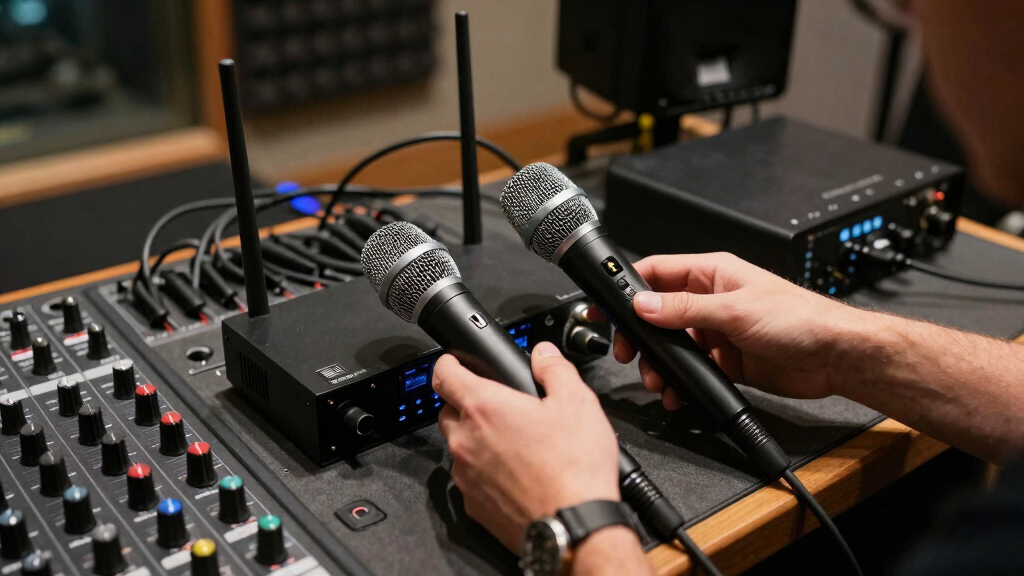

Among the wireless microphone systems in this roundup, the Phenyx Pro Quad-Channel UHF System with Auto Scan is my best overall pick because it balances four-mic capacity, frequency management, range, and professional-event flexibility. The Aveek Four-Microphone System is the value standout, pairing a claimed 262-foot range with long battery life, while the FULAIM X6 Pro is better suited to mobile video creators who need four compact transmitters. The main choice is between more simultaneous microphones, easier frequency setup, specialized mic formats, and a smaller system built for portability. Buyers also need to match the receiver’s connections to their existing mixer, speaker, camera, or phone. Continue reading for the full breakdown of which configuration makes the most sense for each buyer.

Get audio and creator gear delivered free with Prime
- Fast, free delivery on millions of items
- Prime Video, Amazon Music and more included
- Member-only deals all year
Complete the kit

Key Takeaways
- Phenyx Pro’s quad-channel model with auto scan leads this roundup because its frequency-management tools make it more adaptable than fixed or manually tuned four-mic systems.
- Aveek offers the strongest value balance for buyers who want four handheld microphones, long claimed battery life, and broad event coverage without moving to an eight-channel package.
- More channels do not automatically mean a better purchase: the MELONARE eight-mic and PRORECK six-mic systems suit large groups, but smaller setups are easier to transport, connect, and manage.
- Microphone format separates the specialists: the MELONARE conference system favors seated panels, the FULAIM X6 Pro targets mobile recording, and the ES-384 serves four-person lavalier use.
- Auto scan is the clearest premium differentiator among these choices, while mixed microphone bundles from TONOR and Debra Audio trade streamlined setup for greater presenter flexibility.
| MELONARE 8-Channel Wireless Microphone System |  | Best for Eight-Person Groups | Wireless band: UHF 500 MHz | Channels: 8 | Microphones: 8 handheld microphones | VIEW LATEST PRICE | See Our Full Breakdown |
| ES-384 4-Channel UHF Wireless Lavalier Microphone System |  | Best Hands-Free Setup | Channels: 4 | Microphones: 4 | Microphone style: Lavalier/lapel | VIEW LATEST PRICE | See Our Full Breakdown |
| Aveek Wireless Microphone System with 4 Microphones |  | Best Battery Life | Microphones: 4 | Microphone type: Dynamic handheld | Wireless range: 262 ft | VIEW LATEST PRICE | See Our Full Breakdown |
| Melonare 4-Channel Wireless Conference Microphone System |  | Best for Panel Discussions | Channels: 4 | Microphones: 4 gooseneck microphones | Wireless band: UHF 500MHz | VIEW LATEST PRICE | See Our Full Breakdown |
| Phenyx Pro Wireless Microphone System, 4-Channel UHF |  | Best Overall | Channels: 4 | Microphones: 4 handheld microphones | Microphone cartridge: Dynamic cardioid | VIEW LATEST PRICE | See Our Full Breakdown |
| FULAIM X6 Pro Wireless Lavalier Microphones |  | Best for Multi-Person Video | Audio format: 48kHz/24-bit | Transmitters: 4 | Wireless range: Up to 328 feet | VIEW LATEST PRICE | See Our Full Breakdown |
| JBL Wireless Two Microphone System |  | Best for Easy Karaoke | Microphones included: 2 wireless handheld microphones | Receiver channels: 2 | Receiver battery: Rechargeable | VIEW LATEST PRICE | See Our Full Breakdown |
| Phenyx Pro Quad-Channel UHF Wireless Microphone System |  | Best for Four-Performer Stages | Channels: 4 | Frequency selection: 40 UHF frequencies per channel | Wireless range: Up to 328 feet | VIEW LATEST PRICE | See Our Full Breakdown |
| Phenyx Pro Dual UHF Handheld Wireless Microphone System |  | Best Simple Dual-Handheld System | Microphones included: 2 handheld microphones | Frequency band: UHF 500 MHz band | Tunable groups: 30 | VIEW LATEST PRICE | See Our Full Breakdown |
| TONOR 4-Channel UHF Wireless Microphone System |  | Best Mixed-Microphone Kit | Receiver channels: 4 | Wireless range: 60 meters / 200 feet | Handheld microphones: 4 | VIEW LATEST PRICE | See Our Full Breakdown |
| Debra Audio Pro AU400 4-Channel Wireless Microphone System |  | Best Mic-Type Flexibility | Simultaneous channels: 4 | Selectable channels: 8 | Frequency range: 501–538.5 MHz | VIEW LATEST PRICE | See Our Full Breakdown |
| Melonare 4-Channel UHF Rackmountable Wireless Microphone System |  | Best Rackmount Value | Channels: 4 | Frequency band: UHF 500 MHz | Operating range: Up to 260 ft | VIEW LATEST PRICE | See Our Full Breakdown |
| Phenyx Pro Dual UHF Wireless Microphone System with Auto Scan |  | Best Dual-Mic System | Channels: 2 | Frequency range: 536.57–587.12 MHz | Selectable frequencies: 200 total; 100 per channel | VIEW LATEST PRICE | See Our Full Breakdown |
| PRORECK MX66 6-Channel UHF Wireless Microphone System |  | Best for Six Performers | Channels: 6 | Microphones included: 6 handheld microphones | Operating range: Up to 200 ft | VIEW LATEST PRICE | See Our Full Breakdown |
| wireless microphone system | Wireless range | Channels |
|---|---|---|
| MELONARE 8-Channel Wireless Mi | 240 ft | 8 |
| ES-384 4-Channel UHF Wireless | 164 ft | 4 |
| Aveek Wireless Microphone Syst | 262 ft | — |
| Melonare 4-Channel Wireless Co | 200 ft | 4 |
| Phenyx Pro Wireless Microphone | 260 ft | 4 |
| FULAIM X6 Pro Wireless Lavalie | Up to 328 feet | — |
| JBL Wireless Two Microphone Sy | — | — |
| Phenyx Pro Quad-Channel UHF Wi | Up to 328 feet | 4 |
| Phenyx Pro Dual UHF Handheld W | Up to 200 feet | — |
| TONOR 4-Channel UHF Wireless M | 60 meters / 200 feet | — |
| Debra Audio Pro AU400 4-Channe | — | — |
| Melonare 4-Channel UHF Rackmou | — | 4 |
| Phenyx Pro Dual UHF Wireless M | — | 2 |
| PRORECK MX66 6-Channel UHF Wir | — | 6 |
More Details on Our Top Picks
MELONARE 8-Channel Wireless Microphone System
I rank the MELONARE 8-Channel System as the group-capacity pick because its eight handheld microphones can cover a choir, karaoke rotation, or event team without passing microphones between speakers. That is twice the microphone count of the Aveek and Phenyx Pro systems in this batch. Its 240-foot operating range also gives performers ample room to move, while 24-bit/48kHz audio is aimed at keeping voices clear. The compromise is power management: supplying 16 AA batteries becomes expensive during frequent events, even though the first set is included. Frequency coordination may also feel less approachable than the Phenyx Pro model’s fixed-channel setup, and only two systems can operate together. I would choose it for raw microphone capacity, but not for installations that expect painless expansion.
Pros:- Eight included handheld microphones support large groups without mic sharing
- 240-foot range provides room for stage movement and audience participation
- 24-bit/48kHz audio specification supports clear voice reproduction
- Built-in antenna and display simplify transport and initial setup
Cons:- Running all eight microphones requires 16 AA batteries
- Only two complete sets can be used simultaneously
- Eight-channel frequency management may challenge first-time operators
Best for: Choirs, karaoke hosts, schools, and event organizers who need eight people miked at the same time
Not ideal for: Touring operators or busy venues that want rechargeable microphones, broad system expansion, and simpler frequency coordination
- Wireless band:UHF 500 MHz
- Channels:8
- Microphones:8 handheld microphones
- Wireless range:240 ft
- Sampling rate:24-bit/48kHz
- Microphone power:16 AA batteries
- Included batteries:Yes
- Antenna design:Built-in
Our verdict“This is my pick for buyers who value eight-speaker capacity more than rechargeable power or large-scale expansion.”
ES-384 4-Channel UHF Wireless Lavalier Microphone System
I give the ES-384 the hands-free role because four lapel microphones let teachers, presenters, and worship leaders speak while keeping both hands available. The Aveek and Phenyx Pro systems supply handheld microphones instead, making them better for singing but less convenient for demonstrations or panel-style speech. A plug-in 6.35mm receiver keeps this package compact and connects directly to compatible PA equipment, while individual volume adjustment helps balance speakers with different vocal levels. Its 164-foot range trails every other system in this batch, though it remains practical for classrooms and modest halls. The receiver is rechargeable, but the non-rack design limits expansion and permanent installation flexibility. I would skip it when separate mixer routing or a stage-ready handheld capsule matters more than portability.
Pros:- Four lapel microphones keep presenters’ hands free
- Rechargeable receiver reduces reliance on disposable receiver batteries
- Direct 6.35mm connection creates a compact PA setup
- Adjustable volume controls help balance multiple speakers
Cons:- 164-foot range is the shortest among these five systems
- Plug-in receiver offers fewer expansion and installation options than a rack receiver
- Requires PA equipment with a compatible 6.35mm input
Best for: Teachers, church speakers, trainers, and meeting facilitators who need four compact hands-free microphones
Not ideal for: Singers, touring sound crews, and installed venues that need rack mounting, longer range, or extensive routing options
- Channels:4
- Microphones:4
- Microphone style:Lavalier/lapel
- Wireless technology:UHF
- Wireless range:164 ft
- Receiver type:Direct plug-in
- Receiver connector:6.35mm
- Receiver power:Rechargeable
Our verdict“I recommend the ES-384 for four-person spoken-word setups where hands-free convenience outweighs range and rack-level flexibility.”
Aveek Wireless Microphone System with 4 Microphones
The Aveek four-microphone system earns my battery-life pick with up to 40 hours per microphone, making it better suited to weekend events and long programs than the 12-hour Melonare conference set. Its 262-foot range is also the longest among these five by a narrow margin, giving singers and speakers more freedom in larger venues. Four dynamic microphones make it more performance-oriented than the ES-384 lavalier package, and Type-C charging avoids the Phenyx Pro system’s recurring AA-battery purchases. That convenience comes with connection limits: it does not work directly with laptops, phones, iPads, or AV receivers. The receiver can also assign channels randomly, so interference may call for manual adjustment. I see it as a strong endurance choice, but buyers wanting fixed-frequency simplicity may prefer Phenyx Pro.
Pros:- Up to 40 hours of microphone battery life supports long events
- 262-foot range suits large rooms and performance spaces
- Four dynamic handheld microphones cover group performances
- Type-C charging reduces disposable-battery costs
Cons:- Does not connect directly to laptops, iPads, phones, or AV receivers
- Random channel assignment may require manual correction
- Four-microphone capacity is lower than the eight-channel MELONARE system
Best for: Karaoke hosts, event teams, and community performers running long sessions with four handheld microphones
Not ideal for: Mobile creators who need direct phone, tablet, or laptop connectivity, or operators who want fully predictable channel assignments
- Microphones:4
- Microphone type:Dynamic handheld
- Wireless range:262 ft
- Battery life:Up to 40 hours per microphone
- Audio output:1/4-inch
- Charging connection:USB Type-C
- Channel assignment:Automatic/random assignment
- Included audio hardware:Receiver, power adapter, audio cable, and charging cables
Our verdict“This Aveek system makes the most sense when long rechargeable runtime and generous range matter more than device connectivity.”
Melonare 4-Channel Wireless Conference Microphone System
I assign the Melonare Conference System to panel discussions because its four rotatable gooseneck microphones suit desks, lecterns, and meeting tables better than the handheld Aveek or Phenyx Pro sets. Speakers can position each capsule near the mouth, which supports steadier pickup without holding a microphone. The combination of 24-bit/48kHz audio, noise reduction, and frequency hopping is aimed at clear speech across its 200-foot range. Portability is another advantage over a full rack installation, though that compact design offers less expansion potential. Its 12-hour battery life covers most single-day programs but falls far behind Aveek’s 40-hour rating. No echo-cancellation feature is listed, which may matter in reflective conference rooms. I would select it for structured seated discussions, not roaming performances or multiday events.
Pros:- Four rotatable gooseneck microphones suit seated speakers and lecterns
- 24-bit/48kHz specification supports detailed spoken-word audio
- Frequency hopping is designed to reduce wireless interference
- Compact receiver and 200-foot range balance portability with room coverage
Cons:- 12-hour battery life is much shorter than the Aveek system’s rating
- No stated echo-cancellation function for reflective meeting rooms
- UHF 500MHz suitability may vary by region
Best for: Conference organizers, councils, lecture venues, and houses of worship running four-person seated discussions
Not ideal for: Roaming singers, multiday event crews, or users working in echo-prone rooms who need stated acoustic echo cancellation
- Channels:4
- Microphones:4 gooseneck microphones
- Wireless band:UHF 500MHz
- Wireless range:200 ft
- Sampling rate:24-bit/48kHz
- Battery life:Up to 12 hours
- Microphone adjustment:Rotatable goosenecks
- Included hardware:Receiver, power adapter, and cables
Our verdict“I favor this Melonare package for fixed-position panels that need four flexible gooseneck microphones in a portable system.”
Phenyx Pro Wireless Microphone System, 4-Channel UHF
I place the Phenyx Pro 4-Channel System first for buyers seeking a sturdy, straightforward event setup. Its all-metal receiver and microphones are better prepared for repeated transport than the lighter, compact ES-384 arrangement, while four XLR outputs give a mixer operator separate control over each voice. A 260-foot range nearly matches Aveek’s 262 feet, and fixed frequencies remove the uncertainty of Aveek’s random channel assignment. The drawback is that those frequencies cannot adapt as freely when local interference appears, and the system does not support multiple-set operation. Its eight AA batteries are also less economical than Aveek’s Type-C charging. Because an external amplifier or powered speaker is required, this is not a self-contained karaoke solution. Still, I rank its metal construction and individual outputs above the compromises for general event use.
Pros:- All-metal construction is suited to repeated event use and transport
- Four XLR outputs allow individual channel routing and mixing
- 260-foot range supports large rooms and stages
- Fixed frequencies and LCD display make initial setup straightforward
Cons:- Fixed frequencies provide limited flexibility when interference occurs
- Cannot be combined with another set for larger microphone counts
- Requires eight non-rechargeable AA batteries and external sound equipment
Best for: Churches, DJs, karaoke operators, and event venues that want four durable handheld microphones with individual mixer outputs
Not ideal for: Venues planning multi-set expansion or buyers who want rechargeable microphones and sound output without external amplification
- Channels:4
- Microphones:4 handheld microphones
- Microphone cartridge:Dynamic cardioid
- Wireless range:260 ft
- Fixed frequencies:541.9, 546.3, 561.6, and 568.65 MHz
- Outputs:4 XLR outputs
- Power source:8 AA batteries included
- Construction:All-metal
- Display:LCD
Our verdict“The Phenyx Pro is my best all-round choice for buyers who prioritize durability, simple operation, and per-channel mixer control.”
FULAIM X6 Pro Wireless Lavalier Microphones
I rank the FULAIM X6 Pro as the strongest creator-focused system here because its four compact transmitters can capture a full interview panel without handheld microphones filling the frame. Its 48kHz/24-bit audio and noise cancellation offer more recording flexibility than the stage-oriented TONOR system, while real-time monitoring helps a camera operator catch problems during production. The 328-foot range also exceeds the 200-foot reach of the dual-microphone Phenyx Pro. That capability brings added preparation: pairing and managing four transmitters is less approachable than the JBL system’s plug-and-play setup. Battery endurance can also vary with monitoring and noise cancellation. I would choose this for video production and mobile interviews, but singers and event hosts will find handheld UHF systems easier to integrate with a mixer or PA.
Pros:- Captures as many as four speakers simultaneously
- 48kHz/24-bit recording provides detailed audio for editing
- 328-foot range supports wider video locations
- Charging case and broad device support suit mobile production
Cons:- Managing four transmitters creates a steeper setup process
- Battery endurance varies with active features and workload
- Lavalier format is less natural for shared-stage singing
Best for: Video crews, podcasters, and interviewers recording three or four speakers on phones or cameras
Not ideal for: Karaoke hosts and stage performers who need handheld microphones with direct XLR or mixer-friendly outputs
- Audio format:48kHz/24-bit
- Transmitters:4
- Wireless range:Up to 328 feet
- Compatibility:iPhone, Android, and cameras
- Input modes:Mono and secure audio track
- Charging case:Included
- Monitoring:Real-time
- Noise cancellation:Supported
Our verdict“This is my pick for production teams that need four discreet microphones and broad phone-to-camera compatibility.”
JBL Wireless Two Microphone System
The JBL Wireless Two Microphone System earns its place through simplicity rather than channel count. Its rechargeable dual-channel receiver connects two singers with minimal preparation, making it friendlier for home karaoke than the four-channel Phenyx Pro or TONOR sets. JBL Original Pro sound is tuned around clear vocals, and plug-and-play operation removes the frequency scanning that can slow down a casual gathering. I rank it below the larger systems for organized events because it supports only two microphones and offers up to six hours per receiver charge; the quad Phenyx Pro reaches 16 hours and provides four channels. The handheld microphones also rely on disposable or separately rechargeable AA cells. For buyers who value fast setup and familiar controls over routing flexibility, however, this is the most approachable choice in the group.
Pros:- Simple plug-and-play connection suits first-time users
- Dual-channel receiver supports two simultaneous vocalists
- Rechargeable receiver reduces dependence on a wall outlet
- JBL vocal processing prioritizes speech and singing clarity
Cons:- Six-hour receiver runtime is short for long event schedules
- Two channels cannot accommodate larger panels or ensembles
- Handheld microphones still require replaceable AA batteries
Best for: Home karaoke users and casual duet performers who want a two-microphone system with little configuration
Not ideal for: Churches, conferences, and event producers needing more than two channels or all-day receiver runtime
- Microphones included:2 wireless handheld microphones
- Receiver channels:2
- Receiver battery:Rechargeable
- Microphone batteries:Replaceable AA batteries
- Playback time:Up to 6 hours
- Setup:Plug-and-play
- Sound platform:JBL Original Pro sound
- Color:Black
Our verdict“I recommend the JBL for casual duets and karaoke nights where easy setup matters more than channel capacity.”
Phenyx Pro Quad-Channel UHF Wireless Microphone System
I place the Phenyx Pro Quad-Channel UHF system ahead of the other handheld sets for demanding four-person performances. Each channel can scan 40 frequencies, so an operator has more ways to avoid interference than with the simpler dual Phenyx Pro system. Its 328-foot range, 16-hour battery life, and metal construction also make it better suited to recurring church services or live shows than the 200-foot TONOR kit. The tradeoff is complexity: four frequency banks and eight required AA batteries create more setup and upkeep than JBL’s two-microphone package. Local UHF availability may also affect which frequencies can be used legally or reliably. I favor this model when range and four matching handhelds outweigh portability, mixed microphone styles, and beginner-friendly operation.
Pros:- Four independent channels serve complete vocal groups
- Auto scan and 40 frequencies per channel help avoid interference
- 328-foot range suits larger rooms and stages
- Metal microphones and 16-hour battery life support repeated events
Cons:- Eight AA batteries increase recurring cost and charging work
- Four-channel frequency setup may overwhelm beginners
- UHF frequency availability and rules vary by location
Best for: Church audio teams, vocal groups, and event operators running four handheld performers across a large venue
Not ideal for: First-time karaoke buyers who want a compact receiver, two microphones, and minimal frequency management
- Channels:4
- Frequency selection:40 UHF frequencies per channel
- Wireless range:Up to 328 feet
- Battery life:Up to 16 hours
- Microphone type:Handheld dynamic
- Polar pattern:Cardioid
- Construction:Metal
- Frequency span:538.3-599.5 MHz across four channel bands
- Scanning:Automatic frequency scan
Our verdict“This is my preferred four-handheld system for venue operators who need long range, durable hardware, and frequency control.”
Phenyx Pro Dual UHF Handheld Wireless Microphone System
The Phenyx Pro Dual UHF system occupies the middle ground between JBL’s casual simplicity and the quad-channel Phenyx Pro’s venue-scale control. Its two metal handheld microphones pair automatically, while 30 tunable groups provide more frequency flexibility than a fixed-channel karaoke set. Separate XLR outputs are the key advantage over JBL: an audio operator can mix each microphone independently instead of accepting only a combined feed. I would still choose the quad Phenyx Pro for four performers, longer 328-foot coverage, or auto scanning; this model stops at 200 feet and requires manual channel choices in crowded UHF environments. AA power also creates an ongoing supply requirement despite the included starter batteries. For duets, speeches, and smaller worship spaces, its durable build and practical outputs make a sensible balance.
Pros:- Two metal handheld microphones are suited to frequent handling
- Thirty tunable groups provide frequency flexibility
- Separate XLR outputs allow independent mixer control
- Automatic pairing shortens routine setup
Cons:- Two-channel capacity cannot serve larger groups
- Manual frequency selection may be harder in congested venues
- AA batteries create recurring replacement or recharging work
Best for: Small churches, duet performers, and community venues needing two durable microphones with separate mixer channels
Not ideal for: Large productions that need four voices, automatic frequency scanning, or coverage beyond 200 feet
- Microphones included:2 handheld microphones
- Frequency band:UHF 500 MHz band
- Tunable groups:30
- Wireless range:Up to 200 feet
- Power source:AA batteries
- Outputs:2 XLR and 1 mixed 1/4-inch output
- Pairing:Automatic
- Included accessories:Batteries, cables, and anti-rolling rings
Our verdict“I would choose this for two-person performances that need proper mixer outputs without the complexity of a four-channel rack.”
TONOR 4-Channel UHF Wireless Microphone System
I give the TONOR 4-Channel UHF system the versatility slot because it bundles four handhelds, two headsets, and two lavaliers around a four-channel receiver. That mix lets an organizer assign handhelds to singers and wearable microphones to presenters, something the all-handheld Phenyx Pro systems cannot match. Automatic pairing also keeps routine setup manageable, while the 60-meter range and cardioid capsules fit medium-size churches, parties, and presentation rooms. Only four microphones can occupy the available channels at once, so the eight included microphone options should not be mistaken for eight simultaneous inputs. Its 200-foot reach is also shorter than the quad Phenyx Pro’s 328 feet, and every active microphone or bodypack needs two AA batteries that are not supplied. I rank it highest for events with changing microphone needs, not maximum range.
Pros:- Handheld, headset, and lavalier options cover varied event roles
- Four channels support small panels or vocal groups
- Automatic pairing reduces repeated setup work
- Cardioid capsules help focus pickup on the speaker or singer
Cons:- Only four of the eight included microphone options can use the four-channel system at once
- Required AA batteries are not included
- 200-foot range trails longer-range Phenyx Pro and FULAIM systems
Best for: Churches, schools, and event hosts who alternate between singers, presenters, and hands-free speakers
Not ideal for: Large venues needing more than four simultaneous channels, 328-foot coverage, or included rechargeable power
- Receiver channels:4
- Wireless range:60 meters / 200 feet
- Handheld microphones:4
- Headset microphones:2
- Lavalier microphones:2
- Battery requirement:2 AA batteries per microphone or bodypack
- Batteries included:No
- Capsule pattern:Cardioid
Our verdict“This is my choice for mixed-format events that need four active channels and the freedom to swap between handheld and wearable microphones.”
Debra Audio Pro AU400 4-Channel Wireless Microphone System
I place the Debra Audio Pro AU400 here for groups that need different microphone styles from one receiver. Its mix of handheld, lavalier, and headset mics suits a church service, karaoke night, or presentation better than the handheld-only Melonare 4-Channel system. Four simultaneous UHF channels also let several speakers participate without passing microphones around. The metal receiver is a welcome durability advantage, but this is not the strongest choice for long-distance coverage: the Phenyx Pro dual system lists a 328-foot range and adds automatic frequency scanning. The AU400 also consumes eight AA batteries, while its 70 dB signal-to-noise ratio and restricted frequency window leave less margin in crowded wireless environments. I see it as the most adaptable package, rather than the most refined or easiest to coordinate.
Pros:- Includes handheld, lavalier, and headset microphones for different speaking roles
- Supports four simultaneous performers through one UHF receiver
- Metal receiver is better suited to repeated event use than lightweight plastic hardware
- Individual XLR connectivity supports more flexible mixer routing
Cons:- Eight AA batteries increase recurring operating costs
- No automatic frequency-scanning feature is specified
- The 501–538.5 MHz range may require manual adjustment when interference appears
Best for: Churches, community venues, and event hosts who need handheld, headset, and lapel microphones working through one receiver
Not ideal for: Touring performers or RF-heavy venues that need automatic frequency scanning and clearly specified long-range coverage
- Simultaneous channels:4
- Selectable channels:8
- Frequency range:501–538.5 MHz
- Microphone styles:Handheld, lavalier, and headset
- Polar pattern:Unidirectional
- Signal-to-noise ratio:70 dB
- Battery requirement:8 AA batteries
- Receiver weight:1.95 kg
Our verdict“I recommend the AU400 when microphone-style flexibility matters more than automatic setup or maximum operating range.”
Melonare 4-Channel UHF Rackmountable Wireless Microphone System
The Melonare 4-Channel system offers a practical middle ground between casual karaoke equipment and a permanent venue installation. Its 24-bit/48 kHz digital transmission, four color-coded handheld microphones, rack ears, and live displays make it easier to organize in a DJ or church rack than the freestanding Debra Audio AU400. It also reaches a claimed 260 feet, although the Phenyx Pro dual system extends that figure to 328 feet and supplies automatic scanning for easier interference management. Melonare earns its position by serving four singers at once without jumping to the larger PRORECK six-microphone package. I would still allow extra setup time: coordinating several UHF channels can challenge a first-time operator, and eight AA batteries create ongoing expense. Its 500 MHz operating band may also become crowded at busy venues.
Pros:- Four handheld microphones can operate simultaneously
- 24-bit/48 kHz digital transmission supports detailed vocal audio
- Rack ears make the receiver easier to integrate into mobile or installed rigs
- Color-coded controls and live displays help operators identify each channel
Cons:- Channel coordination may be demanding for inexperienced operators
- Eight AA batteries add recurring cost and pre-event preparation
- The 500 MHz UHF band can encounter interference in crowded locations
Best for: Mobile DJs, small churches, and karaoke operators who want four rack-mounted handheld channels at a moderate system size
Not ideal for: First-time users who want automatic frequency selection or performers who need more than 260 feet of stated range
- Channels:4
- Frequency band:UHF 500 MHz
- Operating range:Up to 260 ft
- Sampling format:24-bit/48 kHz
- Microphones included:4 handheld microphones
- Battery requirement:8 AA batteries
- Mounting:Rackmountable; rack ears included
- Included connections:Power adapter and audio cables
Our verdict“I favor this Melonare system for buyers who need four rack-ready vocal channels without the bulk of a six- or eight-microphone setup.”
Phenyx Pro Dual UHF Wireless Microphone System with Auto Scan
I rank the Phenyx Pro dual UHF system as the strongest choice for two-person performances because it concentrates on connection management rather than microphone count. Its automatic scanning and 200 selectable frequencies give it a clearer response to local interference than the fixed-frequency PRORECK MX66, while the claimed 328-foot reach exceeds Melonare’s 260-foot rating. Dynamic cardioid capsules help reject sound away from each singer, which is useful on lively stages, and the metal construction suits regular transport. The compromise is capacity: buyers needing four simultaneous voices get more channels from Melonare, while the Debra Audio AU400 adds headset and lavalier options. Each Phenyx Pro microphone also relies on AA cells rather than onboard charging, though the stated 16-hour runtime is useful for long programs. I value it for range and frequency control, not group expansion.
Pros:- Automatic scanning helps locate a cleaner operating frequency
- Two hundred selectable frequencies provide substantial tuning flexibility
- Claimed 328-foot range is the longest among these four products
- Metal receiver and microphones suit frequent transport and event use
Cons:- Only two microphone channels are available
- Handheld-only package lacks lavalier and headset options
- No built-in rechargeable batteries or charging dock
Best for: Duos, officiants, presenters, and small churches that prioritize long range and automatic frequency selection over microphone count
Not ideal for: Panels, vocal groups, or productions that need four or more simultaneous microphones or rechargeable transmitters
- Channels:2
- Frequency range:536.57–587.12 MHz
- Selectable frequencies:200 total; 100 per channel
- Operating range:Up to 328 ft
- Microphone type:Dynamic handheld
- Polar pattern:Cardioid
- Battery requirement:4 AA batteries total
- Stated battery life:Up to 16 hours
- Construction:Metal
Our verdict“I would choose this Phenyx Pro system for two-microphone events where dependable frequency selection and long reach outweigh channel capacity.”
PRORECK MX66 6-Channel UHF Wireless Microphone System
The PRORECK MX66 fills the clearest high-capacity role in this group: it puts six handheld microphones on one receiver, two more than either the Melonare 4-Channel system or Debra Audio AU400. Six separate XLR outputs let a sound operator mix voices individually, while the 1/4-inch mixed output supports a simpler connection. Eight EQ presets offer quick tonal changes, though I would treat them as convenience settings rather than a substitute for mixer control. Capacity brings real penalties. The receiver is large, the transmitters need 12 AA batteries in total, and its fixed frequencies prevent two MX66 sets from operating together. Its claimed 200-foot range also trails both Melonare and the dual-channel Phenyx Pro. I rank it for single-system headcount; buyers needing easier RF coordination or lighter transport should choose a smaller alternative.
Pros:- Six included handheld microphones support larger groups without sharing
- Six XLR outputs allow independent mixer control for every voice
- Large LCD and separate volume controls simplify channel monitoring
- Eight EQ modes provide fast tonal presets for different programs
Cons:- Fixed frequencies prevent two MX66 systems from being used together
- Twelve AA batteries are required and are not included
- Large receiver and 200-foot range make it less appealing for highly portable or long-distance setups
Best for: Wedding bands, conference panels, and event hosts who need six handheld voices active through one receiver
Not ideal for: Touring users with limited rack space or large productions that need to combine multiple identical systems
- Channels:6
- Microphones included:6 handheld microphones
- Operating range:Up to 200 ft
- Frequencies:600.5, 607.5, 615.5, 653.1, 658.3, and 662.8 MHz
- Audio outputs:6 XLR and 1 x 1/4-inch mixed output
- EQ modes:8
- Battery requirement:2 AA per microphone; 12 total, not included
- Receiver size:21 x 13.5 x 3.2 in
- Warranty:1 year
Our verdict“I recommend the MX66 when six simultaneous handheld channels matter more than portability, automatic scanning, or future system expansion.”
How We Picked
I ranked these wireless microphone systems by connection reliability, channel capacity, frequency control, usable range, and how well each microphone format fits its intended setting. Auto scan and selectable frequencies received extra weight because they can reduce setup friction at churches, event halls, and other locations with competing wireless signals. I also compared battery claims, receiver outputs, included microphone types, physical construction, and whether a system could grow with the buyer’s needs. A high microphone count helped only when the package remained practical to operate.
The final order favors balanced systems over narrowly impressive specifications. Phenyx Pro’s quad-channel auto-scan model ranks above simpler four-channel sets because it combines capacity with better frequency management, while Aveek rises on value through battery life and range. Specialized products rank according to their intended roles: FULAIM for mobile production, MELONARE’s gooseneck set for conferences, and the larger MELONARE and PRORECK packages for group events. I treated manufacturer range and runtime figures as comparative claims rather than guarantees, since walls, local interference, output volume, and battery condition can alter real-world results.
Factors to Consider When Choosing Wireless Microphone Systems
The right system depends less on the largest advertised number and more on how many people speak at once, where they move, and what receives the audio. I would choose the microphone format and receiver connection first, then compare range, frequency controls, power, and expansion needs.
Match the Channel Count to Real Simultaneous Use
A channel represents one microphone that can operate independently, so I would count simultaneous speakers rather than everyone who might appear during an event. Two channels are often enough for a host and guest, while four channels fit panels, vocal groups, and rotating presenters. Six- and eight-channel systems reduce microphone handoffs but add receivers, cables, batteries, and more chances for an open mic to create noise. A common mistake is buying the largest package for occasional use, then discovering that setup and sound checks take longer. If speakers can share microphones between segments, a smaller system may be the cleaner purchase. Large churches, productions, and recurring group events gain more from six or eight dedicated channels because the workflow savings repeat at every session.
Choose the Right Microphone Format
Handheld microphones suit singing, karaoke, audience questions, and speakers who can manage mic distance. Lavalier mics keep hands free and look discreet, but clothing placement can introduce rustling and inconsistent volume. Headsets hold the capsule close to the mouth, making them useful for instructors, energetic presenters, and performers who move often. Gooseneck microphones work best at desks or conference tables, where the speaker stays in a fixed position. Mixed bundles offer flexibility, though their extra cables and bodypacks create more setup work than an all-handheld package. I would select the format around the hardest recurring use case rather than the broadest accessory list. For phone or camera recording, compact clip-on transmitters such as those in the FULAIM system belong to a different workflow than rack-style event receivers.
Treat Range Claims as Best-Case Figures
Advertised wireless range usually reflects a favorable line-of-sight setting, not a crowded room filled with walls, people, lighting equipment, and competing signals. I would leave a healthy margin between the claimed range and the farthest planned microphone position. A 200-foot system can be sensible in a much smaller venue because that reserve may help when conditions are less friendly. Range also says little about how gracefully a system handles interference or whether it offers enough selectable frequencies. For changing venues, auto scan and flexible frequency selection can matter more than another 50 feet on the specification sheet. Buyers working in one controlled room may be comfortable with simpler tuning. Outdoor productions and roaming presenters benefit most from extra range headroom and careful receiver placement.
Check Receiver Outputs Before Buying
A wireless system still needs a compatible path into a mixer, powered speaker, amplifier, camera, or recording device. Many event receivers provide a combined 6.35mm output, individual channel outputs, or both, but those connections serve different workflows. A combined output simplifies karaoke and small events, while individual outputs let an operator adjust each speaker separately at the mixer. Mobile lavalier kits may connect through USB-C, Lightning, or a camera input instead of a conventional sound system. Adapters can solve some mismatches, yet they may remove channel separation or create gain problems. I would verify connector type, output routing, and input level before comparing cosmetic features. Buyers who expect to record and amplify at the same time should confirm that the system supports both destinations without awkward rewiring.
Know When Frequency Management Is Worth Paying For
Simple systems can work well in homes and small venues where few wireless devices compete for space. Busy event sites are less predictable, especially when several microphone systems, in-ear monitors, and production devices operate nearby. Selectable channels let an operator move away from interference, while auto scan speeds up the search for a cleaner frequency. That convenience has less value for a beginner who uses one dual-mic set in the same room every week. It becomes far more useful for rental work, touring, churches, schools, and DJs who cannot control the local wireless environment. I would pay more for auto scan and broader tuning flexibility before paying for decorative displays or an unnecessarily large microphone bundle. No feature replaces a sound check, but better frequency tools reduce avoidable setup delays.
Plan for Power, Storage, and Ongoing Upkeep
Battery life affects more than runtime because it determines how often a team must charge devices, replace cells, and check power before an event. Rechargeable microphones reduce disposable-battery costs, but a failed internal battery may be less convenient to replace later. Systems using common removable cells are easy to refresh quickly if spare batteries are kept nearby. Charging cases, such as the one supplied with the FULAIM X6 Pro, make more sense for mobile crews than for permanently installed receivers. I would also account for labeled storage, spare cables, windscreens, and transmitter organization, especially with four or more microphones. Metal receivers and rack-mounting options suit fixed installations, while lightweight components are easier to carry. A slightly smaller system with a disciplined power routine can be more dependable than a larger kit with neglected batteries.
Frequently Asked Questions
Should I Buy a Two-, Four-, Six-, or Eight-Channel Wireless Microphone System?
I would base the decision on the largest number of people who must speak or sing at the same time. Two channels fit interviews, duets, and simple karaoke; four channels cover many panels, worship teams, and small events. Six or eight channels make sense when frequent handoffs would disrupt a production or when every participant needs an assigned microphone. More channels also create more gain controls, batteries, and frequencies to manage, so spare capacity is not free. For occasional gatherings, four channels are usually the practical middle ground.
Is Auto Scan Worth Paying More For?
Auto scan is worth the premium when the system moves between venues or operates near other wireless audio equipment. It can shorten setup by locating a cleaner available frequency, though the operator should still listen for interference before the event begins. A fixed-room karaoke setup with little wireless competition may gain less from it. Selectable manual frequencies provide a useful middle option for buyers comfortable making their own adjustments. Among this lineup, the Phenyx Pro auto-scan systems make the strongest case for buyers handling changing environments.
Can These Systems Connect Directly to a Powered Speaker?
Many rack-style systems can connect to a powered speaker if the receiver and speaker share a compatible input, often through a 6.35mm or XLR connection. The speaker must provide amplification because a wireless receiver alone does not drive passive speakers. A combined receiver output is convenient, but it gives less control than sending individual microphone channels through a mixer. Buyers using multiple microphones may want a mixer for separate volume, EQ, and feedback adjustments. I would check the exact outputs and required cable type for both devices before purchase.
Are Lavalier or Handheld Wireless Microphones Better for Events?
Handheld microphones are usually better for singing, audience participation, and noisy rooms because users can keep the capsule close to the mouth. Lavalier microphones suit presentations and interviews where hands-free movement and a discreet appearance matter more. Their sound depends heavily on clothing placement, and fabric contact can create unwanted noise. Headsets offer a useful compromise for active speakers by maintaining a steady mouth-to-mic distance. I would choose handhelds for shared use and lavaliers or headsets for assigned presenters.
Will a Longer Advertised Range Produce Better Sound?
A longer range does not automatically produce better sound because distance, audio quality, and interference resistance are separate parts of system performance. The benefit is extra operating margin when a presenter moves far from the receiver or obstacles weaken the signal. Capsule design, microphone placement, gain settings, and the connected sound equipment shape the audible result more directly. A shorter-range system with cleaner frequency selection may outperform a long-range model in a crowded venue. I would treat range as a coverage requirement rather than a sound-quality score.
Conclusion
The Phenyx Pro Quad-Channel UHF System with Auto Scan is my best overall recommendation because it combines four-mic capacity with frequency tools suited to varied venues. The Aveek Four-Microphone System is the best value for buyers prioritizing battery life, range, and a complete handheld setup, while the long-range Phenyx Pro dual system is the premium choice for two-person productions that value auto scan and extra coverage over channel count. Beginners who want a straightforward karaoke pairing should start with the JBL Wireless Two Microphone System. For specialized needs, I would choose the FULAIM X6 Pro for phone and camera content, the MELONARE gooseneck system for conference tables, TONOR or Debra Audio for mixed wearable and handheld formats, and MELONARE’s eight-channel package for large groups. Buyers who need six handheld microphones can place the PRORECK MX66 between the easier four-channel systems and the more demanding eight-mic option.
Halloween Picks
halloween
As an affiliate, we earn on qualifying purchases.