
TL;DR

Get audio and creator gear delivered free with Prime
- Fast, free delivery on millions of items
- Prime Video, Amazon Music and more included
- Member-only deals all year
The CoyoPedal project runs full-size Neural Amp Modeler A2 captures at 48 kHz on an ESP32-S3, with a USB audio interface, effects and presets. Its developer says the same firmware also runs in a browser and on screenless ESP32-S3 boards; hardware compatibility and some practical setup requirements remain relevant.
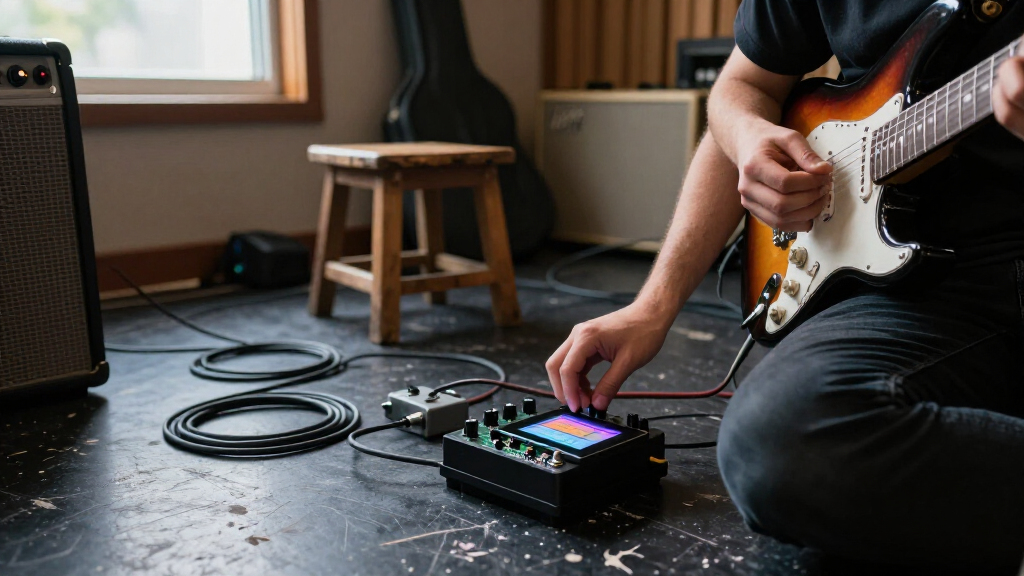
A GitHub project called CoyoPedal turns the Waveshare ESP32-S3-Touch-AMOLED-2.06 into a standalone guitar amp and effects pedal, running Neural Amp Modeler A2 captures at 48 kHz. The project also offers a browser build and firmware for screenless ESP32-S3 boards, extending the same amp and effects processing beyond the touchscreen hardware.
The device uses a USB Audio Class interface connected to the ESP32-S3 in host mode. Its signal chain includes a gate, compressor, chorus and drive before the amp model, followed by digital delay and stereo spring reverb. Presets store amp, control and effects settings. The touchscreen provides controls for the chain, capture selection, presets and a tuner that mutes output while in use.
The project supports 48 kHz, eight-channel NAM A2 WaveNet captures, including compatible members of a SlimmableContainer. Users can put original .nam files on a microSD card or select a folder in the browser build. The pedal prepares and validates captures itself, without a desktop conversion step; the first load can pause audio for tens of seconds. When a card is writable, it saves a verified cache beside the original file.
The developer says the 23-layer model runs in block floating point using hand-written Xtensa kernels, divided across both processor cores in 64-frame blocks. On an ESP32-S3 DevKitC-1, the project reports using 91% and 94% of the 1,333-microsecond processing budget across the two cores, with no missed deadlines in its measurement. The AMOLED board has 8 MB of PSRAM; that memory is required to hold the model.
A Guitar Rig on Small Hardware
CoyoPedal brings neural amp modeling and a multi-effect chain to a compact microcontroller platform. That matters to musicians and hardware developers interested in a dedicated, portable signal chain that does not require a computer to run during a performance. The project’s browser build also gives users a way to try the firmware’s interface and processing with an audio interface, without first obtaining the Waveshare board.
The screen is one control option rather than a requirement for the audio engine. The repository says the same firmware runs on screenless ESP32-S3 boards, where the BOOT button acts as a footswitch and settings are managed through a maintenance API. This broadens the project’s hardware options, though a screenless board has no microSD slot or battery power path, and the USB audio interface needs its own power supply.
Compatibility depends on the model and audio hardware. The project documents tested interfaces and says devices exposing 48 kHz UAC2 input and output should work, but that does not establish compatibility with every USB audio interface. The documented hardware requirement includes an ESP32-S3 with 8 MB of PSRAM and a USB port the chip can operate as a host.
One Firmware, Three Ways to Run
The Waveshare AMOLED board is the project’s reference hardware: factory presets, screenshots and panel-specific firmware are based on it. It combines an ESP32-S3R8 with 8 MB of PSRAM, a 410-by-502 AMOLED touchscreen, a microSD slot and a power-management chip. Users can tap the BOOT button to bypass the pedal or hold it for 1.5 seconds to enter maintenance mode.
Other supported setups include an ESP32-S3-DevKitC-1 with 16 MB of flash and 8 MB of PSRAM, as well as bare S3R8 modules. These have no display, power-management chip or SD slot. A short BOOT press engages or bypasses the sound; screenless boards use a maintenance tool for presets, captures and other controls. The browser version compiles the firmware to WebAssembly and can access a user-selected folder as a substitute for the card.
CoyoPedal uses a TypeScript-style TSX interface compiled to native C++; its developer says the device has no JavaScript engine. The repository also describes maintenance mode functions for authenticated Wi-Fi updates, remote diagnostics and Bluetooth Low Energy discovery. The radios are off during playing, according to the project documentation.
““A standalone guitar amp and effects pedal built on the Waveshare ESP32-S3-Touch-AMOLED-2.06.””
— CoyoPedal project documentation
Compatibility and Setup Limits
The repository lists testing with the XTONE Pro and IK Multimedia iRig HD X, plus a dedicated UAC1 profile for the iRig HD 2. It says interfaces exposing 48 kHz UAC2 input and output should work, but the source material does not provide a complete compatibility list or independent testing across other devices.
The project reports its processing measurements on a DevKitC-1, but the source does not describe the test conditions or provide independent performance results. It also does not establish how the pedal performs across different supported captures, or how much latency users experience in a complete instrument and interface setup. Models using other architectures, sample rates or layer shapes are rejected, according to the documentation.
The source material does not specify a release date, price, commercial availability or long-term maintenance plans. It also does not establish that the browser build will work with every operating system, browser or audio interface.
Trying the Build and Loading Captures
Readers can consult the CoyoPedal GitHub repository for build instructions, supported hardware details and the browser version. To load custom captures on supported hardware, users can copy .nam or prepared .namb files under a folder named nam at the root of a FAT-formatted microSD card, then select a capture from the amp browser. The project limits files to 2 MiB and file names to 127 bytes; the card should be inserted before powering on.
The next practical step for users is to check their board’s PSRAM and USB host capability, and confirm that their interface supports the required audio format and power arrangement. The source gives no schedule for further releases or hardware support, so those developments remain unspecified.
Key Questions
What is CoyoPedal?
CoyoPedal is a guitar amp and effects pedal project for ESP32-S3 hardware. It runs NAM A2 amp captures with a chain of effects and preset controls.
Does it require the Waveshare touchscreen board?
No. The project says the same firmware supports screenless ESP32-S3 boards and runs as a browser build compiled to WebAssembly. Screenless hardware uses the BOOT button and maintenance tools instead of the touchscreen.
Which amp captures can it load?
The documented support is for 48 kHz, eight-channel NAM A2 WaveNet captures, including matching members of a SlimmableContainer. Other sample rates and model architectures or layer shapes are rejected.
What hardware does it need?
The project calls for an ESP32-S3 with 8 MB of PSRAM and a USB port capable of host operation, plus a compatible USB audio interface. A screenless board lacks a microSD slot and does not power the USB interface, so the interface needs its own supply.
Can users try it without installing software?
The project describes a browser version that runs the firmware and lets users select a folder of captures. It says no board or installation is required, though browser and interface compatibility may vary.
Source: hn
Fall Picks
fall essentials
As an affiliate, we earn on qualifying purchases.