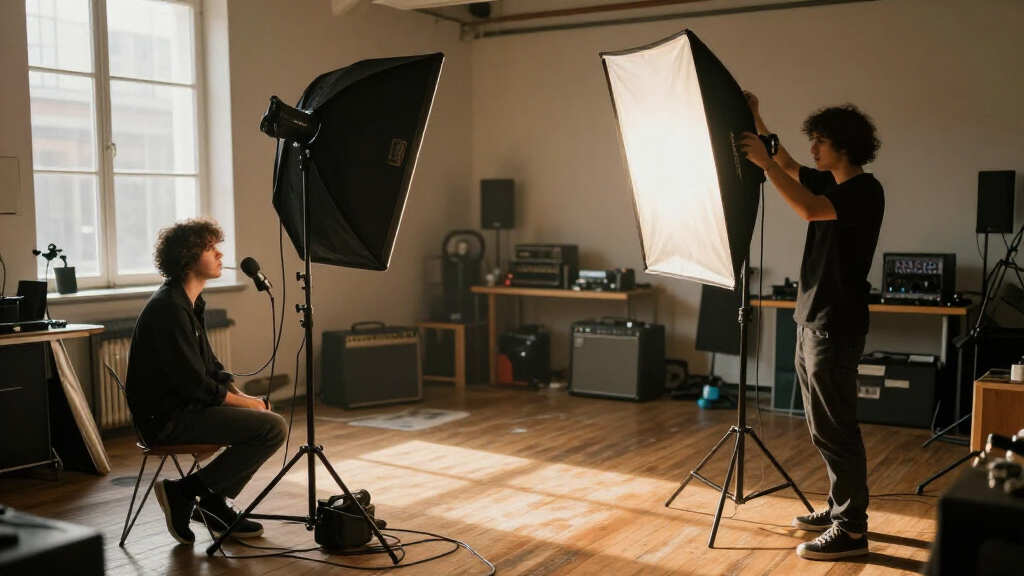
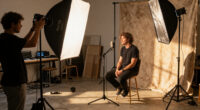
Choosing a studio lighting kit is less about finding a universally better light and more about matching the light to how you shoot. Continuous LED kits keep the subject lit as you adjust position, brightness, and modifiers, so their effect is visible before the shutter fires. Strobe kits release a powerful burst when you take a photo, giving photographers more output for freezing motion, shaping daylight, or using smaller apertures.

Get audio and creator gear delivered free with Prime
- Fast, free delivery on millions of items
- Prime Video, Amazon Music and more included
- Member-only deals all year
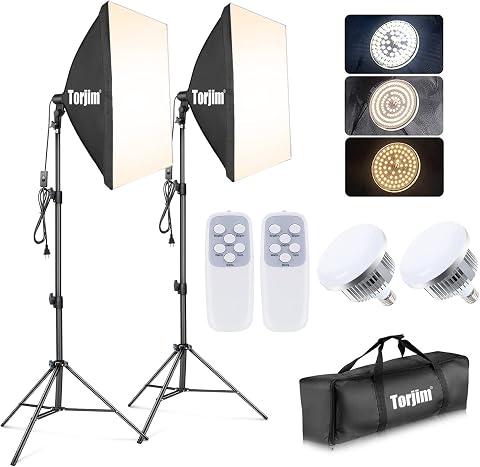
Torjim Softbox Photography Lighting Kit with Two 27 x 27 in Softboxes and LED Bulbs
- ✔ Softboxes: 2, 27 x 27 in
- ✔ Bulbs: 2 x 85W, E26
- ✔ Listed color temperature: 7500K
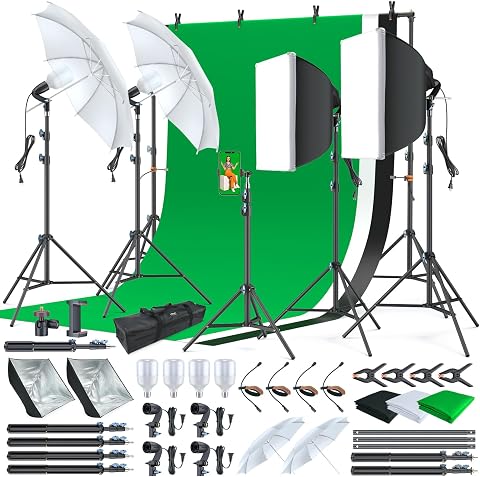
LINCO Photo and Video Studio Light Kit AM169
- ✔ Softboxes: 2 Pavo Real, 24 x 24 in
- ✔ Umbrellas: 2, 33 in
- ✔ LED bulbs: 4 x 30W, 5700K, E26/E27 base

Torjim Softbox Photography Lighting Kit with 16-Inch Softboxes and 85W LED Bulbs
- ✔ Softboxes: 2, 16 in
- ✔ Bulbs: 2 x 85W LED
- ✔ Color temperature: 3000–7500K
That creates the central tradeoff: LEDs are easier to understand and more versatile across photo and video, while strobes are usually the stronger tool for still photography that needs power. A portrait photographer learning light or a creator recording video may prefer LEDs. A working still photographer shooting groups, action, or bright-location portraits may get more from strobes. The right choice also depends on room size, modifier needs, flash compatibility, and whether the kit will be carried often.
At a Glance
| Criteria | Continuous LED studio lighting kits | Strobe flash studio lighting kits | Winner |
|---|---|---|---|
| What you see while setting up | The light is on continuously, so shadows and highlights are visible in real time. | You see a modeling lamp or preview, but the actual exposure comes from a flash burst. | A |
| Power for still photography | Often less output than a strobe at a comparable kit size, especially when competing with daylight. | Generally much more powerful for the size, giving more room for modifiers, smaller apertures, or daylight. | B |
| Freezing motion | Can use short exposure times only within the camera’s ambient-light exposure; output may require high ISO or wide apertures. | Short flash duration can freeze action; high-speed sync and camera compatibility vary by kit. | B |
| Video suitability | Well suited to video, subject previews, and mixed photo-video work. | Not a continuous video source; modeling lamps are previews, not substitutes for dedicated video lights. | A |
| Learning curve | Usually easier for beginners to judge and adjust by eye. | Requires learning exposure, flash sync, and often a meter or test shots. | A |
| Portability and setup | Often straightforward to use, though stands, power supplies, and modifiers still take space. | Can be compact, but stands, heads, triggers, and cables or batteries add setup steps. | Depends |
| Long-term value | Useful across photo and video, but lower output may limit demanding still-photo jobs. | Strong value for still-focused work if the output and system fit the photographer’s needs. | Depends |
Torjim Softbox Photography Lighting Kit with Two 27 x 27 in Softboxes and LED Bulbs
For photographers who want a two-light foundation without adding a backdrop system, this Torjim kit gives us the best balance of modifier size and adjustability in the group. Its 27 x 27-inch softboxes are substantially larger than the 16-inch units in the other Torjim kit and larger than LINCO’s 24 x 24-inch softboxes. That extra surface area can make it easier to spread a softer-looking light across a portrait or tabletop subject, provided there is enough room to position the stands.The stands adjust from 27 to 74.5 inches, and the softboxes rotate up to 210 degrees. Together, those features give photographers more freedom to place a light above, beside, or at an angle to the subject. Removable diffusers help soften the output, and the carrying bag makes the two-light setup easier to transport than a sprawling collection of separate studio pieces. Compared with LINCO, however, this kit does not provide umbrellas or backdrops; it is a lighting foundation, not a complete shooting environment.We would also keep the bulb specification in view before choosing it. The listing gives a 7500K color temperature, rather than the adjustable 3000–7500K range stated for the 16-inch Torjim. Photographers who need to shift color temperature between warm and cool sources may prefer that smaller model’s stated range, while those prioritizing larger modifiers should find the 27-inch design more compelling. This is our top pick for flexible, straightforward two-light work, but it is not the most complete or color-adjustable package.
Pros:
- Two 27 x 27-inch softboxes provide more modifier area than the other kits’ softboxes.
- Stands adjust from 27 to 74.5 inches for varied light placement.
- Softboxes rotate up to 210 degrees and include removable diffusers.
- Includes two lights, two stands, and a carrying bag.
Cons:
- The listed bulb temperature is 7500K, not a stated adjustable range.
- Does not include backdrops or umbrella modifiers.
- Larger softboxes need more room to position and store than the 16-inch option.
Best for: Photographers who want two larger softboxes and adjustable stand height for portraits, product work, or video in a dedicated indoor space.
Not ideal for: Photographers who need included backdrops, umbrella modifiers, or a clearly specified adjustable color-temperature range.
Bottom line: We recommend this as the best overall pick when larger softboxes and flexible positioning matter more than bundled backdrops or adjustable color temperature.
“We recommend this as the best overall pick when larger softboxes and flexible positioning matter more than bundled backdrops or adjustable color temperature.”
LINCO Photo and Video Studio Light Kit AM169
The LINCO AM169 is the clear choice when a photographer needs more than two lights. It combines two softboxes, two umbrellas, four LED bulbs, four stands, and a backdrop support system with black, white, and green muslin backdrops. Compared with either Torjim kit, it can support a broader range of basic studio scenes from the outset: use the softboxes for diffused light, add umbrellas for another way to soften or spread it, and change the background without sourcing a separate support kit.That breadth suits portrait sessions, product shoots, and streaming setups where the background is part of the job. The 5700K daylight-balanced bulbs offer a specified color temperature, and the 5 x 10-foot backdrops give photographers material to work with across different looks. Its softboxes are 24 x 24 inches, so they fall between the Torjim options in listed size: larger than the 16-inch units, smaller than the 27-inch pair. The difference is that LINCO spends its kit space on variety, rather than maximizing softbox size.That completeness comes with real practical costs. There are more pieces to assemble and organize than in either Torjim package, and four stands plus a backdrop frame call for more space during setup and storage. The 30W bulbs are also lower wattage than the Torjim kits’ 85W bulbs, so buyers should not choose LINCO on the assumption that a higher bulb rating is part of its advantage. We rank it second because it is the strongest all-in-one studio bundle, but photographers who already own backgrounds or want a simpler, larger-softbox setup may prefer the Torjim 27-inch kit.
Pros:
- Bundles softboxes, umbrellas, four bulbs, and four stands.
- Includes a backdrop support system and black, white, and green muslin backdrops.
- 5700K bulbs provide a specified daylight-balanced color temperature.
- Backdrops are washable, and the carrying bag has a water-resistant coating.
Cons:
- Multiple lights, stands, and backdrop parts make setup more involved.
- The 24 x 24-inch softboxes are smaller than the 27-inch Torjim pair.
- The included bulbs are 30W, compared with the 85W bulbs in both Torjim kits.
Best for: Photographers setting up a home studio who need lighting, multiple modifier types, a backdrop frame, and several background colors in one package.
Not ideal for: Photographers with very limited setup or storage space, or those who already own backdrops and want a simpler two-light kit.
Bottom line: We would choose the LINCO when a photographer values a ready-made lighting-and-backdrop workspace more than a compact setup or the largest softboxes.
“We would choose the LINCO when a photographer values a ready-made lighting-and-backdrop workspace more than a compact setup or the largest softboxes.”
Torjim Softbox Photography Lighting Kit with 16-Inch Softboxes and 85W LED Bulbs
This Torjim is the most space-conscious choice in the lineup. Its 16-inch softboxes take up less room than the 24-inch LINCO modifiers and the 27-inch Torjim pair, which can be a practical advantage in a small home studio, bedroom, or corner used for streaming. The kit includes two softboxes, diffusers, 85W LED bulbs, 62-inch stands, and a remote, so buyers get a self-contained basic two-light setup rather than needing to assemble a larger studio bundle.Each head adjusts through 210 degrees, making it easier to direct the lights at a subject or reposition them around a small set. Reflective interiors and included diffusers are intended to create softer, more even illumination. For a photographer learning basic two-light placement or creating a video-call and streaming setup, that combination keeps the essential controls approachable. Compared with the 27-inch Torjim, however, these smaller modifiers cover less area; compared with LINCO, this kit cannot change the background or switch to umbrellas.The listed 3000–7500K color-temperature range is an advantage for buyers who want to vary the light’s appearance, though the stated CRI of 80 is a limitation for photographers who place a premium on color rendering. It is also not water resistant, so this is an indoor option, not a kit to rely on in exposed conditions. We place it third because its compact footprint and remote are useful, but the larger Torjim offers more softbox area and the LINCO gives photographers more complete scene control.
Pros:
- Compact 16-inch softboxes are easier to fit in small rooms than the larger options.
- Includes two LED bulbs, two stands, diffusers, and a remote.
- 210-degree adjustable heads support flexible positioning.
- Lists a 3000–7500K color-temperature range.
Cons:
- Smaller softboxes offer less coverage than either competing kit.
- The stated color rendering index is 80.
- Not water resistant.
Best for: Beginners, streamers, and photographers working in tight indoor spaces who want a compact pair of softboxes with remote control.
Not ideal for: Photographers who need broad softbox coverage, stronger stated color-rendering performance, or a bundled backdrop system.
Bottom line: We recommend this compact kit for small indoor setups where a remote and listed adjustable color temperature matter more than larger modifiers or backdrops.
“We recommend this compact kit for small indoor setups where a remote and listed adjustable color temperature matter more than larger modifiers or backdrops.”
As an Amazon Associate we earn from qualifying purchases.
Key Differences
The biggest practical difference is how the light meets the camera. LEDs illuminate the scene continuously, so a change in angle or brightness is immediately visible to the eye. This makes experimentation direct: move a light, watch the shadow shift, and adjust. But the camera records that light as it exists, so limited output can force a higher ISO, a wider aperture, or less control over ambient light. Large softboxes and bright rooms can make that limitation more apparent.
Strobes put energy into a brief flash rather than maintaining a bright output. For still photography, that usually means more exposure headroom and a better chance of stopping movement. The tradeoff is that photographers must understand flash exposure and synchronization; a modeling lamp can preview direction and shadow, but it does not show the final flash exposure perfectly. LEDs are the more flexible purchase when video matters. Strobes are the more capable still-photo choice when power, modifiers, or motion control matter more than seeing the final light continuously.
Detailed Comparison
What you see while setting up (Continuous LED studio lighting kits wins — moderate)
LEDs win, by a moderate gap. Because an LED shines continuously, photographers can see how it falls across a face, product, or background without taking a test frame. This helps beginners learn how distance, angle, and diffusion affect the result, and it can speed up small adjustments. Strobes commonly include modeling lamps, which reveal direction and approximate shadow shape, but those lamps are not the flash itself and may not match its final exposure or color perfectly. Choose LEDs when immediate visual feedback matters more than output.
Power and exposure control (Strobe flash studio lighting kits wins — major)
Strobes win, usually by a major gap for stills. A flash kit can provide substantially more usable light than a similarly sized continuous kit. That extra output helps when placing a softbox farther from a subject, using diffusion that absorbs light, shooting at smaller apertures, or overpowering daylight. An LED can still produce excellent portraits and product images in a controlled room, but photographers may need to raise ISO or work closer to the subject. If the work regularly demands strong, shaped light, the strobe advantage is practical rather than merely technical.
Freezing motion (Strobe flash studio lighting kits wins — major)
Strobes win, by a major gap for fast action. A short flash duration can freeze a moving subject even when the camera’s shutter speed alone would leave blur, provided the exposure is controlled so ambient light does not add a ghosted image. Continuous LEDs rely on the camera’s shutter speed and available output; faster shutter speeds may require a higher ISO or wider aperture. For posed portraits, this may not matter. For dancers, athletes, energetic children, or splashing products, a strobe kit is the safer choice. Check flash duration and sync specifications rather than assuming every strobe performs the same.
Video and mixed-media work (Continuous LED studio lighting kits wins — major)
LEDs win, by a major gap. Continuous fixtures can light both photographs and video without changing the basic setup. They also let a photographer preview how the subject and background look on camera while recording. Strobes cannot serve as the main exposure source for ordinary video; modeling lamps are generally too dim and may not be designed for sustained recording. If video is occasional but important, the convenience of one LED kit can outweigh the flash system’s extra still-photo power. If the work is almost entirely still photography, this advantage has less value.
Learning curve (Continuous LED studio lighting kits wins — moderate)
LEDs win, by a moderate gap for new users. With continuous light, what the photographer sees is close to what the camera records, subject to exposure and display differences. Strobes add flash power settings, trigger channels, sync limits, and the distinction between ambient and flash exposure. Those skills are learnable and can be rewarding, but they add setup and troubleshooting. A new portrait photographer who wants to focus on posing and composition may find LEDs less demanding. Someone willing to practice flash technique can progress quickly and gain more control.
Portability and setup (moderate difference)
This is a close call, with the result depending on the kit. Neither category is automatically portable: both need stands and often modifiers, and a large softbox can dominate the packed volume. LEDs may need AC power or substantial batteries to sustain useful brightness. Strobes can be compact and battery-powered, but require triggers and may involve more steps before shooting. For location work, compare the full packed kit, battery runtime, charging arrangements, and setup time rather than judging by the light head alone. The best portable option is the system designed around the photographer’s actual locations.
Value over time (moderate difference)
Neither wins for everyone; the value depends on the work. An LED kit earns its place when the same lights regularly support video and photography, or when simple operation saves time. A strobe kit often gives more still-photo capability per unit of light output and may be the better investment for professional portrait, commercial, or action work. Paying more for a strobe system makes sense when its power, flash duration, battery performance, or ecosystem will be used. Paying more for a high-output LED is sensible when video requirements demand it. Avoid paying for features that do not solve a recurring job.
Continuous LED studio lighting kits: Pros and Cons
Pros:
- Continuous preview makes light placement easier to understand.
- Supports both photography and video.
- Simple adjustments suit beginners and small studios.
- No flash trigger or flash synchronization is needed for stills.
Cons:
- Often offers less output than a strobe kit.
- Can struggle against daylight or through large light-modifying setups.
- Fast shutter speeds may require higher ISO or wider apertures.
- Bright, high-output models and batteries can raise cost and heat.
Strobe flash studio lighting kits: Pros and Cons
Pros:
- High output offers more control over aperture, distance, and modifiers.
- Short flash duration can freeze movement.
- Often a strong fit for still-photo portrait and commercial work.
- Battery-powered options can support location shoots.
Cons:
- Does not provide a practical continuous source for video.
- Requires learning flash exposure, triggers, and sync limits.
- Modeling lamps preview direction but not the exact flash result.
- A complete system may involve more components and setup steps.
Who Should Choose What
Choose Continuous LED studio lighting kits if:
- You shoot both stills and video and want one lighting system.
- You are learning lighting and value seeing changes as they happen.
- Your subjects are mostly stationary and you work in a controlled room.
- You prefer a simple setup and can work within continuous-light output.
Choose Strobe flash studio lighting kits if:
- You mainly shoot still photographs and need more output for modifiers or daylight.
- You photograph action or movement and want flash-duration control.
- You need smaller apertures, lower ISO, or more distance between light and subject.
- You are ready to learn flash technique and will use the extra capability regularly.
Skip both if: If you only need occasional natural-looking fill outdoors, a full kit may be unnecessary; a reflector or a compact on-camera light may be a better fit.
Value for Money
Paying more is worthwhile only when the extra capability matches the assignments. A higher-output LED can be worth its cost to a creator who records video and photographs in the same space, but it is poor value if the photographer needs to overpower daylight or freeze action and buys it expecting strobe-like performance. Conversely, a strobe system can provide excellent still-photo capability for the money, yet it is an unnecessary complication for someone who primarily records video or wants to judge every lighting change by eye.
Compare complete systems, not just the heads: stands, modifiers, batteries, chargers, triggers, and replacement options affect the real cost. For still-only work, strobes are usually the stronger value when power is a regular need. For mixed-media work, LEDs can justify a higher outlay by replacing separate photo and video lights. Pick based on recurring use, not the most impressive specification.
Final Verdict
For photographers focused on still images, a strobe kit is the stronger default: it delivers more power, handles modifiers more comfortably, and offers a real advantage when freezing motion. Choose LEDs instead if video is part of the job, if visual feedback is your priority, or if your subjects and studio setup do not demand high output. The biggest deciding factor is not whether one type is easier or more powerful; it is whether you need a continuous source or a flash burst. Pay more for strobes when still-photo performance will make a difference across regular assignments. Pay more for LEDs when you will use their continuous output for video as well as photographs.
Frequently Asked Questions
Are LED lights or strobes better for portrait photography?
Both can produce strong portraits. LEDs are easier to preview and suit video portraits, while strobes usually offer more output for large softboxes, lower ISO, and daylight control. For still-only portrait work, strobes are the stronger choice when you need that extra power; LEDs are a good fit for simple indoor sessions and mixed-media work.
Can an LED kit freeze motion?
It can freeze motion if the camera uses a sufficiently fast shutter speed and the LED provides enough light for the chosen ISO and aperture. Strobes have an advantage because a brief flash can stop movement even when shutter speed alone is not enough, as long as ambient light is controlled.
Can I use a strobe kit for video?
Not as the main video light in normal use. A strobe’s modeling lamp may help with focus or a rough preview, but it is generally not a substitute for a continuous video fixture. Choose LEDs or add dedicated video lights if you record regularly.
Should a beginner buy a strobe kit?
Yes, if the beginner is willing to learn flash exposure and wants a system that can support demanding still photography. If immediate visual feedback and a gentler learning curve matter more, start with LEDs. Either way, a small, complete kit with compatible modifiers is more useful than buying power or accessories that will rarely be used.
Fall Picks
fall essentials
As an affiliate, we earn on qualifying purchases.