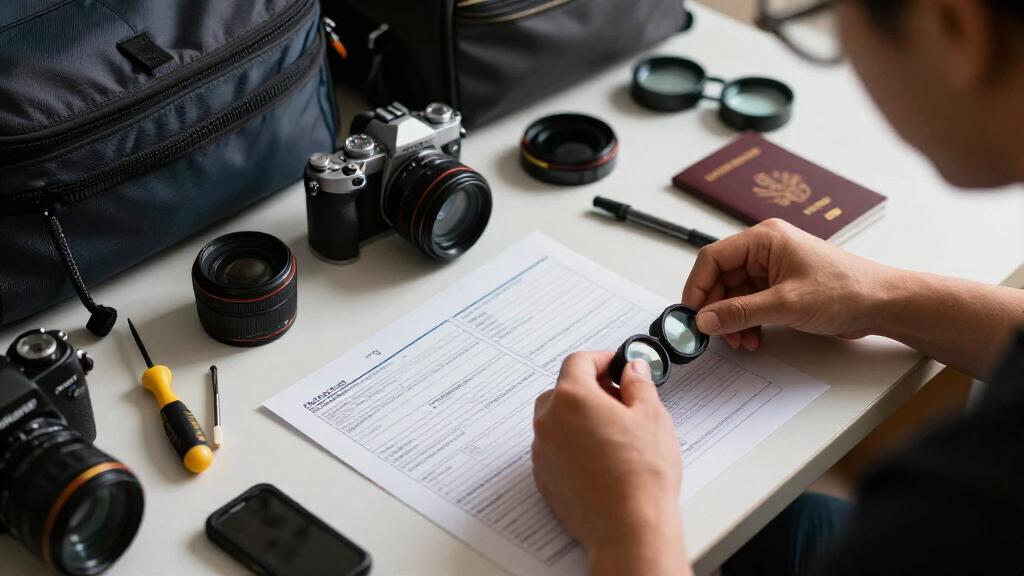

TL;DR

Get audio and creator gear delivered free — and shop member deals
- Fast, free delivery on millions of items
- Access to Prime Big Deal Days deals on October 6–7
- Prime Video, Amazon Music and more included
Photographing abroad with professional gear may require an ATA Carnet, a temporary-import declaration, or proof that you owned the equipment before your trip. Check every destination and transit country, build a serial-numbered inventory, and carry paper and digital copies of your ownership, assignment, insurance, and customs documents.
A camera body rarely causes trouble at a border, but three bodies, six lenses, lighting cases, and audio equipment can look less like holiday luggage and more like a commercial shipment. The difference may come down to a serial-numbered inventory, the right customs document, and five calm minutes at the inspection desk. Without them, your tightly planned shoot can begin under cold fluorescent lights beside an open equipment case.
You will learn when an ATA Carnet makes sense, what you can use when it does not, and how to create gear documentation that a customs officer can check quickly. You will also see why proof of ownership, insurance records, work permits, and location permissions solve different problems. One document cannot do every job.
I treat border paperwork the way I treat spare batteries: boring until the moment it saves the shoot. A clean folder does more than prove value; it tells a simple story about who owns the gear, why you are carrying it, and when it will leave. That preparation lets you return your attention to weather, light, timing, and the people waiting on the other side of arrivals.
Check customs requirements for every destination, transit stop, border crossing, and transport method before packing professional equipment.
Use an ATA Carnet for eligible temporary professional imports when the route, equipment value, and project complexity justify it.
Create a matched inventory containing serial numbers, clear photographs, ownership records, rental agreements, and honest values.
Collect entry and departure validations, then inspect every stamp and date before leaving the customs desk.
Treat customs clearance, insurance, work authorization, drone approval, and permission to photograph as separate jobs.
Photographing Abroad: Customs, Carnets, and Gear Documentation
A camera body may look like holiday luggage. Three bodies, six lenses, lighting cases, and audio equipment can look like a commercial shipment. The difference at the border is often a serial-numbered inventory, the right customs document, and five calm minutes at the inspection desk.
When does an ATA Carnet make sense?
A Carnet acts like a passport for equipment: listed gear can enter participating customs territories temporarily without ordinary import duties or taxes. It simplifies customs—not employment, aviation, or location rules.
High-value commercial kit
Multiple bodies, lenses, lighting, tethering, audio, or production cases clearly exceed ordinary personal effects.
Best signal: professional load + meaningful valueSeveral participating borders
A single recognized document can make repeated temporary admissions easier to explain and track.
Best signal: complex, multi-country itinerarySmall kit or non-member route
Prior-possession records or a destination’s local temporary-admission process may suit a lighter kit or non-participating country.
Verify with each customs authorityFour documents, four different functions
A home-country ownership record is not automatically permission to import professional equipment elsewhere. Ask each authority what applies to your dates, value, entry point, and working purpose.
| Document or process | Best fit | What it proves | Main limitation |
|---|---|---|---|
| ATA Carnet | ✓Professional gear visiting participating territories | Listed equipment is moving under a recognized temporary-import process. | Every movement needs correct validation; missing gear can trigger duties or claims. |
| Local temporary admission | ~Non-Carnet destination or locally managed shipment | The equipment entered temporarily under that country’s customs rules. | Deposits, bonds, brokers, or local-language paperwork may be required. |
| Prior-possession record | ✓Showing equipment belonged to you before departure | The gear was not purchased during the trip. | ✗Does not authorize commercial import into another country. |
| Receipts and appraisals | ~Supporting ownership, origin, and honest value | Where an item came from and its documented value. | ✗Does not replace a required customs declaration. |
Make every item easy to identify
Your gear file should work like a clean contact sheet: numbered, consistent, and fast to verify. Record details directly from each item, not from memory or an old invoice.
Identity
Maker, model, exact description, and readable serial number.
Ownership status
Owned, rented, borrowed, employer-owned, or client-supplied.
Visual evidence
One close serial plate image plus one wider photograph of the item.
Value and origin
Use honest current values and country of origin where required.
Supporting record
Match each item to a receipt, appraisal, rental agreement, or schedule.
Consistent wording
Use the same descriptions across customs, insurance, and shipping files.
Five calm minutes at the inspection desk
Keep the cases accessible and the story simple. Your goal is to let the officer move from document to serial number to validation without searching through unrelated paperwork.
Declare
Use the correct customs lane and state that the professional gear is temporary.
Present
Open the route-specific document and concise serial-number inventory.
Match
Make cases easy to inspect and help locate requested serial plates.
Validate
Collect the required entry or departure stamp, signature, and date.
Inspect
Check every field before leaving the desk; fix omissions immediately.
Customs clearance is only one layer
A Carnet can solve temporary-import duty questions. It does not grant permission to work, fly a drone, insure a loss, enter a restricted site, or publish someone’s likeness.
Gear entry and exit
Carnet, local admission, declaration, or prior-possession evidence.
Financial protection
International coverage, equipment schedule, exclusions, and valuation.
Right to perform the job
Visa, work authorization, press status, or assignment documentation.
Drone operations
Registration, operator approval, airspace rules, and local flight permits.
Permission to photograph
Site permits, filming approval, releases, and cultural restrictions.
A simple story from ownership to departure
Each link answers a different border question. Missing links create uncertainty; matching links create confidence.
Check the entire route, document every serial, and validate every movement.
Carry paper and offline digital copies of customs, ownership, assignment, rental, appraisal, and insurance records. A clean folder returns your attention to weather, light, timing, and the people waiting beyond arrivals.
Know When an ATA Carnet Can Save Your Shoot
Photographing Abroad: Customs, Carnets, and Gear Documentation begins with one practical question: will the destination treat your equipment as a temporary professional import? An ATA Carnet is a customs document that lists gear entering a participating territory temporarily, allowing it to leave again without ordinary import duties or taxes [1].
Think of the Carnet as a passport for equipment. Customs stamps the gear into a territory and stamps it back out, creating a paper trail that follows your cases across borders. According to the International Chamber of Commerce’s World Chambers Federation, a Carnet is generally valid for up to one year and accepted in more than 80 countries and customs territories [1].
For instance, a photographer carrying two rolling lighting cases, four camera bodies, eight lenses, and tethering equipment through several participating countries has a clear reason to use one. Without temporary-import paperwork, an officer may request a deposit, duties, local forms, or proof that every item will leave. A Carnet makes that commercial load easier to explain, though every listed item must return or receive proper customs treatment.
A Carnet removes many duty questions, not every travel requirement. It does not replace a work visa, filming permit, drone authorization, press credential, or location release.
A single personal camera and one lens may pass as ordinary personal effects in many places, while a production kit attracts closer attention. The decision depends on destination rules, equipment value, the purpose of the trip, and how often you cross borders. Verify current requirements with the destination’s customs authority because participation alone does not tell you how officers will handle your specific job.
ATA Carnet for professional photography equipment
As an affiliate, we earn on qualifying purchases.
As an affiliate, we earn on qualifying purchases.
Choose the Border Document That Matches Your Trip
The right document depends on where you are going, why the equipment is traveling, and whether the country accepts ATA Carnets. A Carnet often suits a multi-country commercial assignment, while personal-ownership records or a local temporary-admission process may fit a smaller kit or a non-participating destination.
| Document or process | Best fit | What it proves | Main limitation |
|---|---|---|---|
| ATA Carnet | Professional gear visiting participating territories temporarily | The listed equipment may enter and leave under a recognized temporary-import process | Every border movement needs correct handling, and unreturned items can trigger claims |
| Local temporary admission | A country outside the Carnet system or a shipment handled under local rules | The gear entered temporarily under that country’s customs procedure | Deposits, bonds, agents, or local-language forms may apply |
| Prior-possession record | Proving gear belonged to you before departure | The equipment was not purchased abroad | It does not automatically authorize commercial import into your destination |
| Receipts and appraisals | Supporting ownership and value | Where the item came from and its documented value | They do not replace required customs declarations |
A common mistake is treating a home-country ownership form as permission to import professional equipment somewhere else. For example, U.S. Customs and Border Protection offers Form 4457 as a record for certain personal effects taken abroad, helping travelers show those items were previously in the United States [2]. That record can help when you return home, but it does not control what another country requests on arrival.
Imagine flying from New York to a shoot in a Carnet country, then driving into a neighboring country that does not accept the document. Your folder may need two different customs solutions for the same equipment. Check transit stops too; a missed connection that forces you to collect checked cases can turn an airport transfer into an unexpected import event.
The safest approach is to ask each customs authority a narrow question: what paperwork applies to temporarily imported professional camera equipment that will leave after a specified assignment? Include the gear value, transport method, entry point, and dates. Written guidance gives you something concrete to show a broker or officer if the route becomes complicated.
gear documentation organizer for travel
As an affiliate, we earn on qualifying purchases.
As an affiliate, we earn on qualifying purchases.
Build a Gear File an Officer Can Check in Minutes
Photographing Abroad: Customs, Carnets, and Gear Documentation becomes much easier when your gear file works like a clean contact sheet: every item is identified, numbered, and easy to match. Record the maker, model, serial number, description, ownership status, country of origin when required, and honest value for each piece.
Start with the equipment most likely to draw attention: camera bodies, lenses, lights, drones, computers, transmitters, and audio recorders. Photograph each serial-number plate close enough to read, then make one wider frame showing the whole item. A scuffed black 70–200mm lens can resemble ten others in a case; its serial number gives it a distinct identity.
- Lay out the working kit and remove anything you will not use.
- Record every serial number directly from the item, not from memory or an old invoice.
- Match each item to a photo, receipt, rental agreement, or appraisal.
- Use consistent descriptions across your inventory, Carnet, insurance schedule, and shipping paperwork.
- Print two copies and save offline digital copies on your phone and laptop.
For instance, write Nikon Z8 camera body, serial 1234567 rather than black camera. List a rented Profoto head under the rental company’s ownership, attach the agreement, and show the return date. Rented and borrowed gear deserves extra care because your name will not match the purchase receipt.
I also place a small inventory card inside each case. If customs opens case two of three, the officer can compare its contents without sorting through a master spreadsheet full of unrelated items. Keep password-protected digital backups, but carry paper as well; a dead phone, weak airport Wi-Fi, or an empty laptop battery should not become a customs problem.
serial number inventory kit for camera gear
As an affiliate, we earn on qualifying purchases.
As an affiliate, we earn on qualifying purchases.
Move Through Customs Without Creating New Problems
A smooth customs inspection comes from declaring gear through the proper channel, presenting documents in a usable order, and collecting every required stamp before you leave the desk. Stay calm and factual: explain that the equipment is entering temporarily for a defined project and will depart with you or your crew.
Arrange the folder in the same order as the border conversation. Put your passport and travel details first, followed by the Carnet or local declaration, gear inventory, assignment letter, ownership records, insurance confirmation, and permits. When an officer asks about one silver equipment case, you should reach the matching page in seconds.
- Before joining a line, find the customs office or declaration channel rather than assuming baggage exit is enough.
- Present the complete document and tell the officer how many cases and loose items it covers.
- Open cases when requested and let the officer match serial numbers without rushing.
- Check every validation, stamp, date, and customs counterfoil before walking away.
- Repeat the process on departure, even when the flight is early or the customs desk looks closed.
Departure validation is where tired photographers get caught. Imagine wrapping a night shoot at 1 a.m., reaching the airport at 4 a.m., and discovering that the customs desk sits in another terminal. Build at least an hour of paperwork time into unfamiliar departures, and confirm office hours before the shooting day begins.
If an officer disagrees with your paperwork, avoid guessing or changing your story. Ask what specific rule or missing document applies, request a supervisor or licensed customs broker when appropriate, and record the office and time. Never alter values or hide commercial use to make the conversation easier; a short delay is safer than a false declaration that follows the equipment to later borders.
customs clearance documentation for photographers
As an affiliate, we earn on qualifying purchases.
As an affiliate, we earn on qualifying purchases.
Protect the Gear Even When Customs Papers Are Perfect
Customs documentation protects the temporary-import status of your equipment, while insurance protects you from financial loss under the policy’s actual terms. You need both when a case disappears, a lens hits stone, or a thief lifts a backpack from a train before the first frame of the assignment.
Ask the insurer whether your policy covers international commercial work, unattended vehicles, checked baggage, theft, accidental damage, and every country on the route. Read the limits for single items and rented equipment. A policy may cover a camera body in your hands yet exclude the lighting kit left overnight in a production van.
Your customs value, purchase receipt, replacement estimate, and insurance schedule can serve different purposes, but wild inconsistencies invite questions. For instance, a lens listed at a token value on customs paperwork and a much higher value on an insurance claim creates an obvious credibility gap. Use honest, supportable valuations and ask the issuing body which valuation method its form requires.
- Carry the insurer’s emergency contact and policy number offline.
- Save photographs showing the equipment’s condition before departure.
- Keep checked-case tags, police reports, repair estimates, and airline records after a loss.
- Protect spare lithium batteries from short circuits and follow the airline’s current carry-on rules.
A practical example: if a roller case arrives with a cracked shell and a missing strobe head, photograph it before leaving the baggage hall. Report the damage to the airline, preserve the baggage tag, and compare the remaining contents with your inventory. That same gear file now works like a before-and-after record, speeding both the customs explanation and insurance claim.
Handle Non-Carnet Countries Without Guesswork
Photographing Abroad: Customs, Carnets, and Gear Documentation requires a different plan when a destination does not accept ATA Carnets. Contact the national customs authority or a qualified local broker and ask about temporary admission, deposits, bonds, guarantees, declarations, and re-export proof for professional photographic equipment.
Understanding customs regulations means learning the route your gear will take, not merely the country printed on your assignment. A road border may follow a different procedure from the main international airport, while a courier shipment can fall under rules unlike accompanied baggage. Give officials the exact entry point and transport method when requesting guidance.
Suppose you fly with a three-case kit into a country that requests a refundable deposit based on equipment value. You may need funds, a customs broker, or paperwork prepared before arrival. If you discover that rule beside the baggage carousel, the cases can remain in customs storage while the sunrise location sits empty.
- Ask whether pre-approval is available and how long it takes.
- Confirm which currency and payment methods customs accepts for a deposit or bond.
- Request written instructions for proving re-export on departure.
- Check whether a local client, producer, or fixer must act as importer of record.
- Build storage, brokerage, and inspection delays into the production schedule.
Embassies can point you toward official agencies, but the customs authority controls customs procedure. Keep emails and reference numbers with your travel folder, then recheck the rules shortly before departure. Digital applications and electronic Carnet projects are growing, yet paper and electronic workflows can coexist; never assume a phone screen replaces a stamped document at your chosen border.
Keep Border Clearance Separate From Permission to Shoot
Clearing customs only means your equipment may cross the border under the stated procedure; it does not grant permission to work, fly a drone, enter protected land, photograph restricted infrastructure, or use images commercially. Treat customs, immigration, aviation, location access, and photography rules as separate checkpoints.
This distinction catches photographers because every approval feels like a green light. For instance, a Carnet may admit a drone and its cameras as equipment while the aviation authority still bans the flight near an airport, national park, military site, or crowded event. The customs stamp covers the object, not the operation.
Before travel, ask the client or local producer who holds responsibility for work authorization, location permits, model releases, wildlife access, and drone registration. Get the answer in writing. If you are joining a workshop, ask whether its permit covers participants making personal images, commercial portfolios, or only the organizer’s activity.
A legal camera is not automatically a legal photograph. Customs clears the equipment; local law and site rules govern where, what, and how you shoot.
Cultural judgment matters even where the law permits a photograph. A quiet ceremony, memorial, or sacred interior may demand restraint, a local guide, or a camera kept inside the bag. The best travel work grows from access and trust, not from treating every open doorway as permission, and no border document repairs a relationship damaged by an intrusive frame.
Frequently Asked Questions
Do I need an ATA Carnet for one camera and two lenses?
You may not need a Carnet for a small personal kit, but equipment quantity alone does not decide the issue. The destination’s rules, your purpose, and the gear’s value matter. Ask the customs authority how it treats temporary professional equipment, especially when you are being paid or carrying specialized cases.
How far ahead should I apply for an ATA Carnet?
Start the process several weeks before departure when possible, especially for a first application or a long equipment list. Issuing organizations may need a security guarantee, corrected inventory details, or supporting records. A rushed application leaves little time to fix a wrong serial number or missing destination.
What happens if I leave a Carnet-listed item abroad?
A listed item that does not leave can create a customs claim for duties, taxes, or penalties, even if it was lost, stolen, sold, or broken. Contact the Carnet issuer and relevant customs office promptly. Keep police reports, repair records, or proof of lawful import treatment because silence does not close the customs record.
Can photographs of serial numbers replace purchase receipts?
Serial-number photographs provide strong identity evidence, but they do not always prove ownership, purchase date, or value. Pair them with receipts, appraisals, rental contracts, or insurance schedules. Think of the photo as the equipment’s face and the receipt as part of its ownership history.
Should I list memory cards, batteries, and small accessories?
Follow the issuing body’s instructions and focus first on high-value, uniquely identifiable equipment. Consumables and low-value accessories may receive different treatment, while expensive batteries, monitors, transmitters, or media systems can deserve individual entries. Keep a broader packing list even when the customs document uses a shorter official inventory.
Conclusion
Your best defense at a border is a simple, consistent story backed by documents: this is your equipment, this is its value, this is why it is here, and this is when it leaves. Choose the right import process, match every serial number, and leave enough airport time to get the paperwork handled properly.
Do that work before the cases click shut. Then, when an officer lifts a lens from its foam slot under the hard white light of customs, you can place one clear page on the counter instead of searching through emails with a fading battery. Prepare the paper trail, protect the assignment, and save your improvisation for the photograph.
Fall Picks
fall essentials
As an affiliate, we earn on qualifying purchases.






![Netflix Postpones Gary Glitter Docuseries, Citing “New Legal Information” [Updated]](https://photomocha.com/wp-content/uploads/2026/09/netflix-postpones-gary-glitter-docuseries-citing-new-legal-information-updated-featured-260x140.jpg)